AI Answer Engines vs Traditional Search: How Google Rankings Are Changing
AI answer engines are reshaping online search by providing direct, conversational responses beyond traditional search engines. Explore how AI-powered search, AI search optimization, and changing Google rankings are influencing SEO and online visibility.
 Priyanka BR
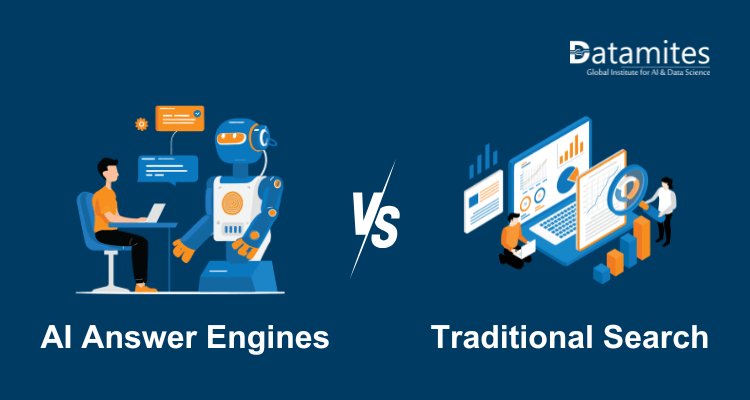
Search is changing rapidly as users move beyond traditional search engines toward systems that can interpret queries, synthesize information, and deliver direct responses. AI answer engines are reshaping how people discover information, products, and services, while AI-powered search is changing the way websites compete for visibility. Understanding these differences is becoming increasingly important for businesses, publishers, and SEO professionals adapting to new search behavior.
Google rankings are also evolving as search experiences increasingly incorporate AI-generated answers, contextual results, and broader interpretations of user intent. These developments are creating new considerations around search engine rankings, content quality, relevance, authority, and content visibility. Comparing AI-driven discovery with traditional search can help marketers understand how AI is changing Google rankings and what adjustments may be needed to maintain organic visibility in the changing search landscape.
AI Answer Engines vs Traditional Search: Key Differences
The evolution of search is creating two distinct ways for users to discover information. Traditional search engines primarily help users find relevant webpages, while AI answer engines focus on understanding a query and delivering a synthesized response. The distinction becomes clearer when the two approaches are compared across the way they process queries, display information, use sources, and influence user behaviour.
| Comparison Area | Traditional Search | AI Answer Engines |
| Query Processing | Relies heavily on keywords, entities, context, and search signals to identify relevant pages. | Interprets natural-language questions, conversational context, and relationships between concepts. |
| Results Format | Presents ranked webpages along with features such as snippets, images, videos, maps, and other results. | Generates a consolidated response, which may include supporting links, citations, or references to source material. |
| Information Discovery | Users generally visit and evaluate multiple webpages themselves. | Information from different sources can be synthesized into a single conversational response. |
| Search Journey | Users commonly refine queries and move between search results and websites. | Users can ask follow-up questions while maintaining context within the same interaction. |
| Visibility Opportunity | Websites compete primarily for positions and exposure within conventional search results. | Content can gain exposure when an AI system selects, summarizes, references, or cites information from a source. |
For publishers and marketers, organic search traffic remains important, but AI-generated responses are changing how users discover information and sources. According to IMARC Group, the India next-generation search engines market was valued at USD 1.54 billion in 2025 and is projected to reach USD 3.79 billion by 2034, growing at a CAGR of 10.19% during 2026 to 2034.
This growth reflects rising demand for personalized, conversational, multilingual, and voice-enabled search experiences, making AI search optimization increasingly relevant for content creators. Businesses and publishers need to create clear, relevant, accessible, and useful content that can support visibility across both conventional search results and AI-driven search experiences.
How Google Rankings Are Changing with AI-Powered Search
Google Search is evolving from a simple list of ranked webpages into a more interactive information experience. As AI becomes part of search, artificial intelligence trends are influencing how users discover, interact with, and evaluate information online, creating new opportunities and considerations for website owners.
From Rankings to Broader Visibility
A high organic position remains valuable, but it is no longer the only way users can discover content. AI summaries and other search features can place information in front of users before they visit a webpage, making overall search rankings more complex.
The Growing Role of AI Overviews
AI Overviews can summarize information directly within search results and provide links to relevant sources. This changes the traditional user journey, as people may receive an initial answer before deciding which websites deserve further attention.
Greater Focus on Search Intent
Google increasingly works to understand what users are actually trying to accomplish with a query. Content that answers the underlying need, provides useful context, and addresses related questions can be more valuable than pages created mainly around keyword repetition.
Quality Still Drives Visibility
AI has not removed the importance of established SEO fundamentals. Relevant content, clear organization, trustworthy information, technical accessibility, and a useful page experience continue to support strong organic visibility.
SEO Is Expanding Its Focus
These developments are making AI search optimization an additional consideration for content teams rather than a complete replacement for established SEO. Businesses need to create content that works for conventional search while remaining clear and useful enough to be understood and surfaced within AI-driven experiences. This broader approach reflects how Google rankings are changing with AI and how search visibility is becoming more multifaceted.
Refer to these articles:
- Artificial Intelligence Vs Machine Learning Vs and Deep Learning
- What Is AI? Know Everything About Artificial Intelligence (AI)
- Top 10 Examples Of Artificial Intelligence In Use Today
What Factors Influence Visibility in AI Search Results
AI search visibility depends on how clearly and reliably content answers a user's needs. Relevance, originality, credibility, structure, and accessibility can all contribute to stronger content visibility across AI-driven search experiences.
Relevance and Topic Coverage
- Focus on the user's main question and search intent.
- Cover important related concepts naturally.
- Use specific questions and long-tail topics where relevant.
Originality and Experience
- Add original research, examples, case studies, or expert insights.
- Avoid simply rewriting information already available online.
- First-hand experience can make content more distinctive.
Accuracy and Trust
- Support important claims with reliable sources.
- Keep statistics and industry information updated.
- Provide transparent and trustworthy information.
Clear Content Structure
- Use descriptive H2 and H3 headings.
- Give direct answers before adding supporting details.
- Use lists, tables, or FAQs when they improve readability.
Changing Search Behaviour
A Pew Research Center study found that users clicked a traditional Google result in 8% of visits when an AI summary appeared, compared with 15% when no AI summary appeared. Only 1% of visits resulted in a click on a link within the AI summary.
AI Search Visibility Formula
A practical way to assess content readiness is:
AI Search Visibility = Relevance × Depth × Originality × Trust × Accessibility
This is an SEO framework, not an official Google ranking formula. Google states that its AI search features use existing SEO fundamentals rather than requiring a separate optimization system.
What Marketers Should Measure
- Organic rankings and impressions
- AI-generated search visibility
- Citations and links
- Organic traffic
- Branded searches
- User engagement and conversions
Together, these factors make AI search optimization broader than traditional rankings and help businesses prepare for changing search behaviour.
Traditional SEO Strategies vs AI Search Optimization
Traditional SEO remains important, but AI search optimization is expanding how businesses approach online visibility. Unlike traditional AI applications that typically follow predefined models and workflows, AI-powered search can interpret queries and provide more contextual responses. The focus is shifting from rankings alone toward relevance, usefulness, and visibility across different search experiences.
- Keywords to Topics: Traditional SEO focuses on target keywords, while AI search encourages broader topic coverage. Content should naturally address related questions and concepts.
- Rankings to Visibility: Traditional SEO emphasizes search positions, while AI search creates additional visibility through AI-generated answers, citations, and mentions.
- Backlinks to Original Value: Backlinks remain important for authority, while original research, expert insights, examples, and unique data can strengthen content value.
- Clicks to Content Value: Traditional SEO focuses heavily on attracting website clicks, while AI search makes useful, distinctive information important for earning further user attention.
- Technical SEO to Search Readiness: Technical SEO remains essential, while content should also be clearly structured and easy for AI systems to understand and interpret.
- Traditional SEO + AI SEO: Businesses do not need to choose between the two approaches. Combining established traditional SEO practices with AI SEO can support broader search visibility.
How to Prepare Your Content for the Future of Search
Preparing for the future of search means creating content that directly addresses search intent, provides original value, and remains accurate over time. This shift is already visible in Google Search. A Pew Research Center analysis found that 18% of Google searches produced an AI summary, while 60% of searches that began with question words such as “who,” “what,” “when,” or “why” produced an AI summary. This highlights the importance of creating content around clear questions and useful answers.
Businesses should focus on useful information, expert insights, updated content, clear structure, and strong technical SEO. Google also confirms that existing SEO fundamentals remain important for AI Overviews and AI Mode, while helpful, reliable, people-first content continues to matter. Combining traditional SEO with AI search optimization can help businesses adapt to Google ranking changes and prepare their content for the evolving search landscape.
Refer to these articles:
- What Are the Top Job Roles in Artificial Intelligence?
- Artificial Intelligence In Media and Entertainment Industries?
- Advantages and Disadvantages of Artificial Intelligence (AI)
As AI-powered search reshapes how information is discovered, practical Artificial Intelligence skills are becoming increasingly valuable. DataMites Institute offers industry-focused training in Artificial Intelligence, Machine Learning, Deep Learning, NLP, and Python through hands-on projects, helping learners build skills relevant to emerging AI technologies and digital experiences.
To build on these skills, DataMites Institute offers a 9-month Artificial Intelligence course with advanced learning in TensorFlow, Keras, computer vision, neural networks, AI automation, and generative AI, supported by practical projects. Learners also receive placement support and mock interview preparation. With 2,00,000+ learners trained and 50+ offline centres across India, learners can explore the artificial intelligence course in Coimbatore, Pune, Bangalore, Hyderabad, Chennai, Delhi, Ahmedabad, Mumbai, and many other locations.
As AI adoption continues to grow across industries, learners can strengthen their skills through practical training. Those exploring artificial intelligence courses in Pune and other cities can build relevant knowledge and prepare for opportunities in the evolving AI landscape.