From Graduate to Data Analyst: Sathish Kumar’s Career Journey
Discover Sathish Kumar’s career journey from graduate to Data Analyst, highlighting his learning experience, technical skill development, project practice, and preparation for a career in data analytics.
 Prerana B A
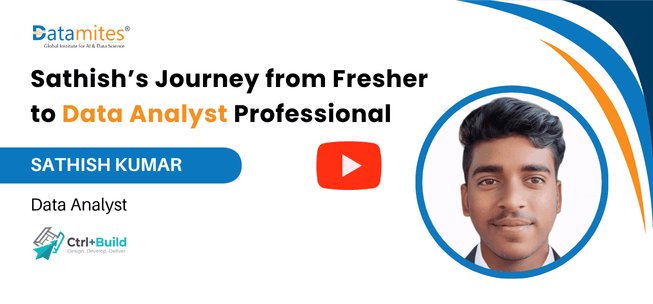
Transitioning from mechanical engineering to data analytics can be challenging for graduates without programming experience. Sathish Kumar joined DataMites Bangalore in June 2025 to build his technical skills through structured training and practical projects. After clearing his mock interview on the first attempt and learning from company interviews, he secured a Data Analyst role.
Sathish Kumar’s Journey from Mechanical Engineering to Data Analyst
After completing his mechanical engineering degree, Sathish Kumar explored IT courses in Bangalore to transition into the data analytics field. He joined DataMites in June 2025, where he developed his technical skills through live classes, practical projects, and interview preparation. His journey from a non-IT background to securing a Data Analyst role highlights the importance of continuous learning and hands-on experience.
He also completed capstone and final projects, attended revision sessions, and received resume guidance from the placement team. His interview experiences helped him identify skill gaps, improve his SQL knowledge, and prepare more effectively for technical assessments. Through consistent practice and continued learning, Sathish successfully secured a Data Analyst position.
1. Can you tell us about your educational background?
I completed my undergraduate degree in mechanical engineering and initially had limited knowledge of programming and computers.
I wanted to transition into the growing data industry and develop the technical skills required for a career in data analytics.
2. Why did you choose DataMites for your data analytics training?
I researched different training options and came across DataMites. I chose DataMites to build my technical foundation through structured classes, practical assignments, and project-based learning.
3. When did you join DataMites, and how was your course structured?
I joined DataMites Bangalore in June 2025 and completed four months of live classes followed by two months of project work.
The training helped me understand technical concepts from the basics and apply my learning through practical exercises.
4. How was your learning experience as a beginner?
Since I came from a mechanical engineering background, learning programming from scratch was challenging initially.
The foundation classes, revision sessions, and doubt-clearing support helped me improve my understanding and gain confidence in technical subjects.
5. Which technical skills were most important during your preparation?
During my preparation, I focused on the following technical skills to strengthen my knowledge and perform better in interviews.
- Python: Practise programming fundamentals and data manipulation.
- SQL: Focus on joins, window functions, CTEs, and complex queries.
- Machine Learning: Understand algorithms and their practical applications.
- Power BI: Learn dashboard creation and data visualisation for data analyst roles.
These data analyst skills helped me build a stronger technical foundation and prepare for data analyst interviews.
6. How did the projects and internship help you gain practical experience?
During my project training, I completed four capstone projects and two final projects involving datasets, algorithms, and practical applications.
These projects helped me understand how to apply machine learning concepts and connect SQL databases with Python for data-related tasks.
7. How did you prepare for and clear the mock interview?
I cleared the DataMites mock interview on my first attempt by revising the topics taught during the training.
My advice is to attend classes regularly, practise consistently, and understand concepts thoroughly instead of simply memorising answers.
8. How did the DataMites placement team support your job search?
The placement team helped me improve my resume by correcting formatting issues, checking grammar, and recommending relevant project details.
I also received interview opportunities, which helped me understand employer expectations and identify areas where I needed further preparation.
9. How many interviews did you attend before getting placed?
I attended two machine learning interviews and two data analyst interviews before securing my data analyst position.
Although I was not selected for the machine learning roles, those experiences helped me recognise my weaknesses and improve my preparation.
10. What was the biggest challenge you faced during interviews?
SQL was one of my biggest challenges because some interviewers expected more advanced query-writing skills than I had initially prepared for.
I realised that freshers should practise joins, window functions, common table expressions (CTEs), stored procedures, and complex SQL queries.
11. Can you share an example of a machine learning interview task?
During one interview, I received a CSV dataset and was asked to build a random forest classification model to predict rainfall categories.
The task tested my practical understanding of machine learning and taught me the importance of practising independently without relying on AI tools.
12. Which projects did you build to strengthen your technical skills?
I worked on an OpenCV project using Python, developed an LLM-based chatbot, and built a RAG model that retrieved information from uploaded PDFs.
I also created a clustering project inspired by the COVID-19 pandemic to explore how location-based data could be grouped and analysed.
13. Why are communication skills important for data analyst interviews?
Technical knowledge alone is not enough; candidates must also explain their code, analytical approach, and project decisions clearly.
Good communication helps interviewers understand your reasoning and assess your ability to collaborate within a professional team.
14. What advice would you give to freshers entering data analytics?
My advice is to strengthen Python and SQL, practise problem-solving, build practical projects, and prepare consistently for technical interviews.
Freshers should also improve communication skills, learn from interview rejections, and continue developing their knowledge beyond classroom training.
Refer to these Articles:
- Why Data Analytics Matters in Every Career
- Best Programming Languages for Data Analysts
- Difference Between Data Science and Data Analytics
Key Findings from Sathish Kumar’s Career Journey
Sathish Kumar’s DataMites Success Story highlights how technical training, practical projects, and interview preparation helped him transition from mechanical engineering to data analytics.
- Learn the fundamentals: Build a strong foundation in Python, NumPy, Pandas, SQL, and machine learning.
- Practise regularly: Attend revision and doubt-clearing sessions to strengthen your understanding.
- Improve SQL skills: Practise joins, window functions, CTEs, and complex queries to prepare for technical interviews.
- Build practical projects: Work on projects such as OpenCV applications, LLM chatbots, RAG models, and machine learning solutions.
- Understand algorithms: Learn how algorithms such as linear regression and logistic regression work instead of memorising concepts.
- Prepare a strong resume: Highlight relevant projects and be ready to explain the data analyst tools, methods, and results.
Sathish’s journey shows that consistent learning, hands-on experience, and preparation based on interview feedback can help freshers work toward a data analyst career.
Refer to these Articles:
- How Did Ajay Build His Career as a Business Analyst
- How Harshil Built an Inspiring Career in Data Analytics
- Journey of Manali from Fresher to Data Analyst
DataMites is a globally recognized data science and analytics training provider that helps aspiring professionals build industry-relevant skills through practical, career-focused learning. DataMites data analyst course in Bangalore is designed to provide structured learning, practical exposure, and career preparation for aspiring data professionals.
Accredited by IABAC and NASSCOM FutureSkills, DataMites offers online and offline learning modes, flexible schedules, mock interviews, placement assistance, and lifetime access to learning resources. DataMites has also received the Best Skill Development EdTech award from BW Businessworld for its contribution to skill development and career-focused learning. With numerous offline centres across India, DataMites Hyderabad offers learners opportunities to develop practical and career-focused skills. DataMites also operates offline training centres in major cities such as Mumbai, Pune, Chennai, Delhi, Kolkata, Coimbatore, Ahmedabad, Chandigarh, and several others.