How Kalaiarasan Built a Successful Career in Data Analytics
Discover how Kalaiarasan successfully transitioned into Data Analytics through hands-on projects, internship experience, and continuous learning. Explore his inspiring career journey, key challenges, interview preparation strategies, and valuable insights for aspiring Data Analysts.
 Kriti Maurya
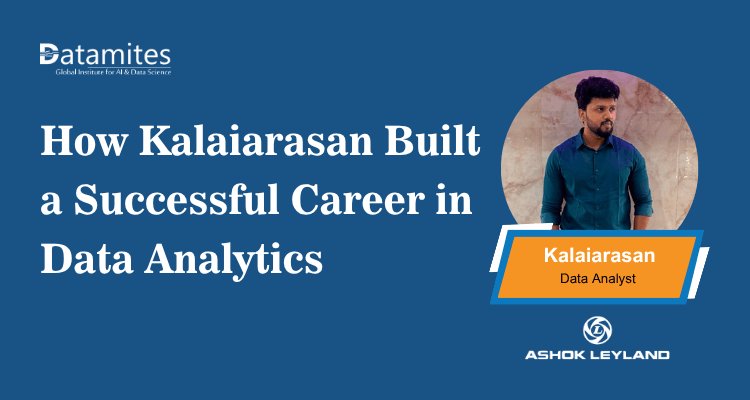
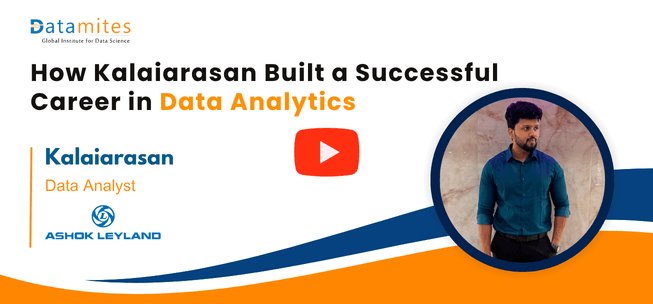
The field of Data Analytics offers exciting career opportunities for professionals looking to transform data into meaningful business insights. However, successfully entering this competitive domain requires the right training, practical experience, project exposure, and interview preparation. Kalaiarasan's journey from a Data Engineer to a Data Analyst at Ashok Leyland demonstrates how dedication, continuous learning, and hands-on experience can help professionals achieve their career goals. In this alumni interaction, Kalaiarasan shares his experiences with training, internships, projects, and job interviews, offering valuable guidance for aspiring data analysts.
Kalaiarasan’s Transformation into a Data Analytics Professional
The journey to becoming a successful Data Analytics professional often requires dedication, continuous learning, and practical experience. Kalaiarasan's transformation demonstrates how the right training, hands-on projects, internship exposure, and interview preparation can help individuals build industry-relevant skills and successfully transition into a rewarding analytics career. As the demand for skilled professionals continues to grow, IT courses in Chennai provide aspiring learners with valuable opportunities to gain practical expertise and enhance their career prospects in Data Analytics.
Q1. Could you introduce yourself and share your background?
Before joining DataMites, I was working as a Data Engineer. Although I had experience in data-related work, I wanted to transition into Data Analytics and Data Science. While searching for suitable training programs, I discovered DataMites and decided to enroll in the course to enhance my skills and expand my career opportunities.
Q2. What motivated you to choose DataMites?
One of the major reasons I chose DataMites was its flexibility. Since I was working full-time, balancing work and studies was initially challenging. However, the availability of multiple time slots, weekend sessions, and backup classes made learning convenient. The trainers were highly supportive, and even students from non-technical backgrounds were able to understand concepts easily because the training started from the fundamentals.
Q3. How was your learning experience during the course?
The learning experience was excellent. I already had basic knowledge of SQL and Python, which helped me initially. However, the trainers focused on strengthening core concepts and providing deeper technical understanding. The support team regularly followed up whenever students missed classes and helped resolve any challenges. This level of support made the learning journey smooth and effective.
Q4. How important were mock interviews in your career journey?
Mock interviews played a significant role in helping me secure my current job. The mock interview sessions were highly structured and often more challenging than actual interviews. They helped me identify my strengths and weaknesses, improve my confidence, and prepare thoroughly for real interview situations. I attended several mock interview sessions over a period of four to five months, which greatly improved my interview performance.
Q5. Did you work on any projects during your training?
Yes, I completed three Machine Learning projects during my training. Although my primary goal was to become a Data Analyst, I chose the Data Science track to gain additional exposure to Machine Learning concepts. My projects focused on three key areas: regression, classification, and clustering. Working on these real-world projects helped me strengthen essential data analyst skills, including data analysis, problem-solving, model evaluation, and data interpretation, while also enhancing my technical expertise and understanding of practical business challenges.
Q6. What challenges did you face while working on the projects?
One of the biggest challenges was improving model performance. I spent nearly two months refining my models and increasing their accuracy. Through continuous experimentation and learning, I was able to achieve approximately 98% accuracy in my classification and regression projects. This process taught me persistence, problem-solving, and analytical thinking.
Refer to these Articles:
- Top Skills for Data Analyst in Coimbatore
- Can Freshers Kickstart a Data Analyst Career in Coimbatore
- Why Coimbatore IT sector is rising as a new tech hub
Q7. How did internships contribute to your career growth?
After completing the projects, I earned a six-month internship certificate. The internship experience was extremely valuable because it validated my practical skills and demonstrated my ability to apply concepts in real-world scenarios. Employers often look for candidates with hands-on experience, and the internship significantly strengthened my profile during job applications and interviews.
Q8. How did the internship help you crack interviews?
The internship provided focused mentoring and personalized guidance. Trainers closely monitored each student's progress and helped identify areas for improvement. Through project discussions, technical reviews, and continuous feedback, I gained a better understanding of data analytics concepts and industry expectations. This practical exposure made a noticeable difference during interviews.
Q9. What types of questions were asked during your interviews?
Most companies followed a multi-stage interview process. Apart from technical rounds, there were aptitude tests, communication assessments, and group discussions. During technical interviews, recruiters focused heavily on project experience. They asked detailed questions about the projects I completed, the techniques I used, model optimization methods, the visualizations created, and alternative approaches to solving problems. Therefore, candidates should have a thorough understanding of every project they showcase on their resumes.
Q10. How many interviews did you attend before securing your current role?
I attended around four to five interviews and successfully cleared three of them. This gave me multiple options to choose from, allowing me to select the role that best aligned with my career goals. My advice to aspiring professionals is to actively participate in mock interviews, complete all assigned tasks, and continuously improve their skills.
Q11. What is your current role as a Data Analyst?
As a Data Analyst, my primary responsibility is working with Key Performance Indicators (KPIs) and business reports. I analyze sales performance, revenue trends, cancellation rates, and other business metrics for different stakeholders. My work helps organizations make informed decisions and identify growth opportunities. Understanding business requirements is one of the most important aspects of my role because technical solutions are effective only when they address actual business needs.
Q12. What advice would you give aspiring Data Analysts?
Focus on building strong fundamentals, completing practical projects, participating in internships, and taking mock interviews seriously. Learn to understand business requirements and develop problem-solving skills. Technical knowledge is important, but the ability to apply that knowledge in real-world situations is what ultimately helps you succeed in the industry.
Career Highlights from Kalaiarasan's Analytics Journey
Kalaiarasan's career progression demonstrates how practical learning, project experience, and consistent effort can help professionals build successful careers in Data Analytics. Like many inspiring DataMites Success Stories, his journey highlights the value of hands-on training, internships, and interview preparation in achieving career goals.
- Transitioned from Data Engineer to Data Analyst: Kalaiarasan successfully moved from a Data Engineer role into the field of Data Analytics. His structured learning approach helped him gain the knowledge and confidence needed for this career transition.
- Leveraged Flexible Learning Opportunities: The flexible training schedule allowed him to balance professional responsibilities while upgrading his skills. This made continuous learning more accessible and effective.
- Built Strong Technical Expertise: Through dedicated training and practice, he strengthened his skills in SQL, Python, Machine Learning, and Data Analytics. These technical competencies played a key role in his career advancement.
- Completed Multiple Industry-Relevant Projects: He worked on three major Machine Learning projects focused on regression, classification, and clustering. These projects provided valuable hands-on experience in solving real-world business problems.
- Achieved High Project Performance: By continuously refining and optimizing his models, Kalaiarasan achieved nearly 98% accuracy in his projects. This experience enhanced his analytical thinking and problem-solving abilities.
- Earned Valuable Internship Experience: After completing his project work, he received a six-month internship certificate. The internship helped him gain practical exposure and strengthen his professional profile.
Kalaiarasan's journey highlights how continuous learning, hands-on projects, internships, and interview preparation can contribute to career success. His experience serves as a valuable example for aspiring Data Analysts seeking to build industry-relevant skills and secure rewarding opportunities in the analytics field.
Refer to these Articles:
- Is AI Changing the Role of Data Analysts
- Future of Data Analytics: What Skills Will Matter
- Essential Technical vs Non-Technical Skills for Data Analysts
DataMites Institute emphasizes industry-oriented training and globally recognized certifications to help professionals build successful careers in data-driven fields. Accredited by IABAC and NASSCOM FutureSkills, the institute offers comprehensive Data Analytics Chennai, along with specialized programs in Data Science, Machine Learning, Artificial Intelligence, Python, Tableau, and MLOps. Learners can further strengthen their expertise through advanced certifications such as Certified Data Scientist, AI for Managers, and Computer Vision Expert, enhancing their career opportunities in the evolving technology landscape.
In addition to offering a data analyst course in Coimbatore, DataMites operates offline training centers in major cities, including Bangalore, Pune, Hyderabad, Chennai, Delhi, Kolkata, Mumbai, Ahmedabad, Chandigarh, and others. The training programs combine classroom-based learning, practical project work, internship opportunities, and dedicated career support, enabling learners to develop job-ready skills and gain real-world industry experience.