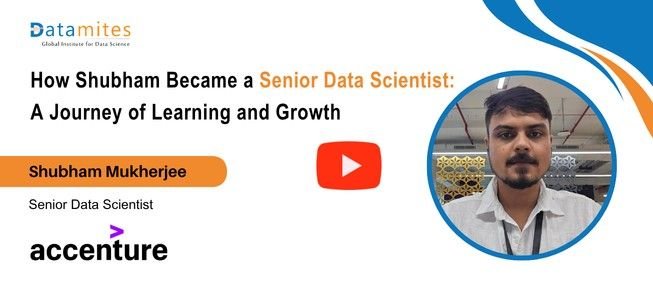
How Shubham Became a Senior Data Scientist: A Journey of Learning and Growth
Through consistent learning, hands-on practice, and real-world project experience, Shubham successfully transitioned into data science and advanced to a Senior Data Scientist role.
 Prerana B A
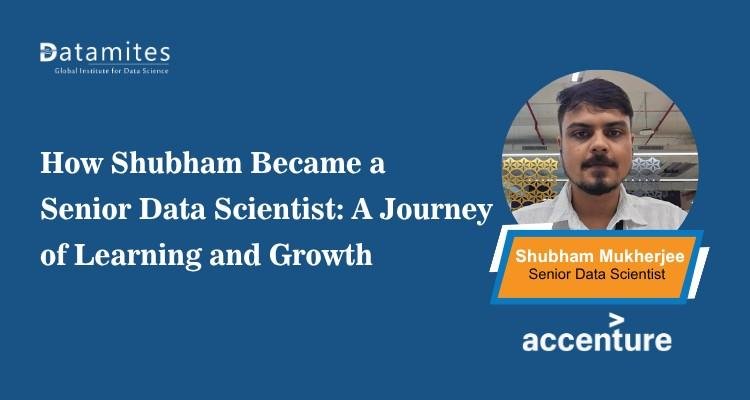
Shubham's journey is a strong example of how consistent learning, hands-on practice, and persistence can help professionals successfully transition into data science from a completely non-IT background. Coming from an electrical engineering and hardware automation background, he moved toward data science by pursuing specialized training during the COVID-19 lockdown. Through structured learning, capstone projects, daily practice, and continuous interview preparation, he successfully secured a role as a Senior Data Scientist at Accenture.
What truly set Shubham apart was his focus on building strong fundamentals and gaining practical exposure rather than looking for shortcuts. His journey reflects how discipline, hands-on learning, and persistence can gradually transform a non-IT professional into a confident and capable data science professional. His inspiring journey stands as a true DataMites success story example, showcasing how structured learning, practical exposure, and consistent mentorship can help shape skilled and confident data science professionals.
Read these articles:
- Databricks vs Snowflake: Which Is Better for Data Science?
- Best Python Web Frameworks for Beginners and Professionals in 2026
- Data Science Career Scope in India
Shubham’s Transition from Hardware Automation to Data Science
Read how Shubham successfully moved from hardware automation into data science through structured learning, continuous upskilling, practical projects, and real-world industry exposure at DataMites.
Q1. Please introduce yourself.
My name is Shubham, and I completed my engineering in Electrical Engineering. I initially worked in the hardware automation field after graduating in 2019. During that time, I became interested in the growing opportunities in data science and machine learning.
Q2. How did your journey into data science begin?
While working in automation, I learned about the growing impact of AI and machine learning from colleagues and friends. During the COVID-19 lockdown, I joined DataMites to build my knowledge in data science and machine learning. At that time, technologies like GPT and large language models were still emerging, and I wanted to prepare myself for future opportunities in this field.
Q3. Did you have any prior IT or programming background?
No, I did not come from an IT background. Since I was from Electrical Engineering, most of my experience was related to hardware and automation systems. However, I had basic exposure to programming concepts during engineering, which helped me understand coding fundamentals.
Q4. Was learning Python difficult for you?
No, Python was comparatively easier to learn because of its simple syntax. Understanding programming logic during engineering also helped me adapt quickly to Python programming.
Q5. What was the most challenging part while learning data science?
The challenging part was understanding statistics, machine learning concepts, neural networks, NLP, and the mathematical foundations behind machine learning systems. Since these technologies were still evolving rapidly at that time, understanding how models worked internally required continuous effort and learning.
Q6. How did DataMites help in your learning journey?
DataMites helped me build a strong foundation in machine learning, modeling, mathematics, and statistics. The trainers provided preparation notes, practice materials, assessments, and guidance that helped me understand concepts clearly and stay consistent throughout the learning process.
Q7. Did you use additional learning resources apart from classroom sessions?
Yes, apart from training sessions and notes, I regularly referred to YouTube videos, online tutorials, and free Udemy courses to strengthen my understanding. I believe continuous learning and staying connected with new technologies is very important in data science because the field evolves rapidly.
Q8. How important are fundamentals in data science?
Fundamentals are extremely important. Before learning advanced concepts, it is necessary to understand the basics of machine learning, statistics, and modeling clearly. Strong fundamentals make it easier to learn advanced technologies later.
Q9. Did you work on projects during your training?
Yes, I completed multiple capstone projects during my training. These projects helped me apply theoretical learning to practical problems. I also worked on time-bound assignments and certification-based projects that improved my understanding of real-world implementations.
Q10. How did projects help you during interviews?
Projects played a major role during interviews because interviewers focused heavily on practical implementation rather than only theoretical knowledge. The projects also helped me build GitHub repositories where I showcased my work and technical skills.
Q11. How did you prepare for job interviews?
I spent a lot of time understanding company requirements and industry expectations. I attended multiple interviews during the initial phase, and every interview helped me understand what companies were looking for in data science professionals.
Q12. Did you face rejections before getting selected?
Yes, I faced multiple rejections initially. However, every interview gave me new insights and helped me improve my technical knowledge, confidence, and interview preparation.
Q13. What was your strategy while starting your career in data science?
My focus was not initially on salary. I wanted to gain practical industry exposure and real-world project experience. Once I started working on real projects, learning and career growth became much faster.
Q14. What advice would you give freshers for getting interview calls?
Freshers should build strong resumes aligned with job descriptions. It is important to include projects from multiple domains like prediction systems, NLP, sentiment analysis, and pipelines. Resume keywords, ATS optimization, and showcasing practical skills are very important today.
Q15. Which interview platforms and resources are useful for freshers?
Platforms like LinkedIn and Naukri are very useful for job applications. Freshers should also regularly monitor job descriptions to understand current industry requirements and skill expectations.
Q16. What technical skills are commonly asked in data science interviews?
Interviewers usually focus on machine learning basics, statistics, data preprocessing, algorithms, hyperparameter tuning, sampling methods, and scenario-based problem-solving questions. Basic Python programming questions are also frequently asked.
Q17. Are programming rounds difficult for freshers?
No, most programming rounds for freshers focus on basic Python concepts, loops, libraries, and logical thinking. The main objective is to evaluate whether candidates understand programming fundamentals.
Q18. What skills should freshers focus on initially?
Freshers should avoid overloading themselves with too many technologies at once. Instead, they should focus on understanding one domain clearly, whether it is machine learning, NLP, pipelines, or predictive analytics systems. Strong clarity in basics and projects is more important than superficial knowledge across multiple areas.
Q19. Is Deep Learning important for freshers?
Yes, understanding deep learning architectures, neural networks, RNNs, and model structures is beneficial. Interviewers often ask conceptual and architecture-related questions to evaluate understanding rather than memorized answers.
Q20. What is your current role at Accenture?
Currently, I work as a Senior Data Scientist at Accenture. I work on predictive analytics projects, fraud prediction systems, agentic API development, and machine learning solutions for business use cases.
Q21. What does your day-to-day work involve?
My daily work includes understanding business requirements, discussing use cases with stakeholders, data preprocessing, building machine learning models, pipeline development, and ensuring project delivery within deadlines. Understanding the business problem is often more important than simply writing code.
Q22. Which tools and technologies do you currently use?
I work with Python, Databricks, VS Code, Azure pipelines, CI/CD systems, and machine learning workflows. Depending on project requirements, we also use internal enterprise tools and systems.
Q23. What is your biggest advice for aspiring data science professionals?
Focus on mastering the basics first. Understanding machine learning concepts, business requirements, and problem-solving approaches is more important than memorizing complex coding techniques. Stay curious, keep learning, and continuously improve through projects and practical implementation.
Refer to these articles:
- How Parag Thakur Built His Career in Data Science
- Vinay Gaikwad’s Journey in Freelance Data Science
- Nirmal Vani’s Journey to Success in Data Science
What Aspiring Data Scientists Can Learn from Shubham’s Journey
Shubham’s journey highlights how continuous learning, adaptability, and practical implementation can help professionals successfully transition into data science careers, even from non-IT backgrounds.
- Strong Fundamentals Create Long-Term Growth: Understanding statistics, machine learning, and core concepts helped him build confidence in advanced technologies.
- Continuous Learning is Essential: Regular learning through videos, online resources, and self-practice helped him stay updated with rapidly changing technologies.
- Projects Build Practical Understanding: Capstone projects and hands-on implementation strengthened his problem-solving ability and interview performance.
- Persistence Helps Overcome Rejections: Multiple interview attempts helped him improve technical skills and understand industry expectations.
- Business Understanding Matters: Understanding client requirements and business problems is equally important as technical knowledge.
- Industry Demands Adaptability: Continuous upskilling in technologies like LLMs and modern machine learning systems helped him remain industry-ready.
- Resume Optimization is Important: ATS-friendly resumes and domain-based projects improve interview opportunities for freshers.
- Confidence and Communication Matter: Being confident, humble, and eager to learn positively impacts interview performance.
- Practical Knowledge is Highly Valued: Companies focus more on real-world implementation and project understanding than theoretical memorization.
- Freshers Should Focus on One Domain at a Time: Learning one domain deeply is more effective than trying to learn everything at once.
- Understanding Use Cases is Crucial: Successful data science professionals focus on understanding business use cases before developing models.
- Technology Continuously Evolves: Staying updated with modern tools and automation technologies is necessary for long-term career growth.
Shubham's journey demonstrates that a successful career in data science does not depend on prior technical background or years of IT experience. What truly makes the difference is discipline, consistent effort, guided learning, and a strong focus on developing practical, job-ready skills.
For working professionals considering a career transition, his experience highlights the importance of mastering fundamentals, practicing regularly, and gaining real-world exposure. With data science becoming one of the most sought-after IT courses in demand globally, organizations across industries are actively looking for skilled professionals who can turn data into actionable insights.
His growth was shaped through structured training at institutes like DataMites Hyderabad, continuous practice, and hands-on exposure to real-world projects. Starting from a hardware automation background, he gradually built expertise in Python, statistics, machine learning, and deep learning, which eventually helped him secure a Senior Data Scientist role at Accenture.
His journey reflects how focused learning, real-world project experience, and continuous upskilling can help aspiring professionals transition successfully into data science and build a strong, future-ready career. Industry-focused programs like data science training in Ahmedabad further demonstrate how structured, mentor-led learning is helping learners across India bridge the gap between academic knowledge and industry expectations.