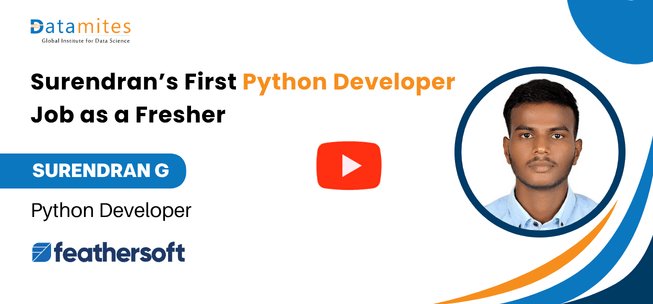
How Surendran Landed His First Python Developer Job as a Fresher
Surendran transformed his passion for Python into a successful career by focusing on consistent learning, hands-on projects, and strong mentorship. His journey shows how dedication and the right guidance can help freshers secure their first developer role.
 Priyanka BR
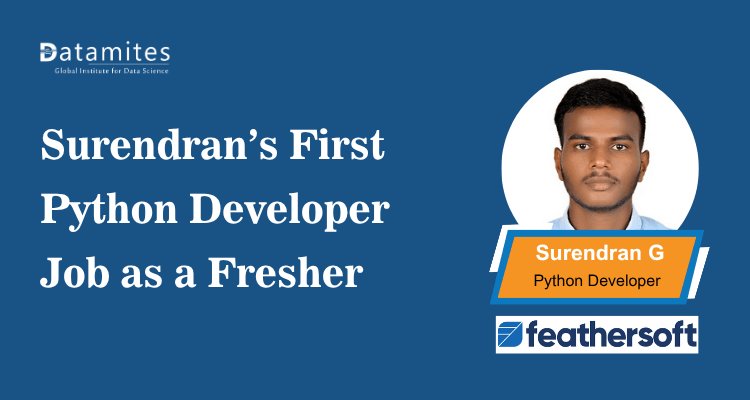
Meet Surendran, a Computer Science graduate who turned his interest in Python into a successful career by making the right learning choices, gaining proper mentorship, and staying consistent throughout his journey.
His path was not easy. From improving his understanding of Python and machine learning concepts to working on real-time projects, Surendran showed that dedication and continuous practice can help overcome challenges. A key turning point in his journey was enrolling in a structured, hands-on training program at DataMites, where he learned how to apply theoretical knowledge to real-world problems.
Today, Surendran’s journey serves as a strong example for freshers aiming to start their career in Python development and AI. His experience clearly highlights how the right guidance, practical exposure, and consistent effort can transform career goals into real achievements.
How Surendran Strengthened His Python Developer Journey with DataMites
Surendran’s journey shows how a fresher can build a strong foundation in Python development through structured learning, hands-on projects, and consistent practice. With the right mentorship and real-time exposure at DataMites, he gained the skills and confidence needed to crack interviews and secure his first role as a Python Developer. His journey also reflects how stepping into the Artificial Intelligence world with the right guidance can open strong career opportunities in the IT industry.
1. Can you introduce yourself and your achievement?
I am a Computer Science Engineering graduate, and I recently secured my first job as a Python Developer at Feathersoft. As a fresher, getting into a development role required strong fundamentals, project experience, and interview preparation, all of which played a key role in my success.
2. What is your educational background?
I completed my Bachelor’s degree in Computer Science Engineering. This helped me build a basic foundation in programming, algorithms, and problem-solving, which later supported my learning in Python and machine learning.
3. Where did you complete your training?
I joined a structured data science and Python training program at DataMites in Bangalore, specifically at the Kudlu Gate branch. The training environment, mentorship, and practical exposure helped me prepare for real industry requirements.
4. When did you start your learning journey?
I started my course in May 2024. From that point, I focused on building strong technical skills, working on projects, and preparing consistently for job opportunities.
5. Did you know Python before joining the course?
Yes, I had basic knowledge of Python due to my computer science background. However, the training helped me understand Python in depth, including real-time applications, libraries, and coding practices used in the industry.
6. How was your overall learning experience?
My learning experience was very effective because the curriculum was designed according to industry needs. It covered Python, machine learning, and practical implementation, which directly helped me during interview preparation.
7. How did you learn machine learning concepts effectively?
I focused on hands-on practice rather than only theory. I worked on datasets, implemented algorithms, and solved real-world problems. Mentors played an important role in clearing doubts and guiding me through difficult concepts.
8. What learning resources did you use apart from classes?
Along with training sessions, I used multiple resources to strengthen my skills:
- LMS platform for structured learning and revision
- Reference books and notebooks shared during training
- Kaggle for real-time dataset practice
- YouTube for concept clarity and additional explanations
9. How important was the LMS platform in your preparation?
The LMS platform was very important because it provided organized content, assignments, and practice materials. It helped me revise concepts regularly and stay consistent in my learning.
10. What projects did you work on during your training?
I completed four capstone projects and one client project. These projects involved working with real datasets, performing data preprocessing, and applying machine learning techniques.
11. How did projects help you crack the Python developer interview?
Projects gave me practical experience, which was very useful in the final interview round. I was able to confidently handle coding tasks, understand datasets, and apply concepts like feature engineering and data cleaning.
12. How many mock interviews did you attend and how did they help?
I attended three mock interviews. These helped me improve my communication skills, reduce hesitation, and understand the interview pattern. It also boosted my confidence for real interviews.
13. What challenges did you face during your preparation?
My biggest challenge was communication. I was not very confident while speaking initially, but mock interviews helped me overcome this issue and improve my overall presentation skills.
14. Did you get support for resume building?
Yes, I prepared my resume and then got it reviewed. Corrections and improvements were suggested, which helped me create a professional and job-ready resume.
15. What was the interview process at Feathersoft?
The interview process consisted of three rounds:
- Aptitude Round
- Technical Round (Python and Machine Learning)
- Practical Task Round
Each round tested different skills including problem-solving, technical knowledge, and practical implementation.
16. What kind of aptitude questions were asked?
The aptitude round included basic problem-solving questions such as speed, distance, and time calculations, along with work-based numerical problems. These were not very difficult but required practice.
17. What Python interview questions were asked?
The technical round focused on basic Python concepts such as:
- Data structures like lists and tuples
- Differences between arrays and NumPy
- Basic programming concepts
Strong fundamentals were important to answer these questions confidently.
18. What task were you given in the final round?
In the final round, I was given a dataset and asked to perform:
- Data cleaning
- Feature engineering
- Feature selection
This tested my practical knowledge. I completed the task in around 45 minutes.
19. Which skills are most important for freshers today?
In my experience, strong knowledge of Python, machine learning basics, and understanding of AI concepts are very important. NLP may seem difficult at first, but with regular practice, it becomes easier.
20. What is your advice for freshers preparing for Python developer roles?
My advice is to focus on consistent learning and practice. Revise your curriculum regularly, work on real-time projects, and improve your communication skills. Daily practice, hands-on experience, and confidence are the key factors that help freshers successfully crack interviews and secure their first job.
Refer to these articles:
- Generative AI and Predictive AI: Key Differences Explained
- Learn about the Types of Machine Learning Algorithms
- What is the Difference Between AI Engineer and AI Expert Course?
Key Python Developer Career Insights from Surendran’s Journey at DataMites
Surendran’s journey offers practical insights for freshers aiming to build a career in Python development and step confidently into the Artificial Intelligence domain. His experience shows how structured learning, consistent practice, and the right guidance can help transform a beginner into a job-ready professional.
- Surendran showed that consistent learning and daily practice are essential to build strong programming fundamentals and improve confidence
- His Computer Science background, along with basic Python knowledge, helped him understand concepts faster and apply them effectively
- He focused on strengthening core skills like Python programming, problem-solving, and understanding real-time coding practices
- Working on multiple capstone and client projects helped him apply concepts practically and gain hands-on experience with real datasets
- Guidance from mentors helped him simplify complex topics and improve his overall understanding
- Support from the team helped him refine his resume and prepare effectively for interviews
- Mock interviews played a key role in improving his communication skills and boosting his confidence
- Regular practice and revision helped him perform better in technical and task-based interview rounds
- His journey highlights that strong fundamentals, practical implementation, and communication skills are important to succeed as a Python Developer
Refer to these articles:
- How Shubham Cracked Two AI Engineer Job Offers as a Fresher
- Can an Electronics Graduate Become an AI Developer as a Fresher? Suyog’s Success Story
- How Did Preet from Surat Land His First AI Engineer Job as a Fresher?
Surendran’s journey shows that building a strong foundation in Python development is achievable with the right strategy, consistent effort, and hands-on experience. After completing his Computer Science Engineering degree, he began his learning journey by enrolling in an Artificial Intelligence Course in Bangalore at DataMites. Through this offline program, he focused on strengthening his skills in Python programming, problem-solving, and real-time implementation. With multiple project experiences, practical exposure, and continuous support from mentors, he was able to improve his technical abilities and gain the confidence needed to clear interviews and successfully start his career as a Python Developer.
DataMites Institute provides a comprehensive 9-month Artificial Intelligence training focused on building job-ready skills through hands-on tools, real-time project experience, and an emphasis on ethical AI practices. The program is designed with multiple career tracks, including AI Engineer, AI Specialist, AI for Product Managers, AI Foundation, and Certified NLP Professional, enabling learners to select a path that matches their career goals. With certifications accredited by IABAC and NASSCOM FutureSkills, the course equips learners with practical expertise and the confidence required to take on real-world roles in AI and machine learning.
With over 30+ offline centers across India, DataMites makes AI learning accessible to learners nationwide. If you are from Tamil Nadu, exploring Artificial Intelligence Courses in Chennai is a smart way to begin your journey. With 3 offline centers in Chennai located in Anna Nagar, Perungudi, and Guindy, DataMites offers hands-on training, real time projects, and expert mentorship to help you build a strong foundation and confidently move toward a successful career in AI.