How to Start a Data Science Career in Kenya
Learn how to start a data science career in Kenya with a practical roadmap covering essential skills, Python, SQL, machine learning, projects, portfolios, career options, and salary expectations.
 Swagatam Sinha
A graduate exploring technology careers in Kenya may come across several options involving Python, SQL, analytics, machine learning, and artificial intelligence. The difficult part is often not finding information about these skills but knowing where to begin and how they fit together.
Data is already used across many Kenyan industries. Banks and fintech companies work with transaction and customer information, retailers study buying patterns, and businesses in healthcare, agriculture, logistics, and technology rely on data for planning and decision-making.
For someone considering a data science career in Kenya, these developments provide useful context. However, becoming a data scientist is not simply about learning Python or memorising machine learning algorithms. You need to work comfortably with statistics, databases, programming, analysis, and the business problem behind the data.
Why Consider a Data Science Career in Kenya?
A person looking at data science opportunities in Kenya does not have to focus only on technology companies. Financial services, telecommunications, retail, e-commerce, healthcare, agriculture, logistics, and insurance all deal with data in different ways.
A bank may examine customer activity and transactions to understand financial risk. A telecom company may look at network usage, while a retailer can use sales records to understand which products customers are buying. These are different business problems, but they all involve collecting, preparing, and interpreting data.
The wider technology market also provides some context. Mordor Intelligence's Kenya ICT Market 2026 report estimates the market at about US$11.81 billion in 2026, up from US$11.19 billion in 2025. The report projects a 5.55% CAGR between 2026 and 2031, with cloud services among the faster-growing areas.
Cloud adoption is also becoming connected with AI and machine learning. According to PwC Kenya's 2026 cloud outlook, 90% of surveyed organizations had increased cloud usage to support AI and machine learning, while half were already piloting or deploying agentic AI.
This does not mean every learner needs to become an AI specialist. It does show why modern data work increasingly involves more than spreadsheets. Data may come from databases, move through cloud systems, and eventually be used for analytics, machine learning, or AI applications.
There are still practical issues to deal with. A 2026 GSMA report on Kenya's data ecosystem points to fragmented datasets, inconsistent data quality, limited digitization, interoperability problems, and skills gaps. Learning how to prepare and assess data is therefore just as important as learning how to build a model.
Refer to these articles:
- Top Data Extraction Tools to Streamline Your Data Collection
- Understanding Hadoop in Data Science
- Top Data Modeling Tools for Efficient Data Management
What Does a Data Scientist Do?
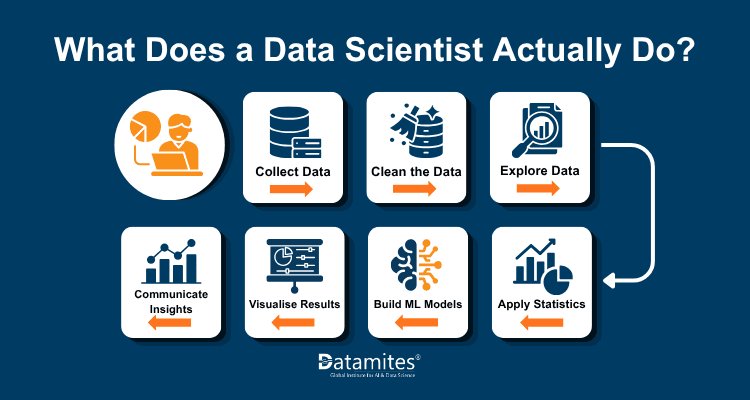
A data scientist works with data to answer questions, investigate patterns, and build models that can help an organization make decisions.
The work can involve several stages:
- Finding and collecting relevant data
- Cleaning incomplete or inconsistent records
- Exploring the data
- Applying statistical techniques
- Building and testing machine learning models
- Creating visualizations
- Explaining findings to other teams
Consider a simple Kenyan business example. A fintech company might want to understand why some customers stop using a particular service. A data professional could examine transaction history, customer activity, and other relevant information, prepare the data, and build a model to identify patterns associated with customer churn.
A retailer could take a different approach and use historical sales information to estimate future demand.
In both cases, writing Python code is only one part of the work. The person also needs to understand the business question, check whether the data is reliable, and explain what the results actually mean.
Can You Start Data Science Without a Computer Science Degree?
Yes. A computer science degree can provide useful technical foundations, but it is not the only route into data science.
Someone with a background in mathematics, statistics, engineering, economics, finance, information technology, or a related subject may already have skills that can be applied to data work. Professionals from marketing, operations, business, and other fields can also move into data-related roles by building the technical knowledge they are missing.
The harder part is usually learning several new areas at once. Python, statistics, SQL, and machine learning each take time to understand, so trying to master everything together can become confusing.
A more practical approach is to build the skills in stages. Start with statistics and basic programming, then add SQL and data analysis before moving further into machine learning. For learners who prefer guided instruction, an online data science course in Kenya can provide a structured way to work through these topics.
Refer to these articles:
- How Gradient Boosting Works in Machine Learning
- Data Lake vs Data Warehouse: Which Is Right for You?
- Top 10 Data Analyst Projects for Beginners
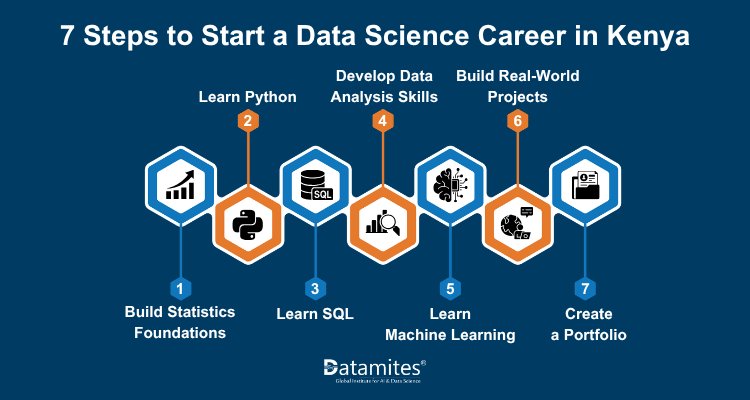
A Step-by-Step Roadmap to Start a Data Science Career in Kenya
Starting a data science career is easier when you build your skills in the right order. The roadmap below takes you from the basics of statistics and programming to practical projects, machine learning, and a portfolio you can use to demonstrate your skills.
1. Build a Foundation in Mathematics and Statistics
Before getting deep into machine learning, make sure you are comfortable with the basic ideas behind data analysis. You do not need advanced mathematics to begin, but you should understand how to interpret numbers and recognize when a statistical method makes sense.
Start with:
- Descriptive statistics
- Mean, median and standard deviation
- Probability
- Correlation
- Distributions
- Hypothesis testing
- Regression
- Basic linear algebra
The important part is not memorising formulas. You should be able to look at a dataset, understand what the numbers are showing, and question whether the conclusion is reasonable.
2. Learn Python for Data Science
Python is a practical starting point because the same language can be used for data analysis and, later, machine learning. Begin with variables, conditions, loops, functions, and data structures before moving into libraries such as NumPy, Pandas, Matplotlib, and Seaborn.
Try writing code as you learn instead of spending months only watching tutorials. Pick a public dataset and work through a simple question. You could calculate monthly sales, compare products, identify changes over time, or create a basic visualization.
If you are comparing an online data science course in Nairobi, check whether the learning involves actual datasets and coding practice rather than only recorded explanations.
At this stage, the project does not need to be impressive. The goal is to become comfortable opening a dataset, working with it, and figuring out what the information is telling you.
3. Learn SQL and Database Fundamentals
SQL is another important skill for anyone pursuing a data-related career.
Not all data work starts in Python. Business information is often stored in databases, so knowing how to retrieve the right records is an important part of the process.
Begin with:
- SELECT statements
- Filtering with WHERE
- Sorting
- GROUP BY
- Aggregate functions
- JOIN operations
- Subqueries
- Basic database concepts
Once you understand SQL, it becomes easier to see how information moves from an operational database into an analytical workflow. Learning SQL alongside Python also gives you a clearer picture of how data is handled before analysis begins.
4. Develop Data Analysis and Visualization Skills
Before spending too much time on machine learning, learn how to investigate a dataset properly. Real data is rarely ready to use immediately. You may find missing values, unusual records, inconsistent formats, or relationships that are not obvious at first.
Work on areas such as:
- Data cleaning
- Exploratory Data Analysis
- Identifying missing values
- Finding outliers
- Understanding relationships between variables
- Creating charts
- Building dashboards
- Presenting insights
Depending on the role, you may use Excel, Power BI, Tableau, Python, or other visualization tools. When comparing online data science courses, look at whether these practical skills are included.
A useful analysis should answer more than “What does the chart show?” It should help explain why the result matters and what someone could do with that information.
5. Learn Machine Learning
Once statistics, Python, and data analysis feel familiar, machine learning becomes easier to approach.
Start with the main concepts:
- Supervised learning
- Unsupervised learning
- Regression
- Classification
- Clustering
- Feature engineering
- Model evaluation
- Overfitting and underfitting
There is no need to memorize every algorithm at the beginning. First understand the type of problem an approach is designed to solve, what assumptions it makes, and how you can tell whether the model is performing well.
After building this foundation, you can move into areas such as deep learning, natural language processing, computer vision, and generative AI.
6. Build Real-World Data Science Projects
This is where learning starts to become practical.
Instead of creating five projects that all follow tutorials, build two or three projects where you can explain the entire process from beginning to end:
Problem → Data → Cleaning → Analysis → Model → Evaluation → Findings
Kenya-specific project ideas could include:
- Mobile money transaction analysis
- Retail demand forecasting
- Customer churn prediction
- Loan default analysis
- Agricultural yield analysis
- Transport or traffic analysis
- E-commerce customer segmentation
Public datasets can be useful for this work. Always check the licensing conditions and avoid using private customer information or confidential financial data.
A project is much stronger when you can explain why you selected the dataset, what problems you found in it, how you prepared the information and why you selected a particular analytical method.
7. Build a Data Science Portfolio
Once you have completed a few projects, put them somewhere that another person can review.
GitHub and Kaggle can be useful for technical projects, while LinkedIn or a personal website can provide additional context.
For each project, explain:
- What problem you were trying to solve
- Where the data came from
- What tools you used
- How you cleaned the data
- What analysis you performed
- Which model or methodology you selected
- What you found
- What the findings could mean for a business
Do not treat your GitHub repository as a place to upload code and leave it there. A short explanation of the project makes it much easier for someone else to understand your work.
Which Skills Are Needed for a Data Science Career in Kenya?
A strong data science foundation combines technical and non-technical skills.
Technical skills include Python, SQL, statistics, machine learning, data visualisation, databases and basic cloud concepts.
Analytical skills include problem-solving, critical thinking, experimentation and data interpretation.
Professional skills include communication, presentation, teamwork, documentation and business understanding.
A data scientist may spend hours cleaning a dataset and then have only a few minutes to explain the result to a manager, client or another department. Being able to explain the finding clearly is therefore part of the job.
The World Economic Forum's Future of Jobs Report 2025 expects AI and big data to be among the fastest-growing skills through 2030, while analytical thinking, creative thinking, curiosity and lifelong learning also remain important.
For a person starting a data science career in Kenya, this combination is worth keeping in mind. Technical knowledge gets you into the analysis, but problem-solving and communication help you make sense of the result.
Refer to these articles:
- A Beginner’s Guide to Linear Programming for Data Science
- Your Roadmap to Becoming a Data Science Architect
- Understanding Data Archiving in Data Science: Key Concepts and Benefits
What Career Options Are Available After Learning Data Science?
Learning data science does not mean you have to apply only for data scientist positions.
Depending on your skills and experience, related career paths include:
- Data Analyst: Works with datasets, reports and dashboards to help teams understand business performance.
- Data Scientist: Uses statistics, programming and machine learning to investigate more complex problems and develop predictive models.
- Machine Learning Engineer: Concentrates on developing, deploying and maintaining machine learning systems.
- Data Engineer: Builds and maintains systems used to collect, store and process data.
- Business Analyst: Connects business requirements with analysis and reporting to support organisational decisions.
For beginners, a data analyst role can sometimes provide a more accessible entry point while they continue developing advanced data science skills. The appropriate route depends on an individual's background, technical ability and career goals.
How Much Can a Data Scientist Earn in Kenya?
The data scientist salary in Kenya varies depending on experience, location, employer, technical skills, and the type of compensation being reported.
According to Glassdoor's 2026 salary data for Kenya, Data Scientists have a median total pay of about KSh 103,000 per month, with reported total compensation ranging from approximately KSh 62,000 to KSh 242,000 per month. The reported base-pay range is KSh 60,000 to KSh 190,000 per month, while additional pay is reported at around KSh 2,000 to KSh 52,000 per month.
Nairobi shows a similar variation. Glassdoor reports an average base pay of about KSh 90,000 per month for data scientists in Nairobi. Its current reported total-pay range for data scientists is approximately KSh 900,000 to KSh 2.2 million per year, while senior data scientists are reported at around KSh 1.8 million to KSh 3.1 million per year.
These differences show why salary figures should be compared carefully. When researching data scientist salaries in Kenya, check the source, publication date, location, experience level and whether the figure represents base salary, total compensation, or a market benchmark.
Where Can Data Science Skills Be Used in Kenya?
Data science has applications across several industries.
In banking and financial services, analysts can work with customer behavior, transactions, credit risk and fraud-related information.
In telecommunications, data can help organizations understand customer usage, network performance and service patterns.
In retail and e-commerce, businesses can study purchasing behavior, forecast demand, and group customers according to their activity.
In healthcare, analytics can support operational planning, research and service delivery.
In agriculture, data can be used for crop analysis, supply chain planning, and understanding the effects of weather and other conditions.
In logistics, organizations can analyze routes, delivery times, demand and operational costs.
Kenya's economic data also shows the continued role of digitally connected sectors. According to the KNBS Economic Survey 2026, the financial and insurance sector grew by 6.5% in 2025, while the Information and Communication sector recorded 4.8% growth.
These figures do not mean that every organization in these sectors is hiring data scientists. They do, however, provide useful context for understanding where data-intensive work can take place.
For graduates, the focus can be on building strong technical foundations and a portfolio. When comparing online data science courses, it is worth looking beyond the number of modules and checking whether the program includes practical assignments, projects, statistics, Python, SQL, and machine learning.
The broader Kenyan technology environment is changing, but the fundamentals of becoming a capable data professional remain fairly straightforward: understand the numbers, learn how to work with data, solve useful problems, and explain what you find.
For learners looking to build skills for data-related roles, DataMites is a globally recognized institute offering professional training in data and technology fields. With more than 12 years of experience and 200,000+ learners globally, DataMites offers learning programs in data science, data analytics, artificial intelligence, and data engineering, along with related areas such as Python, statistics, machine learning, databases, big data, and business intelligence.