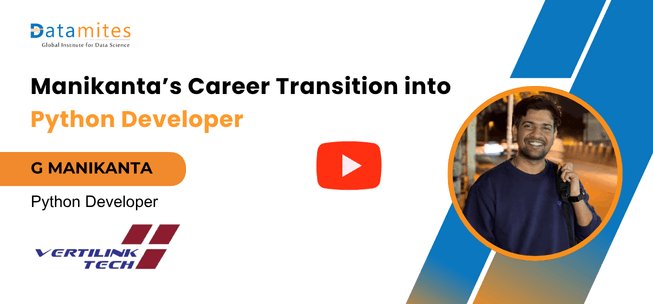
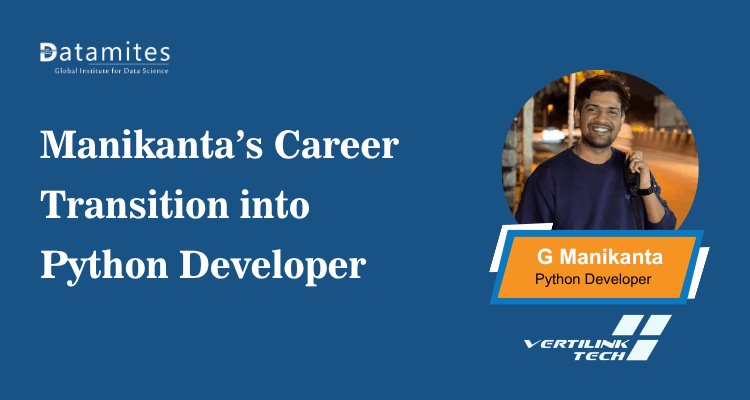
Manikanta’s Career Transition into Software Python Developer
Manikanta successfully transitioned from a non-technical background to a Software Python Developer role through focused learning and upskilling. His journey reflects how consistent practice and skill development in Python can open strong opportunities in the tech industry.
 Priyanka BR
Breaking into IT without a technical background can feel challenging, especially in a competitive job market. But Manikanta showed that the right mindset and consistent effort can make it possible.
His journey was not easy. He started with zero technical knowledge and struggled with Python basics, logic building, and machine learning concepts. Through structured learning at DataMites, he slowly improved his skills.
Hands-on practice, internships, and teamwork played a major role in his growth. With continuous learning and real-world exposure, he built strong confidence and technical skills, turning his goal into reality. Let’s see how his dedication and the right guidance helped transform his ambition into achievement.
How Manikanta Started His Python Developer Journey with DataMites
Manikanta’s journey shows how structured learning and consistent practice can transform a non-IT background into a technical career. With training at DataMites, he built strong Python skills and gained confidence in real-world concepts.
Q1. Please introduce yourself and tell us about your current role.
Hello everyone. My name is Manikanta, and currently I am working as a Python Developer at Vertilink Technologies. Along with my work, I am also trying to improve my knowledge in Artificial Intelligence because AI is becoming very important in today’s technology industry.
Q2. What was your educational background before entering the IT field?
I completed my MBA, and I came from a completely non-technical background. Initially, I thought it would be very difficult to enter the IT industry because there is a lot of competition, and most people believe only engineering students can crack software jobs.
Q3. How did you decide to enter the software industry?
One of my cousins suggested DataMites for IT-related courses. Before joining, I attended bridge sessions and watched testimonials from learners who successfully entered the IT industry even though they were from non-technical backgrounds. That gave me the confidence to start learning.
Q4. How was your initial learning experience?
Honestly, during the early days, I was not able to understand many concepts because everything was related to coding and technical topics. Since I had no prior technical knowledge, it felt difficult in the beginning. But slowly, with continuous practice and regular learning, I started understanding concepts step by step.
Q5. How did you learn Python programming as a beginner?
I always compare Python to learning a new language. In spoken languages, we first learn the alphabet and small words before speaking fluently. Python is also similar.
The basics, like data types, syntax, and simple concepts, are the foundation. Once you become strong in the basics, programming becomes much easier. Beginners should focus more on fundamentals instead of directly trying advanced topics.
Q6. How long did it take you to complete your course and internship?
I joined the program at DataMites around August 2023. It took me nearly six months to complete the course and another four to five months to complete the internship successfully.
Q7. Was learning through online classes difficult for you?
Even though I attended online classes at DataMites, the teaching was very clear and easy to understand. Initially, coding felt difficult because I came from a non-IT background, but the trainers, support sessions, and continuous guidance helped me improve my understanding and confidence step by step.
Q8. How important were internships in your learning process?
Internships played a major role in my improvement. I believe training programs teach only a small percentage of concepts, while internships help learners understand practical implementation and teamwork.
During internships, interaction with teammates helped me learn much faster and understand projects in a better way.
Q9. Can you explain your internship experience?
My internship team had around five to six members. Some members were already working professionals, while others also had limited technical knowledge.
We created our own learning environment where we taught concepts to each other. We conducted separate discussion sessions, solved doubts together, watched videos, and practiced regularly. That teamwork helped us successfully complete the projects.
Q10. What projects did you work on during the internship?
During the internship period, I worked on several projects, including:
- Flight fare prediction
- House loan prediction
- Employee retention prediction
- Hospital-related prediction projects
These projects helped me understand machine learning models and real-time implementation techniques.
Q11. How did you learn additional concepts outside the course?
Apart from learning materials, I also used Artificial Intelligence tools and online resources to improve my knowledge.
One thing that helped me a lot was learning concepts in my native language, Telugu. Sometimes, technical English explanations felt difficult, so I used AI tools to simplify concepts into an understandable Telugu language. That improved my understanding significantly.
Q12. Did mock interviews help you prepare for real interviews?
Yes, mock interviews helped me a lot because they improved my confidence and preparation level. Even though I did not completely clear the mock interview process, it helped me understand how to answer questions, improve my communication skills, and prepare myself mentally for real interview situations.
Q13. What kind of questions were asked during your interview?
During the interview, questions were mainly asked about:
- Python programming
- Machine Learning concepts
- Artificial Intelligence
- Deep Learning
- Object-Oriented Programming concepts
I strongly recommend that learners prepare OOP concepts thoroughly because many companies ask those questions for Python Developer roles.
Q14. Were coding rounds part of your interview process?
Yes. In many companies, interviewers ask candidates to write code using pen and paper instead of laptops, so I strongly suggest practicing coding manually. While coding on laptops, auto suggestions and syntax support make things easier, writing code on paper improves memory, understanding, and logical thinking skills.
Q15. What role did teamwork play during your learning process?
Teamwork played a huge role in my learning journey because during internships, discussing concepts with teammates and teaching each other helped everyone improve together. When learners actively interact and collaborate with their team, they naturally understand concepts better and gain more confidence.
Q16. How did you stay motivated during difficult phases?
There were times when learning felt very difficult, especially in the beginning, but I never stopped learning. I continuously practiced, watched videos, attended sessions, and improved gradually because consistency is very important in the IT field, where learning happens step by step.
Q17. What message would you like to share with aspiring Python developers?
I want to tell beginners that coming from a non-IT background is not a limitation. If you focus on basics, practice regularly, improve your concepts, and continue learning consistently, you can definitely build a successful career in the software industry.
Key Career Insights from Manikanta’s Journey into Python Development
Manikanta’s journey into Python development highlights the importance of strong fundamentals, consistent practice, and real-world exposure in building a successful IT career. Coming from a non-IT background, he successfully transitioned into a software role at Vertilink Technologies through structured learning, internships, and continuous effort.
- Strong fundamentals in Python and programming basics are essential before moving into advanced topics like machine learning and AI.
- Coming from a non-IT background is not a barrier if learning is consistent and properly guided.
- Training support from DataMites helped in building structured learning and foundational understanding.
- Initial struggles with coding are normal, but continuous practice helps in gradual improvement.
- Internships play a crucial role in transforming theoretical knowledge into practical skills.
- Team collaboration and peer learning significantly improve understanding of technical concepts.
- Real-time projects help learners understand how machine learning models are applied in practical scenarios.
- Communication skills and confidence are important during interviews along with technical knowledge.
- Mock interviews help improve preparation, interview strategy, and self-confidence.
- Practicing coding on pen and paper strengthens logic building and reduces dependency on tools.
- Consistency and daily practice are key factors in overcoming challenges in the learning process.
- Understanding concepts is more important than memorizing code for long-term career growth.
Manikanta’s journey shows that building a strong foundation in Python development is possible with the right guidance, consistent practice, and hands-on learning. Coming from Andhra Pradesh and a non-IT background, he started his learning journey through an online program at DataMites, focusing on Python programming, problem-solving, and real-world implementation. While he chose online learning, for those preferring offline training, an Artificial Intelligence Course in Hyderabad is also available with centers in Madhapur and Kukatpally. Through continuous practice, project exposure, and mentor support, he improved his technical skills and gained confidence in his Python journey.
DataMites offers a comprehensive 9-month Artificial Intelligence program designed to build job-ready skills through hands-on training, real-time projects, and a strong focus on ethical AI practices. The course provides multiple career paths, such as AI Engineer, AI Specialist, AI for Product Managers, AI Foundation, and Certified NLP Professional, allowing learners to choose based on their career goals. With certifications from IABAC and NASSCOM FutureSkills, the program helps learners gain practical knowledge, industry exposure, and the confidence required to work in real-world AI and machine learning roles.
DataMites has established a strong offline presence across 30+ cities in India, making quality AI education more accessible to learners nationwide. Along with Hyderabad, it also offers training in major tech hubs, including Artificial Intelligence Courses in Chennai, Bangalore, Ahmedabad, Delhi, Pune, Mumbai, and Coimbatore, giving learners the flexibility to choose a nearby location while still receiving standardized, industry-focused, and practical hands-on training.