The Future of AI in Healthcare: Trends Healthcare Professionals Should Watch
Artificial intelligence is transforming healthcare through predictive analytics, personalized treatment, automation, and improved diagnostics. Healthcare professionals who stay informed about emerging AI trends will be better equipped to enhance patient outcomes and operational efficiency.
 Prerana B A
Artificial intelligence is rapidly becoming a core part of modern healthcare rather than a futuristic concept. The global AI in healthcare market is expected to exceed USD 180 billion by 2030 as organizations invest in technologies such as AI-powered diagnostics, predictive analytics, and personalized treatment planning. These tools are helping healthcare providers improve patient outcomes, increase efficiency, and manage growing volumes of clinical data more effectively.
For healthcare professionals, administrators, researchers, and IT teams, understanding emerging AI healthcare trends is increasingly important. As healthcare systems become more data-driven, AI is transforming decision-making, clinical workflows, and patient care. Staying informed about these developments will be essential for organizations that want to remain competitive and deliver high-quality, patient-centered care in the years ahead.
The Current State of AI in Healthcare
Artificial intelligence is rapidly becoming a key part of modern healthcare. Healthcare organizations are increasingly adopting AI in healthcare to improve diagnostics, streamline operations, and enhance patient outcomes. According to Grand View Research, the global AI in healthcare market is projected to reach USD 187.7 billion by 2030, growing at a CAGR of 38.5%.
The growth of healthcare artificial intelligence is driven by increasing healthcare data, rising demand for personalized care, workforce shortages, and advances in machine learning. Today, AI healthcare applications support medical imaging, predictive analytics, clinical decision support, drug discovery, and healthcare automation. As adoption continues to grow, AI is helping healthcare providers deliver faster, more accurate, and more efficient patient care while shaping the future of healthcare technology.
Refer to these articles:
- Career Transition Tips for Aspiring AI Product Managers
- How AI Is Used in HR: Key Applications and Benefits
- Top AI Career Opportunities in Finance for Future Professionals
Why the Future of AI in Healthcare Matters
The future of AI in healthcare is gaining importance as healthcare organizations seek to improve patient outcomes, enhance efficiency, and deliver more personalized care. AI technologies are helping address key industry challenges while driving healthcare innovation.
Rising Patient Expectations
Patients today expect faster diagnoses, personalized treatment plans, and convenient digital healthcare experiences. AI helps healthcare providers deliver more responsive and patient-centered care.
Healthcare Workforce Challenges
Healthcare systems worldwide face shortages of physicians, nurses, and support staff. AI can automate repetitive tasks, reduce administrative burdens, and allow professionals to focus on patient care.
Growing Demand for Data-Driven Healthcare
Healthcare generates vast amounts of clinical and operational data. AI transforms this data into actionable insights that support better decision-making and improved patient outcomes.
Rising Healthcare Costs
Increasing healthcare expenditures are pushing organizations to find more efficient ways to deliver care. AI-powered automation and predictive analytics can reduce costs while improving operational efficiency.
Regulatory and Technological Advancements
Governments and healthcare regulators are developing frameworks that encourage responsible AI adoption. At the same time, advancements in machine learning, natural language processing, and generative AI are accelerating healthcare innovation.
Shift Toward Preventive and Personalized Care
Healthcare is moving from reactive treatment to proactive and personalized care. AI enables early disease detection, risk prediction, and customized treatment recommendations, helping improve long-term patient outcomes.
Expanding Digital Health Ecosystems
The growth of telemedicine, wearable devices, remote patient monitoring, and connected healthcare platforms is generating new opportunities for AI-driven healthcare delivery and digital health innovation.
AI is transforming healthcare by enabling smarter decision-making, greater efficiency, and better patient experiences. As adoption continues to grow, healthcare professionals who embrace AI will be better prepared for the future of healthcare.
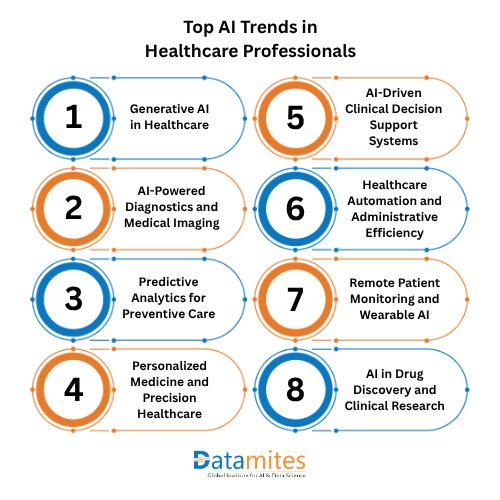
Top AI Trends in Healthcare Professionals Should Watch
Below are the top AI trends in healthcare that are driving innovation, improving patient outcomes, and transforming the way healthcare is delivered.
Generative AI in Healthcare
Generative AI in healthcare is revolutionizing how medical information is created, analyzed, and communicated. Healthcare organizations are using large language models to summarize clinical notes, generate patient education materials, assist medical documentation, and support clinical workflows.
Real-world applications include:
- Automated clinical documentation
- Medical report generation
- Patient communication support
- Healthcare knowledge management
As generative AI continues to mature, it is expected to become an essential productivity tool for healthcare professionals.
AI-Powered Diagnostics and Medical Imaging
AI-powered diagnostics are enhancing disease detection and diagnostic accuracy across specialties such as radiology, pathology, cardiology, and oncology.
Advanced machine learning algorithms can analyze medical images and identify abnormalities that may be difficult for humans to detect quickly. These technologies help clinicians make faster and more informed decisions while improving patient outcomes.
Applications include:
- Cancer screening
- Radiology image analysis
- Retinal disease detection
- Cardiovascular risk assessment
Predictive Analytics for Preventive Care
Predictive analytics in healthcare enables providers to identify potential health risks before symptoms become severe.
By analyzing historical and real-time patient data, predictive models can:
- Detect disease risks early
- Predict hospital readmissions
- Identify high-risk patient populations
- Improve preventive care strategies
This proactive approach supports better healthcare outcomes while reducing treatment costs.
Personalized Medicine and Precision Healthcare
Personalized medicine AI is transforming treatment planning by tailoring interventions to individual patient characteristics.
AI systems can analyze:
- Genetic information
- Lifestyle data
- Medical histories
- Biomarker patterns
This enables healthcare providers to develop highly targeted treatment plans, particularly in oncology, rare diseases, and chronic disease management.
AI-Driven Clinical Decision Support Systems
Clinical decision support systems powered by AI help healthcare professionals make evidence-based decisions by analyzing vast clinical datasets.
Benefits include:
- Improved diagnostic accuracy
- Reduced medical errors
- Evidence-based treatment recommendations
- Faster clinical decision-making
These systems enhance physician expertise rather than replacing human judgment.
Healthcare Automation and Administrative Efficiency
Healthcare automation is addressing one of the industry's biggest challenges administrative burden.
AI-powered systems are streamlining:
- Appointment scheduling
- Claims processing
- Medical coding
- Revenue cycle management
- Patient registration
Reducing repetitive administrative tasks allows healthcare organizations to improve efficiency and lower operational costs.
Remote Patient Monitoring and Wearable AI
The growth of wearable devices and connected health technologies is enabling continuous patient monitoring beyond traditional clinical settings.
AI-powered wearables can track:
- Heart rate
- Blood pressure
- Glucose levels
- Sleep patterns
- Physical activity
These insights support early intervention and improve chronic disease management.
AI in Drug Discovery and Clinical Research
AI is significantly accelerating pharmaceutical research and clinical development.
Researchers are leveraging AI to:
- Identify drug candidates faster
- Analyze clinical trial data
- Predict treatment effectiveness
- Optimize research processes
This has the potential to reduce development timelines and bring life-saving therapies to market more quickly.
Skills Healthcare Professionals Need for an AI-Driven Future
As AI becomes increasingly integrated into healthcare, professionals must develop new skills to effectively work alongside intelligent technologies. Building these competencies will help healthcare workers adapt to evolving roles and deliver better patient care in a technology-driven environment.
AI Literacy
Understanding the fundamentals of AI, machine learning, and healthcare AI applications is becoming essential for healthcare professionals.
Data Interpretation Skills
The ability to understand and interpret healthcare data analytics and AI-generated insights supports better clinical and operational decision-making.
Digital Health Competencies
Familiarity with digital health tools, telemedicine platforms, electronic health records, and AI-powered healthcare systems is increasingly important.
Human-AI Collaboration
Healthcare professionals must learn how to effectively use AI tools while applying human judgment, empathy, and clinical expertise.
Critical Thinking and Ethical Awareness
Evaluating AI recommendations, identifying potential biases, and ensuring ethical use of AI are crucial skills in modern healthcare.
Continuous Learning and Upskilling
As healthcare technology evolves rapidly, ongoing education and professional development are essential to stay current with emerging AI trends and innovations.
Refer to these articles:
- Reinforcement Learning: Basics and Applications
- What is the Difference Between AI Engineer and AI Expert Course?
- What is an AI Agent? Guide to Intelligent Agents in AI
Future Predictions for AI in Healthcare
The future of AI in healthcare points toward highly connected, intelligent healthcare ecosystems where AI works alongside healthcare professionals to deliver superior patient outcomes.
Emerging innovations expected to shape future healthcare technology include:
- Autonomous diagnostic systems
- Advanced multimodal AI platforms
- Digital twins for personalized healthcare
- Real-time predictive healthcare analytics
- AI-assisted robotic surgery
- Intelligent population health management
Rather than replacing healthcare professionals, AI will augment human expertise, enabling clinicians to make more informed decisions while focusing on empathy, communication, and patient relationships.
By 2030, healthcare organizations that successfully integrate AI, automation, and advanced analytics will likely achieve significant improvements in quality, efficiency, and patient satisfaction.
The future of AI in healthcare is being shaped by innovations such as generative AI, AI-powered diagnostics, predictive analytics, personalized medicine, and healthcare automation. As these technologies become more widely adopted, healthcare professionals who develop AI literacy and digital health skills will be better prepared for the evolving healthcare landscape.
Ultimately, the future of healthcare will be driven by collaboration between human expertise and AI, enabling smarter, more efficient, and more personalized patient care.
As AI continues to transform the healthcare industry, professionals must develop the skills needed to leverage these technologies effectively. DataMites offers an industry-focused AI in Healthcare course that helps learners understand the practical applications of artificial intelligence in healthcare, including healthcare data analytics, clinical decision support, patient care optimization, and healthcare operations.
The program combines comprehensive training with hands-on projects, enabling participants to gain real-world experience in applying AI to healthcare challenges. Available through flexible online and classroom learning formats, the course also provides opportunities to earn industry-recognized certifications, including credentials from IABAC. Whether you are a healthcare professional, researcher, administrator, or aspiring AI practitioner, the program can help you stay ahead of emerging AI healthcare trends and prepare for the future of healthcare technology.