AI Product Development Life Cycle Explained
Discover the AI product development life cycle, from data collection and model training to deployment and continuous improvement. Learn how businesses build, test, and scale AI-powered products effectively in today’s data-driven and innovation-focused technology landscape.
 Kriti Maurya
Artificial Intelligence (AI) has transformed modern marketing by enabling organizations to analyze data faster, understand customer behavior more accurately, and deliver personalized experiences at scale. From predictive analytics to automated campaign optimization, AI is reshaping how marketing strategies are designed, executed, and measured.
For business leaders and marketing managers, understanding how AI integrates into the product development life cycle and marketing ecosystem is critical for maintaining a competitive advantage. AI is no longer limited to technical departments; it has become an essential tool that influences strategic decisions across the stages of product management, product innovation, and customer engagement.
This comprehensive guide explores how AI is reshaping marketing and product innovation, the AI product development lifecycle, and how organizations can effectively integrate AI across the new product development life cycle to drive growth and efficiency.
Understanding the Role of AI in Modern Marketing
Artificial Intelligence empowers marketing teams to utilize vast volumes of data to develop more intelligent and efficient campaigns. Advanced AI-driven tools analyze customer behavior, forecast purchasing patterns, and automate repetitive marketing tasks, enabling organizations to operate with greater precision and scalability. Within the product development life cycle, AI helps businesses identify customer needs at an early stage and design solutions that closely align with evolving market expectations.
This data-driven approach enhances decision-making across the stages of product management, from initial ideation and product development to market launch and performance optimization. Many organizations increasingly depend on AI product managers to lead these initiatives, bridging the gap between technological capabilities and business strategy.
As businesses adopt advanced technologies, By integrating AI into marketing operations, companies can streamline the new product development life cycle, accelerate innovation, and deliver more personalized and impactful customer experiences.
Refer to the articles below:
- Who is an AI Product Manager
- A Complete Guide to AI in Marketing
- Popular AI Tools in Healthcare for 2026
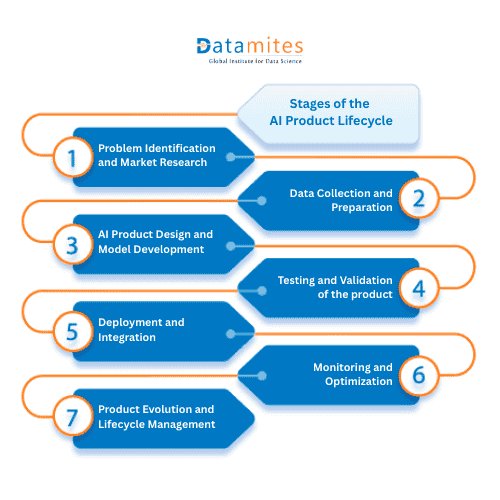
What are the Stages of the AI Product Lifecycle
Understanding the AI product development lifecycle is essential for organizations seeking to integrate AI into their marketing and product strategies. Unlike traditional systems, AI-driven solutions evolve continuously as models learn from new data.
Below are the key stages of product management in the AI-driven environment.
1. Problem Identification and Market Research
The first stage focuses on identifying business problems or customer needs that AI can address. Marketing teams use analytics, customer insights, and market research to uncover opportunities.
At this stage, AI product managers collaborate with marketing leaders to evaluate whether AI can provide advantages such as predictive demand analysis, better targeting, or improved personalization strategies.
2. Data Collection and Preparation
Data is the foundation of AI product development. Organizations collect customer information from multiple channels, including CRM systems, websites, social media platforms, and marketing campaigns. Proper data cleaning and organization are essential to ensure that AI models generate accurate and reliable insights during the new product development life cycle.
3. AI Product Design and Model Development
In the AI product design phase, engineers and data scientists build machine learning models capable of analyzing marketing data and producing insights. AI product managers course ensure that these solutions align with marketing goals and customer expectations while defining performance metrics and key functionalities.
4. Testing and Validation of the product
Testing ensures the reliability of AI models. Organizations evaluate accuracy, predictive capability, and marketing performance outcomes. This stage verifies whether AI-driven tools enhance campaign efficiency, customer engagement, and decision-making across the stages of product management.
5. Deployment and Integration
After validation, AI solutions are integrated into marketing platforms such as CRM systems and automation tools. This stage enables organizations to automate processes like audience segmentation and campaign targeting within the product development life cycle.
6. Monitoring and Optimization
AI systems require continuous monitoring to maintain performance. Marketing teams analyze results, track customer engagement, and refine models to improve outcomes.
7. Product Evolution and Lifecycle Management
Finally, products evolve through the stages of the product life cycle, where AI helps enhance personalization, improve marketing strategies, and identify new growth opportunities.
Through intelligent insights, organizations can adapt their strategies at every stage of the product development life cycle.
How AI leverages the Traditional Product Lifecycle
Artificial Intelligence is significantly enhancing the traditional product development life cycle by introducing continuous learning, predictive insights, and adaptive decision-making capabilities. Unlike conventional development models that progress through fixed stages from ideation to launch, the AI product development lifecycle evolves dynamically as algorithms continuously learn from new and updated data.
AI-powered marketing tools analyze real-time customer interactions and behavioral patterns, enabling organizations to optimize strategies instantly instead of relying solely on historical data trends.
According to a McKinsey report, nearly 73% of organizations have adopted AI in at least one business function, demonstrating its increasing strategic importance.
This transformation reshapes the stages of product management, enabling rapid experimentation, data-driven innovation, and responsible oversight by AI product managers.
AI-Powered Development vs Traditional Product Lifecycle
Comparing AI-powered systems with traditional product development processes highlights the transformative potential of AI technologies.
| Aspects | Traditional Product Development Lifecycle | AI Product Development Lifecycle |
| Decision-Making | Based on predefined requirements and manual analysis. | Driven by real-time data insights and machine learning predictions. |
| Product Updates | Updates are periodic and require significant time and resources. | Continuous learning enables frequent improvements and automated optimization. |
| Data Usage | Relies on limited datasets and traditional analytics. | Uses large-scale data analysis to generate real-time insights. |
| Product Design | Focuses on static features based on initial planning. | AI product design adapts dynamically using behavioral and predictive data. |
| Team Collaboration | Involves product managers, developers, and designers. | Requires cross-functional collaboration including data scientists and AI product managers. |
| Adaptability | Slower response to market changes and customer feedback. | Highly adaptive, improving efficiency across the stages of product management. |
This transformation improves efficiency across the stages of product management, making AI-powered marketing more responsive and scalable than traditional approaches.
Strategic Advantages of Using AI in the Product Lifecycle
Organizations that integrate AI into the product development life cycle gain significant competitive advantages.
The global artificial intelligence (AI) market, value soar from $87 billion in 2022 to $407 billion by 2027, registering a CAGR of approximately 36.2% during the forecast period.(Source: MarketsAndMarkets)
AI-driven marketing enables companies to deliver highly personalized experiences while optimizing operational efficiency.
- Faster Innovation and modification of product: AI significantly accelerates the new product development life cycle by automating research, data analysis, and testing. This allows companies to bring products to market faster.
- Improved Customer Insights: AI can analyze massive datasets to uncover patterns in customer behavior. These insights help businesses design products and marketing campaigns that align with consumer preferences.
- Personalized Marketing: AI-powered marketing platforms enable businesses to deliver highly personalized content, recommendations, and promotions. This enhances customer engagement and increases conversion rates.
- Enhanced Product Design: Through advanced analytics and simulations, AI product design enables teams to test product features before launch. This reduces the risk of failure and improves overall product quality.
- Better Decision-Making: By integrating AI into the product development life cycle, organizations can make more informed decisions based on real-time data rather than assumptions.
Continuous Product Improvement: AI allows products to evolve after launch by learning from user behavior. This dynamic approach ensures that products remain competitive in rapidly changing markets.
For organizations investing in AI product development, the ability to integrate data-driven insights into marketing decisions provides a significant competitive edge in rapidly evolving markets.
Challenges and Risks of Using AI in Product Development
Despite its advantages, implementing AI in the product development life cycle presents several challenges that organizations must address carefully.
- Data Quality and Incorrect Predictions: AI models rely on large volumes of accurate data. Poor data quality can lead to incorrect predictions and ineffective marketing strategies.
- Ethical and Bias Concerns of data: AI systems can unintentionally reinforce biases present in training data. Ensuring fairness and ethical AI usage is a critical responsibility for AI product managers and development teams.
- High Implementation Costs: Developing AI-driven systems often requires significant investment in infrastructure, talent, and technology.
- Regulatory and Privacy Issues: Data privacy regulations are becoming increasingly strict. Companies must ensure compliance with legal frameworks when using customer data for AI-driven marketing.
- Technical Complexity with cross functional team: The integration of AI into the product development life cycle requires collaboration between data scientists, engineers, and product managers. Managing these cross-functional teams can be challenging without strong leadership.
Organizations must also address regulatory challenges related to stages of product management and data privacy and compliance as AI regulations continue to evolve. By implementing robust governance frameworks and leveraging skilled professionals, businesses can effectively integrate AI into the new product development life cycle, enabling AI product managers to drive innovation, enhance data-driven marketing, and sustain competitive advantage.
Refer to the articles below:
- How AI is Transforming Customer Analytics in 2026
- Why Black‑Box Models Are Losing Trust
- CrewAI vs AutoGen vs LangGraph: Top Multi-Agent Frameworks for 2026
DataMites Institute provides a comprehensive AI Product Manager course designed to help professionals integrate artificial intelligence into modern product strategy and decision-making. The program covers AI fundamentals and practical applications, with specialized tracks including AI Product Management, AI for HR & People Analytics, AI for Finance, AI for Marketing, AI for Healthcare, and Generative AI for Business Leaders.
Learners can opt for online, classroom, or case-based internship training. Accredited by IABAC, the Certified AI Professional in Product Management certification is globally recognized, with training centers across India majorly in Hyderabad, Ahmedabad, Chennai, Bangalore, Pune, Mumbai, and Coimbatore.