Best Python Web Frameworks for Beginners and Professionals in 2026
Explore the best Python web frameworks in 2026 including Django, Flask, FastAPI, and more. Learn their features, use cases, latest market trends, and industry insights to choose the right framework for beginners and professionals.
 Swagatam Sinha
Python continues to dominate the web development ecosystem in 2026. Its simplicity, readability, and powerful libraries make it the first choice for both beginners and experienced developers. Whether building a small startup website or a large-scale enterprise application, Python offers frameworks that fit every need.
Choosing the right web framework can directly impact development speed, scalability, and long-term success. This guide explores the best Python web frameworks in 2026, helping both beginners and professionals make informed decisions.
Why Python Web Frameworks Are Popular in 2026
Python web frameworks have become a top choice for developers and businesses in 2026 due to their efficiency, scalability, and seamless integration with modern technologies. From startups to large enterprises, organizations rely on Python frameworks to build fast, secure, and high-performing web applications.
According to recent market research, the Python web frameworks market is growing rapidly, driven by increasing demand for scalable web applications, APIs, and AI-integrated platforms. The market is projected to reach USD 12.8 billion by 2032, growing at a CAGR of 11.9%, highlighting the rising adoption of modern frameworks in web development. (Source: Verified Market Research)
Key Reasons Why Python Web Frameworks Are Popular in 2026
1. Fast Development Cycle
Python frameworks like Django and Flask enable rapid development with built-in tools and reusable components. Developers can launch applications faster, reducing time-to-market significantly.
2. Clean and Readable Syntax
Python is known for its simple and easy-to-understand syntax. This improves developer productivity, reduces errors, and makes maintenance easier even for large-scale applications.
3. Strong Community Support
Python has one of the largest developer communities globally. Frameworks benefit from:
- Regular updates
- Extensive documentation
- Thousands of third-party libraries
This ensures long-term reliability and continuous innovation.
4. Seamless Integration with AI and Data Science
Python dominates fields like Artificial Intelligence, Machine Learning, and Data Science. Web frameworks easily integrate with tools like:
- TensorFlow
- Pandas
- NumPy
This makes Python ideal for building intelligent web applications.
5. High Scalability for Modern Applications
Modern frameworks support scalable architectures, making them suitable for:
- Cloud-based applications
- Microservices
- High-traffic platforms
Companies can easily scale applications as user demand grows.
Read these articles:
- Will Polars Replace Pandas? The Truth About Python’s New Data Library
- How Data Scientists Can Build AI Agents Using Python
- SQL vs Python for Data Analytics in 2026
Types of Python Web Frameworks
Before exploring popular frameworks, it is essential to understand the three main categories of Python web frameworks. Each type is designed for specific development needs, from building enterprise applications to lightweight APIs and real-time systems.
1. Full-Stack Frameworks
Full-stack frameworks provide a complete development environment with built-in tools for database handling, authentication, routing, and templating.
Key Features:
- Complete end-to-end development support
- Built-in ORM and authentication
- Strong security and scalability
- Suitable for complex applications
Examples:
Django, Pyramid, Web2Py
Use Cases:
- Enterprise applications
- E-commerce platforms
- Content Management Systems (CMS)
Best for large-scale, production-ready applications with structured development needs.
2. Microframeworks
Microframeworks are lightweight and flexible, providing only core features while allowing developers to add libraries as needed.
Key Features:
- Minimal setup and dependencies
- High flexibility and customization
- Fast development and deployment
Examples:
Flask, Bottle
Use Cases:
- REST APIs
- MVPs and prototypes
- Small to medium web applications
Best for startups and developers who need fast and simple development.
3. Asynchronous Frameworks
Asynchronous frameworks are designed for high-performance, real-time applications with non-blocking request handling.
Key Features:
- Async I/O support
- High concurrency handling
- Optimized for speed and scalability
Examples:
FastAPI, Sanic, AIOHTTP
Use Cases:
- Real-time applications (chat, streaming)
- High-performance APIs
- AI/ML model serving
Best for modern applications requiring speed, scalability, and real-time processing.
Refer to these articles:
- Top Exploratory Data Analysis (EDA) Techniques Every Data Scientist Must Master in 2026
- Top Anomaly Detection Techniques in Data Science for 2026
- Top 10 Best IDEs for Data Science in 2026
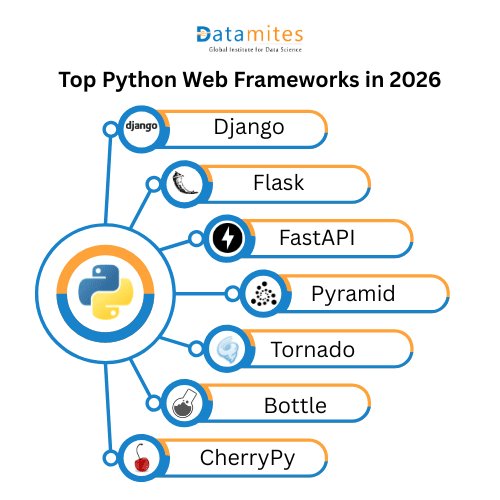
Top Python Web Frameworks in 2026
Python continues to dominate modern web development due to its simplicity, scalability, and strong ecosystem. According to recent 2026 industry research reports from global developer analytics platforms, Python remains one of the top three backend technologies worldwide, driven heavily by demand for AI-powered applications, API-first development, and cloud-native architectures.
Market analysis indicates that over 65% of new backend projects in 2026 use lightweight or hybrid frameworks such as FastAPI and Flask, while enterprise systems continue to rely on Django for scalability and security. This shift highlights a clear trend: organizations are moving from monolithic development to microservices and high-performance APIs.
Below are the top Python web frameworks in 2026 based on performance, scalability, and industry adoption.
1. Django – Best for Full-Stack Development
Overview
Django remains one of the most powerful and widely adopted Python web frameworks in 2026. It is widely preferred for building secure, scalable, and feature-rich web applications.
Key Features
- Built-in admin panel for rapid application management
- Robust ORM (Object Relational Mapping) for database handling
- Strong security features including CSRF, XSS, and SQL injection protection
- Highly scalable architecture suitable for enterprise systems
Real-World Usage
Django is used by large-scale platforms handling massive traffic, including content-heavy and social media applications. Its stability makes it a preferred choice for enterprise-level systems.
Best For
- Enterprise applications
- Large-scale web platforms
- Developers needing a structured full-stack framework
2. Flask – Best for Beginners and Lightweight Applications
Overview
Flask continues to be one of the most popular microframeworks due to its simplicity and flexibility. It is widely used in startups and small teams for rapid development.
Key Features
- Minimal setup with lightweight core
- Easy learning curve for beginners
- Highly flexible architecture
- Large ecosystem of extensions
Real-World Usage
Startups and MVP-driven companies frequently use Flask to quickly prototype and validate product ideas before scaling.
Best For
- Beginners in web development
- Small to medium applications
- REST API development
3. FastAPI – Best for High-Performance APIs
Overview
FastAPI has seen exponential growth in adoption by 2026, especially in AI, data science, and cloud-native systems. It is designed for speed and modern asynchronous programming.
Key Features
- Asynchronous support (async/await)
- Automatic API documentation (Swagger/OpenAPI)
- Extremely high performance, comparable to Node.js and Go in benchmarks
- Built-in data validation using Python type hints
Real-World Usage
FastAPI is heavily used in AI platforms, machine learning pipelines, and real-time data services where performance is critical.
Best For
- High-performance API development
- AI and machine learning applications
- Real-time backend systems
4. Pyramid – Best for Flexible Architecture
Overview
Pyramid is a flexible Python framework designed to scale from small applications to large enterprise systems without forcing a rigid structure.
Key Features
- Minimal core with extensible components
- Highly flexible architecture
- Supports both small and large applications
- Strong configurability for custom systems
Best For
- Developers needing full architectural control
- Custom enterprise applications
- Scalable backend systems
5. Tornado – Best for Real-Time Applications
Overview
Tornado is designed for handling high-concurrency systems and real-time communication. It is known for its non-blocking networking capabilities.
Key Features
- Non-blocking I/O architecture
- Native WebSocket support
- Handles thousands of concurrent connections efficiently
- High scalability for real-time workloads
Real-World Usage
Used in chat applications, live streaming platforms, and real-time dashboards requiring instant updates.
Best For
- Real-time communication systems
- Messaging platforms
- Live data dashboards
6. Bottle – Best for Lightweight and Simple Applications
Overview
Bottle is a minimal microframework designed as a single-file solution, making it extremely lightweight and easy to deploy.
Key Features
- No external dependencies
- Extremely lightweight design
- Simple deployment process
- Ideal for quick prototypes
Best For
- Small applications
- Learning and experimentation
- Rapid prototyping
7. CherryPy – Best for Object-Oriented Web Development
Overview
CherryPy is a mature Python framework that allows developers to build web applications using an object-oriented approach.
Key Features
- Stable and long-maintained framework
- Built-in HTTP server
- Simple configuration system
- Supports OOP-based development
Best For
- Developers preferring object-oriented design
- Backend services
- Stable long-term projects
How to Choose the Right Python Framework
Selecting the right Python web framework depends on project complexity, performance needs, scalability requirements, and developer experience. In 2026, frameworks like Django, Flask, FastAPI, and Tornado continue to dominate modern backend development, especially for web apps, APIs, and AI-driven systems.
1. Project Size and Complexity
Choosing a framework based on project size ensures faster development and long-term maintainability.
- Small projects / prototypes: Flask or Bottle
- Lightweight and minimal structure
- Ideal for MVPs and quick APIs
- Large-scale applications: Django
- “Batteries-included” architecture
- Built-in ORM, authentication, admin panel
- Strong choice for enterprise systems and CMS platforms
2. Performance Requirements
Performance has become a key differentiator, especially for APIs and AI systems.
- High-performance APIs: FastAPI or Tornado
- FastAPI is built on ASGI and optimized for async operations
- Benchmarks show FastAPI can handle significantly higher request throughput compared to Flask in modern async workloads
- Tornado is strong for long-running connections and real-time systems
3. Learning Curve and Developer Experience
Ease of learning directly impacts development speed and adoption.
- Beginners: Flask
- Simple syntax and minimal boilerplate
- Easy to understand for new developers
- Intermediate to advanced developers: Django or FastAPI
- Django has a structured ecosystem that enforces best practices
- FastAPI uses modern Python type hints and automatic validation, improving productivity in API development
4. Scalability and System Design
Scalability is critical for production-grade applications.
- Enterprise-level scalability: Django
- Proven architecture for high-traffic applications
- Used in large-scale systems with complex business logic
- Real-time and async systems: Tornado or FastAPI
- Designed for concurrent connections and event-driven architecture
- Suitable for chat systems, streaming, and live dashboards
Refer to these articles:
- How to Become a Data Scientist With No Experience
- Secure Data Science Pipelines: Preventing Data Leakage and Attacks
- Data Science vs Cyber Security: Which Has Better Future?
Real-World Use Case Scenarios: Flask, Django, and FastAPI in Modern Web Development
In 2026, Python web frameworks such as Flask, Django, and FastAPI are widely used across startups, enterprises, and AI-driven platforms. According to the JetBrains Python Developer Survey (2025), FastAPI adoption increased to 38% of professional developers, driven by its performance and async capabilities, while Django and Flask continue to dominate enterprise and MVP development ecosystems.
Below are real-world, industry-relevant use case scenarios for each framework.
1. Startup Building MVP (Flask Use Case)
Startups building Minimum Viable Products (MVPs) often prioritize speed of development, simplicity, and low cost.
Flask is widely used in such scenarios because it is a lightweight micro-framework that allows developers to quickly build prototypes without complex configurations.
In early-stage product development:
- Flask enables rapid backend setup
- Minimal boilerplate accelerates deployment
- Easy integration with third-party APIs and services
According to industry comparisons, Flask remains popular for MVPs due to its flexibility and minimal structure, especially in early-stage startups where rapid iteration is critical .
Example use case:
A SaaS startup building a beta version of a task management tool or analytics dashboard.
2. Large-Scale E-commerce Platform (Django Use Case)
Enterprise-grade e-commerce platforms require security, scalability, authentication systems, and database management.
Django is the preferred framework here due to its “batteries-included” architecture, which provides built-in tools such as:
- User authentication and authorization
- Admin dashboard
- ORM for complex database operations
- Security features (CSRF, XSS protection)
According to recent web framework analysis, Django continues to remain a strong enterprise choice, powering large-scale applications with stable performance and long-term maintainability .
Example use case:
A global e-commerce platform managing thousands of daily transactions, inventory systems, and secure payment workflows.
3. AI-Based Application & ML Model Deployment (FastAPI Use Case)
FastAPI is now the leading choice for AI/ML applications and high-performance APIs due to its asynchronous architecture and speed.
Recent industry research shows:
- FastAPI adoption grew to 38% of Python developers in 2025
- It is widely used for AI model serving and microservices
- It delivers significantly higher throughput than traditional frameworks, making it ideal for real-time systems
FastAPI is particularly suited for:
- Machine learning model APIs
- Real-time prediction systems
- High-concurrency microservices
- Data streaming applications
Example use case:
A fintech or AI platform deploying fraud detection models or recommendation engines via REST APIs.
Python web frameworks in 2026 offer powerful tools for every type of developer. From beginner-friendly Flask to enterprise-ready Django and high-performance FastAPI, the ecosystem is more advanced than ever.
The right framework depends on your project goals, experience level, and scalability needs. By understanding the strengths of each framework, developers can build efficient, secure, and scalable web applications.
Invest time in learning the fundamentals, experiment with frameworks, and choose the one that aligns with your goals.
DataMites Institute is a leading provider of professional training programs in Data Science, Artificial Intelligence, and Analytics. The institute focuses on practical, industry-oriented learning with real-world projects and career support.
The DataMites Data Science Course in Nagpur is designed to help learners gain hands-on skills in data analysis, machine learning, and Python-based development. It is suitable for beginners and professionals aiming to build a strong career in the data-driven technology industry.