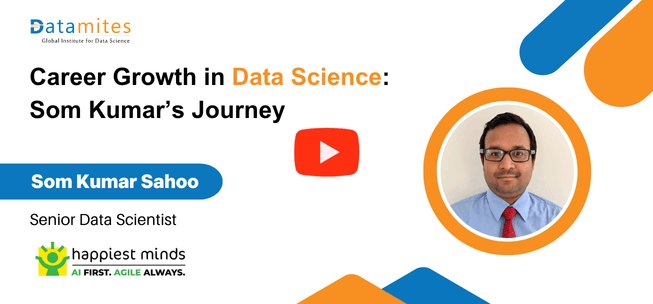
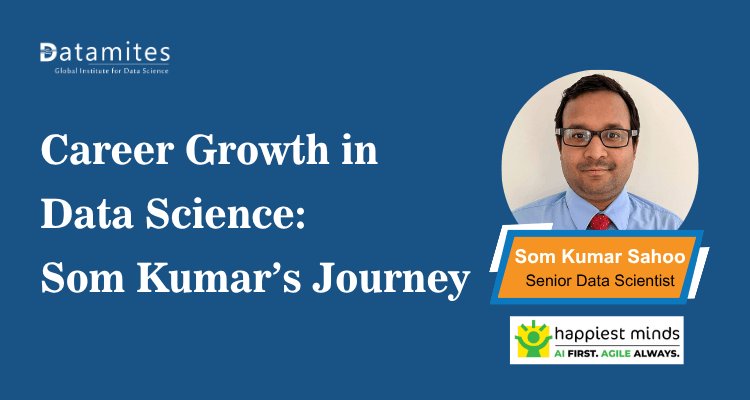
Career Growth in Data Science: Som Kumar’s Journey
Som Kumar’s journey showcases a successful transition from a non-IT background to a Senior Data Scientist through strong fundamentals, consistent learning, and real-world problem-solving, highlighting the growing opportunities in data science careers.
 Prerana B A
Som Kumar’s journey into data science didn’t begin with a technical or AI background, but with a clear decision to transition his career and build the right skill set. Coming from an instrumentation and electronics engineering background, he faced common challenges such as learning programming, statistics, and analytical thinking from the ground up. The early phase demanded consistency, patience, and proper guidance to stay focused and make steady progress.
What truly set Som Kumar apart was his commitment to structured learning and hands-on experience. As part of this DataMites success story, his journey highlights the impact of the right mentorship, practical projects, and continuous upskilling. Through dedicated training and real-world exposure, he gradually transformed into a confident data science professional. His story reflects a realistic path with no shortcuts, just persistence, problem-solving, and continuous learning which ultimately helped him grow into a Senior Data Scientist.
From Instrumentation Engineer to Data Scientist: Som Kumar’s Inspiring Career Transition
Discover how Som Kumar successfully transitioned into data science from instrumentation and electronics engineering background through structured learning, hands-on projects, and real-world problem-solving.
Q1. Can you introduce yourself to our audience?
My name is Som Kumar. I come from an instrumentation and electronics engineering background and have around 9–10 years of professional experience. I transitioned into data science a few years ago without any prior background in AI or computer science.
Q2. What motivated you to switch your career into data science?
My previous role involved a lot of travel and increasing pressure. I wanted a more stable and intellectually engaging career, which led me to explore AI and machine learning.
Q3. When did your data science journey begin?
I am currently working as a Senior Data Scientist at Happiest Minds Technologies, Bangalore. My journey into this field began around 2021 when I decided to transition into AI and started learning from scratch.
Q4. How did you start learning data science?
I joined a training program where I learned Python, AI fundamentals, and data science basics. Gradually, I built my understanding step by step.
Q5. How difficult was the initial phase?
It was quite challenging since everything was new to me. But with consistent practice and learning, things started becoming clearer.
Q6. How important were interviews in your journey?
Interviews were extremely important. Some went well, some didn’t, but each one helped me identify gaps and improve.
Q7. What is your current role?
I work as a Senior Data Scientist at Happiest Minds Technologies, Bangalore, handling multiple projects across different domains.
Q8. What does your daily work involve?
My day includes understanding business problems, analyzing data, performing feature engineering, building and optimizing models, and deploying them. It’s an end-to-end process.
Q9. Is data science only about coding?
No, coding is just a part of it. The main goal is to solve business problems using data.
Q10. What are the biggest challenges you face?
Handling limited data, dealing with data drift, scaling models, and managing bias in data are some of the key challenges.
Q11. What types of data do you work with?
I work with structured data, time series data, healthcare data, sensor data, and sometimes audio or video data.
Q12. Do you work with Generative AI?
I have some exposure to it, but my main work is in core data science areas like statistics, healthcare, and computer vision.
Q13. What was your mindset during interview preparation?
Initially, my focus was to crack interviews. Later I realized that practical understanding and problem-solving are equally important as theory.
Q14. What skills are essential to crack data science interviews?
Strong fundamentals in data structures, programming, EDA, feature engineering, and problem-solving are essential.
Q15. How important is understanding the problem before solving it?
It is very important. Without understanding the problem clearly, you cannot build an effective solution.
Q16. Should one specialize or stay versatile?
It depends on your goals. You can specialize in one domain or stay flexible. I chose to be versatile.
Q17. What do you look for when taking interviews?
I look for problem-solving ability, clarity of concepts, coding skills, and the ability to build complete solutions.
Q18. How important is Python and OOP?
Very important. Writing scalable and structured code requires good knowledge of Python and object-oriented programming.
Q19. Will AI replace coding?
AI may reduce manual coding, but understanding algorithms and logic will always be necessary.
Q20. What matters more than coding?
Understanding data, selecting the right approach, and designing the solution matter more.
Q21. How important is data quality?
It is critical. Without quality data, no model can perform well.
Q22. What mistakes do beginners usually make?
They focus too much on tools and ignore data understanding, preprocessing, and feature engineering.
Som Kumar’s Journey into Data Science: Key Insights
Som Kumar’s journey highlights how a professional from an instrumentation and electronics background successfully transitioned into data science through persistence, continuous learning, and real-world problem-solving. His experience emphasizes the importance of strong fundamentals, adaptability, and understanding data beyond just coding.
- Transitioning into data science from an instrumentation and electronics background is achievable with consistent effort and the right learning approach.
- A strong foundation in Python, statistics, and problem-solving is essential for building a successful data science career.
- Data science is not just about coding, it involves understanding business problems and delivering end-to-end solutions.
- Feature engineering and data preprocessing play a more critical role than just model building.
- Real-world experience, including hands-on projects and interview practice, is crucial for growth.
- Facing interview rejections is part of the journey and helps in identifying skill gaps.
- A data scientist must be comfortable working with different types of data such as structured, time series, healthcare, and sensor data.
- Data quality and proper data validation are the foundation of any successful model.
- Understanding algorithms and logic is more important than just writing code, especially with the rise of AI tools.
- Exploratory Data Analysis (EDA) is a key step in understanding and solving problems effectively.
- Being flexible vs. specialized depends on career goals; both approaches can work if executed well.
- Writing optimized and scalable code is important for real-world production systems.
- Handling challenges like data drift, bias, and limited data is a core part of a data scientist’s role.
- Over-reliance on no-code or AI tools without understanding concepts can lead to incorrect results.
- Continuous learning and staying updated with evolving technologies like AI and Generative AI is necessary for long-term success.
Som Kumar’s journey proves that transitioning into data science is not limited by your background. With dedication, strong fundamentals, and a focus on real-world problem-solving, anyone can build a successful career in this field.
If you’re starting out in data science or planning a career switch, Som Kumar’s journey clearly highlights what truly makes the difference: strong fundamentals, consistent practice, and real-world problem-solving. The global data science platform market was valued at USD 96.25 billion in 2023 and is projected to grow at a 26% CAGR through 2030, according to Grand View Research. This rapid growth shows that data is expanding across industries, and organizations are actively hiring skilled professionals making data science one of the top IT courses in Bangalore and across India today.
Som Kumar’s career transformation was driven by structured learning and a focused approach. Coming from an instrumentation and electronics engineering background, he started with the basics and gradually built a strong foundation in Python, statistics, and machine learning. Through hands-on practice, real-world problem-solving, and continuous upskilling, he developed the expertise required to work on diverse data types and complex business challenges. His journey highlights the importance of choosing the best data science institute in Bangalore that focuses on practical training and industry readiness.
DataMites provides a wide range of career-focused programs including Certified Data Scientist, Data Analyst, AI Engineer, Machine Learning, Deep Learning, and NLP courses. These programs are backed by globally recognized certifications from IABAC and NASSCOM FutureSkills. With flexible learning options available across major cities such as Hyderabad, Bangalore, Pune, Mumbai, Chennai, Delhi, Chandigarh, Coimbatore, and Ahmedabad, DataMites offers a practical and structured pathway for both freshers and career switchers to build successful careers in data science.