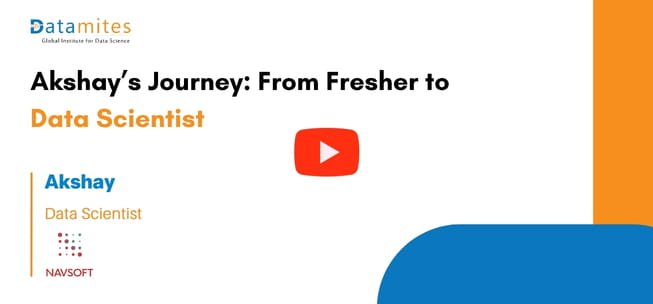
From Fresher to Data Scientist: Akshay's Inspiring Journey
Follow Akshay’s inspiring journey from a fresher to a data scientist, highlighting how dedication, continuous learning, and hands-on experience helped him build skills, overcome challenges, and achieve career success.
 Prerana B A
Akshay's journey into data science didn’t start with a technical background but with a clear decision to shift careers and build relevant skills. Coming from a mechanical engineering background, he faced the common challenges of learning programming, statistics, and analytical thinking from scratch. The initial phase required consistency, patience, and the right mentorship to stay on track.
What truly set Akshay apart was his dedication to structured learning and practical exposure. Through focused training at DataMites, hands-on projects, and continuous practice, he gradually evolved into a confident data science professional. This DataMites success story reflects a familiar pattern of no shortcuts, just steady progress, learning through real-world application, and persistence that ultimately led him to secure a data scientist role at Navsoft.
Mechanical Engineer to Data Scientist: Akshay's Inspiring Interview Journey
Discover how akshay successfully transitioned into data science from a non-IT background through structured learning, hands-on projects, and real-world problem solving with DataMites.
Q1. Can you introduce yourself to our readers?
Hi, I’m Akshay. I come from a mechanical engineering background and currently work as a Data Scientist at Navsoft. My journey into data science has been both challenging and rewarding.
Q2. What inspired you to transition into data science?
I wanted to move into a field with strong growth opportunities. Data science stood out because of its demand, innovation, and real-world impact.
Q3. How did you begin your journey in data science?
I joined DataMites to build my foundation in Python, statistics, and machine learning. It gave me a structured path to follow.
Q4. Did you face challenges coming from a non-IT background?
Yes, initially it was difficult to understand technical concepts. But with consistent practice and guidance, I gradually became comfortable.
Q5. How was your learning experience during the course?
The experience was very practical. The trainers focused on real-world applications, which helped me understand concepts deeply.
Q6. Did you opt for online or offline training?
I started with online classes but later switched to offline sessions in Pune for better interaction and clarity.
Q7. How much time did you dedicate daily to learning?
I studied for around 6–7 hours every day, focusing on both theory and hands-on practice.
Q8. What was your study strategy?
I made daily notes, revised concepts regularly, and practiced problems consistently. Writing short summaries helped me retain concepts better.
Q9. Can you tell us about the projects you worked on?
I worked on 4–5 projects in domains like fintech, healthcare, and insurance. These projects involved predictive modeling and real-world datasets.
Q10. Did these projects help during interviews?
Yes, absolutely. Interviewers asked detailed questions about my projects, especially about the problem statement and how I approached solutions.
Q11. How important were mock interviews in your preparation?
Mock interviews were very important. I attended three, and they helped me identify my weak areas and improve step by step.
Q12. How did your performance improve in mock interviews?
In my first mock interview, I didn’t perform well. But after analyzing mistakes and improving, I cleared the third mock confidently.
Q13. How many real interviews did you attend before getting selected?
I attended more than five interviews before finally getting selected at Navsoft.
Q14. Can you describe the interview process at Navsoft?
There were three rounds:
- Telephonic screening
- Technical interview
- HR/Managerial round
Q15. What kind of questions were asked in the technical round?
The questions were mainly about:
- Python basics and libraries
- Data preprocessing
- Statistics and machine learning
- Some advanced topics like NLP and deep learning
Q16. Were there coding questions in the interview?
No, most questions were theoretical and focused on understanding concepts and problem-solving approaches.
Q17. Were you asked about your projects?
Yes, they asked in detail about my projects, especially how I solved problems and implemented solutions.
Q18. How did you prepare your resume?
The placement team at DataMites helped me create a professional resume that highlighted my skills and projects.
Q19. What key skills are required to become a data scientist?
You need:
- Strong Python knowledge
- Good understanding of statistics
- Machine learning fundamentals
- Data analysis skills
- Ability to apply concepts in real-world scenarios
Q20. What advice would you give to aspiring data scientists?
Stay consistent, focus on practical learning, work on real projects, and don’t get discouraged by failures. Keep improving with every attempt.
Refer to these articles
- How to Become a Data Scientist With No Experience
- How Data Scientists Can Build AI Agents Using Python
- Top 10 Best IDEs for Data Science in 2026
Akshay’s Journey into Data Science: Key Insights with DataMites
Akshay's journey highlights how consistent effort, hands-on project experience, and guided training helped him build a strong foundation in data science. Coming from a non-IT background, his story emphasizes the importance of continuous learning, practical application, and persistence in successfully transitioning into a data science career.
- Career Transition is Possible: Moving from a non-IT background (Mechanical Engineering) to a data science role is achievable with the right approach.
- Structured Learning Matters: Training from DataMites helped build a strong foundation in Python, statistics, and machine learning.
- Consistency is the Key: Studying 6–7 hours daily played a major role in mastering concepts and gaining confidence.
- Practical Learning is Crucial: Hands-on projects in domains like fintech, healthcare, and insurance significantly improved real-world understanding.
- Projects Drive Interview Success: Being able to explain project problems and solutions clearly helped in cracking interviews.
- Mock Interviews are Game-Changers: Attending multiple mock interviews helped identify weaknesses and improve performance step by step.
- Improvement Through Feedback: Analyzing mistakes after each mock interview led to steady progress and eventual success.
- Persistence Pays Off: Success didn’t come immediately. Akshay attended 5+ interviews before getting selected at Navsoft.
- Strong Fundamentals are Essential: Focus on Python, statistics, machine learning, and data analysis to build a solid foundation.
- Conceptual Clarity Over Coding: Interviews focused more on understanding concepts and problem-solving approaches rather than coding implementation.
- Project Knowledge is Critical: Interviewers heavily emphasized project discussions, including approach and real-world application.
- Resume Building Support Helps: Guidance from placement teams improves the quality and impact of resumes.
- Confidence Builds Over Time: Continuous practice and interview exposure help reduce fear and improve communication.
- Right Learning Mode Matters: Switching from online to offline learning improves engagement and understanding.
- Soft Skills Also Matter: Communication, clarity, and confidence played an important role during interviews.
- Never Skip Opportunities: Taking chances (like attending interviews despite challenges) can lead to breakthroughs.
Refer to these articles
- Siddharth's Journey From Beginner to Data Science Professional
- Junaid’s Path from MLOps Engineer to Senior Data Scientist
- Sathish’s Inspiring Journey to Becoming a Data Scientist
Akshay's journey proves that you don’t need a technical background or years of experience to start a career in data science. What truly matters is discipline, consistent practice, the right mentorship, and a strong focus on building real, job-ready skills.
If you’re starting out in data science or planning a career switch, Akshay's journey clearly shows what truly makes the difference: strong fundamentals, consistent practice, and real-world experience. The global data science platform market was valued at USD 96.25 billion in 2023 and is projected to grow at a 26% CAGR through 2030, according to Grand View Research. What this means is simple: data is rapidly expanding across industries, and organizations are actively seeking skilled professionals. That’s why data science continues to be a top IT course in demand today.
Akshay’s career growth was shaped by structured training at DataMites. Despite coming from a non-IT background, he started with the fundamentals and built a strong foundation in Python, statistics, and machine learning. Through hands-on projects in domains like fintech, healthcare, and insurance, along with expert mentorship, mock interviews, and placement support, he successfully developed industry-ready skills and transitioned into a data science role. This journey also highlights the value of choosing the right program, such as a data science course in Pune, for practical and career-focused learning.
DataMites offers comprehensive programs such as Certified Data Scientist, Data Analyst, AI Engineer, Machine Learning, Deep Learning, and NLP courses, along with globally recognized certifications from IABAC and NASSCOM FutureSkills. With flexible learning options across cities like Hyderabad, Bangalore, Pune, Mumbai, Chennai, Delhi, Chandigarh, Coimbatore, and Ahmedabad, it provides a clear and practical pathway for freshers and career switchers to build successful careers in data science.