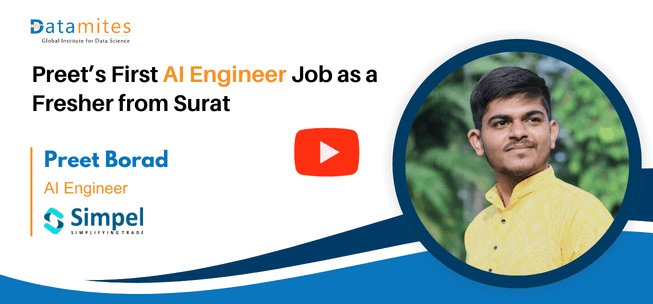
How Did Preet from Surat Land His First AI Engineer Job as a Fresher?
Preet from Surat secured his first AI Engineer role as a fresher by combining targeted learning, hands-on projects, and strategic networking. His journey highlights practical steps for aspiring AI professionals to break into the field without prior experience.
 Priyanka BR
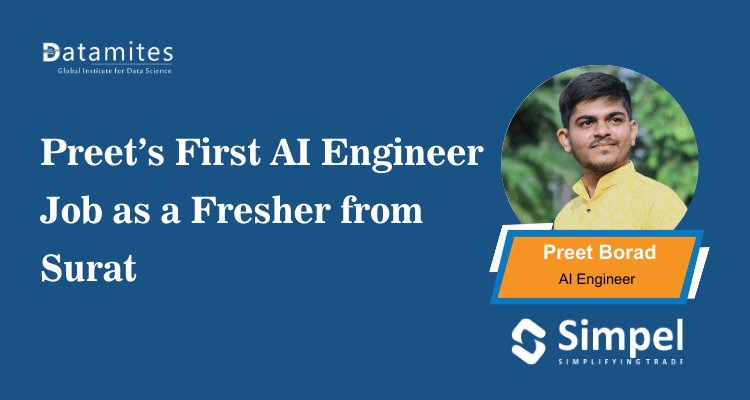
Have you ever wondered how a fresher can land their first AI Engineer role, even coming straight out of college? Meet Preet, who transformed his curiosity about Artificial Intelligence into a successful career by following the right steps, practicing consistently, and leveraging expert mentorship.
His journey wasn’t without challenges. From building a strong foundation in Python to understanding machine learning, NLP, and computer vision, Preet steadily mastered real-world AI projects. The game-changer? A structured, hands-on learning experience at DataMites, which helped him turn theoretical knowledge into practical, job-ready skills.
For anyone aiming to become an AI Engineer as a fresher, Preet’s story is a perfect example of how dedication, applied learning, and the right guidance can open doors in the competitive AI industry.
How Preet Built His Artificial Intelligence Career with DataMites
Preet’s journey from completing his graduation to becoming an AI Engineer, detailing his training, project experience, and strategic preparation for interviews in the Artificial Intelligence career.
1. Can you introduce yourself and share your academic background?
My name is Preet. I completed my Bachelor of Computer Applications from Veer Narmad South Gujarat University in 2024. I am from Surat, Gujarat, and I have always been deeply interested in the IT field and emerging technologies.
2. When did you start your Data Science course?
I joined the Certified Data Scientist course in July 2024. After completing my graduation, I initially planned to pursue a master’s degree, but when that did not work out, I decided to focus on Data Science and Artificial Intelligence. That decision proved to be the right one, as the skills and project experience I gained during the course eventually helped me secure a position as an AI Engineer at Simpel Techlabs.
3. Why did you choose Data Science and AI as your career path?
I was curious about future technologies and researched upcoming IT trends. I found that AI and related technologies would dominate the industry in the coming years, which motivated me to choose this path. To stay disciplined and focused, I joined the offline course at DataMites in the Ahmedabad center, which helped me maintain consistency in my learning.
4. Did you have programming experience before joining?
Yes. Since I completed BCA, I have had exposure to programming languages used in web and application development. This made it easier for me to learn Python, which is essential for Data Science and AI.
5. How did you practice Python beyond classroom learning?
I practiced regularly on platforms like HackerRank and LeetCode. I focused on solving basic problems first, then gradually moved to intermediate and advanced levels. Logic building and critical thinking are very important in this field.
6. How many hours did you study daily?
I followed a strict schedule. I studied around five to eight hours daily. I divided my time between theory and practical work. Mornings were dedicated to theoretical concepts, while afternoons focused on Python, SQL, and dataset practice.
7. What topics did you cover during your learning phase?
I learned Python, Statistics, Machine Learning, Deep Learning, SQL, Big Data, and Data Visualization. These topics built a strong foundation for my career.
8. How many projects did you complete?
I completed around 35 to 40 projects. During my internship phase, we worked in a group of five and completed multiple capstone projects along with a client project. Additionally, I practiced on Kaggle with complex datasets.
9. What types of projects did you include in your resume?
I mentioned four major projects:
- A classification project
- A regression project
- An NLP project
- A computer vision project
This variety helped demonstrate my practical exposure to different domains of AI and Machine Learning.
10. What was your mock interview experience like?
In my first mock interview, I scored 5.5 because I was nervous and made small mistakes. After a week of preparation, I attended another mock interview and improved my score to 5.9. Mock interviews helped me gain confidence.
11. What questions were asked in your actual interview?
Most questions were based on my resume and projects. The interviewer asked me to explain my projects end-to-end, including the business problem, dataset size, feature selection, challenges faced, and model performance. They also asked basic questions about Python, SQL, Machine Learning, Docker, and GitHub.
12. How many interview rounds were there?
There were two rounds: a technical round and an HR round. The technical round lasted about 25 to 30 minutes.
13. How did you prepare for interviews?
For four months, I followed a daily routine. I spent three hours on theory and two to three hours on practical implementation. I revised machine learning models, practiced SQL queries, and strengthened my Python fundamentals.
14. Did you apply for jobs on your own?
Yes, I applied to more than 150 companies through LinkedIn, Naukri, and Indeed. However, due to the current market situation and the demand for experience, I did not receive many responses. Eventually, I secured my job opportunity through structured placement support.
15. What additional skills should aspiring AI Engineers focus on?
Beyond Python and SQL, focus on:
- Machine Learning algorithms
- Deep Learning and Neural Networks
- NLP and Computer Vision
- Mathematics for AI
- Tools like GitHub and Docker
A strong foundation in these areas helps you stand out.
16. How important is resume building?
Resume building is extremely important. Keep it simple and professional. Mention only the skills you truly know because interviewers ask questions directly from your resume. Highlight diverse projects and relevant tools.
Refer to these articles:
- Will AI Agents Replace Your Next Coworker? Exploring the Future of Work
- How AI is Transforming Customer Analytics in 2026
- The Future of Coding: Can AI Replace Software Engineers?
Preet’s Journey into Artificial Intelligence: Key Insights with DataMites
Preet’s journey shows how structured training at DataMites, consistent practice, and strong project experience helped him build the skills required to become an AI Engineer. By mastering Python, working on diverse AI projects, and preparing strategically for interviews, he successfully launched his career in Artificial Intelligence.
- A delayed master’s plan turned into a decisive career pivot. That single shift toward Artificial Intelligence became the defining move in Preet’s professional path.
- His growth did not come from rushing through topics, but from building depth. Strengthening Python logic, understanding algorithms properly, and revisiting fundamentals created long-term confidence.
- The variety in his project portfolio quietly became his biggest advantage. Moving across machine learning, NLP, and computer vision gave him flexibility that reflected clearly during interviews.
- Improvement happened in layers. His first mock interview exposed hesitation, but instead of discouragement, it became feedback that sharpened his preparation.
- The real differentiator was implementation clarity. Explaining business problems, dataset decisions, feature handling, and model outcomes mattered more than reciting definitions.
- The competitive job market tested his patience. Applying to over 150 companies without responses could have slowed him down, but it strengthened his persistence instead.
- Mentor direction acted as a performance accelerator. Targeted guidance on what to improve next prevented scattered learning and kept his preparation aligned with industry needs.
- By the time he secured the AI Engineer role at Simpel Techlabs in Bangalore, it was not a sudden success. It was the outcome of disciplined execution, refined skills, and steady progress over months.
- Preet’s journey, when viewed closely, is less about a single placement and more about how structured effort gradually converts learning into career momentum in Artificial Intelligence.
Refer to these articles:
- From B.Tech Graduate to AI/ML Engineer: Shyama’s Inspiring Success Journey
- Aradhya’s Journey from B.Tech Computer Science Fresher to AI/ML Engineer
- How Prathmesh Cracked His First AI Engineer Job as a Fresher from Nagpur
Preet’s journey from a BCA graduate to an AI Engineer shows that with structured learning, consistent practice, and hands-on projects, freshers can succeed in Artificial Intelligence. Mastering Python, exploring ML, NLP, and computer vision, and focused interview preparation were key to his success. His story highlights how persistence, mentorship, and practical experience can turn curiosity into a rewarding AI career.
For aspiring AI professionals aiming to follow a path like Preet’s, DataMites Ahmedabad offers an ideal launchpad. With a well-structured curriculum, practical hands-on projects, and guidance from industry experts, learners acquire the essential skills and real-world experience needed to become job-ready AI Engineers. Whether you are a beginner or looking to enhance your existing knowledge, this program provides the mentorship and training required to confidently navigate and excel in the competitive field of Artificial Intelligence.
DataMites Training Institute offers a 9-month Artificial Intelligence course in Ahmedabad, designed to make learners industry-ready. The program covers Python, machine learning, neural networks, and frameworks like TensorFlow and Keras, with hands-on experience in big data, cloud computing, and ethical AI. Accredited by IABAC and NASSCOM FutureSkills, it combines online and offline learning with real-world projects, internships, and career support, equipping students with the skills and confidence to excel in the AI-driven job market.
For students and professionals in Surat, who may find it challenging to attend offline sessions, DataMites provides the online Artificial Intelligence course in Surat, offering the same structured learning, practical projects, and career support as the offline program. This ensures everyone, regardless of location, can access quality AI education and training.