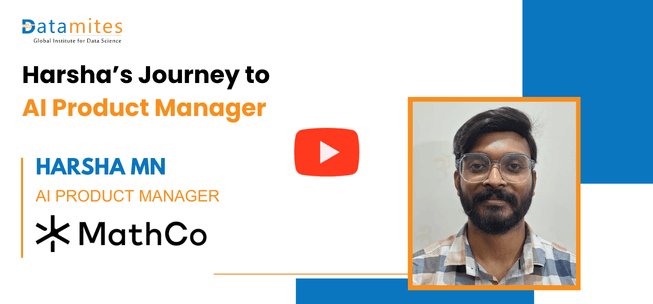
How Harsha Transitioned into an AI Product Manager Role? An Inspiring Success Story
Harsha has been driving innovation in the pharma industry by building impactful GenAI products. His journey highlights practical insights, advanced AI techniques, and strategies that tackle real-world challenges.
 Priyanka BR
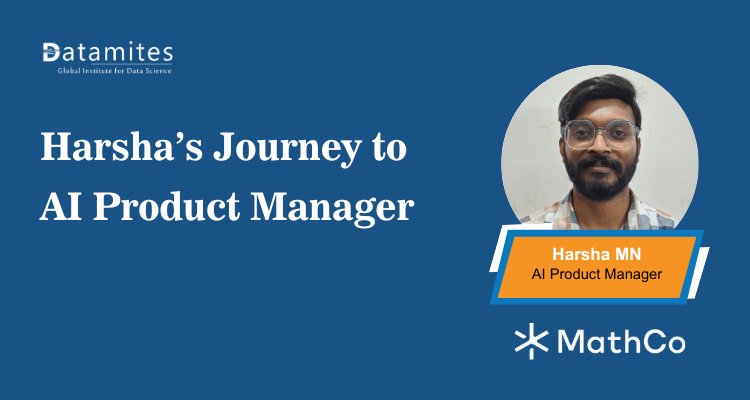
Have you ever wondered how to grow in AI or successfully adapt as Artificial Intelligence rapidly reshapes industries? Meet Harsha, an AI professional based in Bangalore, whose journey shows how strong fundamentals, hands-on experience, and continuous learning can help navigate change and unlock new opportunities.
Harsha began his career working on AI projects in retail and manufacturing, gaining practical exposure to forecasting and computer vision. His turning point came in 2019 at DataMites, where a structured, offline AI course certification helped him build a solid foundation in AI, machine learning, and real-world applications. Earning an AI certificate and a certificate in machine learning boosted his skills and prepared him to take on more advanced challenges as the industry shifted toward Generative AI.
Today, Harsha contributes to building secure and scalable Generative AI solutions for the pharmaceutical industry, focusing on sales enablement and internal applications in a highly regulated environment. His journey proves that anyone wondering how to become an AI professional can succeed with the right training, practical exposure, and commitment to continuous learning, turning AI courses and certifications into a future-ready career.
How Harsha Built a Career in Generative AI with DataMites
Harsha’s journey reflects how strong data science fundamentals and hands-on learning can evolve into impactful Generative Artificial Intelligence roles. In the following Q&A, he shares real-world insights from his career transition, project experience, and working with GenAI in the pharma industry.
1. Can you tell us about your background and experience in the pharmaceutical industry?
I have been working in the pharmaceutical sector for almost two years now, focusing on generative AI projects. Before that, I worked in retail and manufacturing, applying data science techniques like forecasting and computer vision.
2. When did you join DataMites, and what was your learning experience there?
I joined DataMites in 2019 and attended offline classes in Bangalore. The course gave me a strong foundation in data science and AI, which helped me transition into working with pharma clients. Now, with my experience at The MathCo, I manage generative AI projects and AI product development effectively.
3. How has the industry changed with the rise of generative AI?
The Artificial Intelligence industry has shifted focus from traditional data science and machine learning to large language models (LLMs) and generative AI, enabling faster insights, automated processes, and more efficient decision-making.
4. How is generative AI being applied in pharmaceutical research?
Generative AI helps researchers develop medicines faster by analyzing vast datasets, reducing failure rates, and accelerating drug discovery, which traditionally takes 10 years and billions of dollars for FDA approval.
5. What are the primary areas where generative AI is used in pharma?
AI can assist researchers in developing new drugs or help sales representatives optimize pre-call planning, post-call reporting, and decision-making processes.
6. How do pharma companies ensure data security when using generative AI?
Pharma companies often host AI models internally, training them with their own data. This ensures sensitive medical data remains secure while complying with strict ethical and compliance standards.
7. How can generative AI help sales representatives in pharma?
AI can build chatbots or agents that fetch information quickly, generate dashboards, provide sales insights, analyze regional performance, and even summarize documentation for FDA submission.
8. Can you explain the concept of text-to-SQL agents in pharma?
A text-to-SQL agent converts natural language queries into SQL commands, allowing sales reps and management to access complex databases and insights instantly without navigating dashboards manually.
9. What are the challenges of using LLMs in pharma?
LLMs can hallucinate or generate incorrect responses if not properly instructed. They are also costly to test and run, so balancing performance with cost is crucial.
10. How fast can these AI-powered systems provide information to sales reps?
Latency is critical. Systems are designed to provide responses within 10 seconds because sales reps have only 2–5 minutes between calls to prepare and gather relevant information.
11. Can generative AI assist in competitive analysis?
Yes. Sales reps can receive insights comparing their products against competitors, helping them make strategic decisions and improve engagement with AI healthcare professionals (HCPs).
12. Is a pharmaceutical degree required to work in this space?
No, a pharma degree is not mandatory. However, domain knowledge can help you understand client requirements better and provide effective solutions.
13. How do AI systems handle compliance and policy checks?
Orchestrator layers route queries through multiple agents and compliance modules to block inappropriate or non-compliant questions, ensuring all outputs align with company policies.
14. What advice do you have for professionals transitioning into pharma AI roles?
Focus on gaining domain knowledge gradually. Data science and Artificial Intelligence skills are transferable across industries, and you can become proficient in pharma without a formal pharmaceutical background.
Refer to these articles:
- Generative AI and Predictive AI: Key Differences Explained
- Will AI Agents Replace Your Next Coworker? Exploring the Future of Work
- LLMs vs. SLMs: Key Differences and How to Choose the Right Model
Harsha’s Key Takeaways for Aspiring AI Professionals
Harsha shares practical insights from his journey, highlighting the importance of strong fundamentals, hands-on experience, and continuous learning in AI. His takeaways offer clear guidance for aspiring professionals looking to build and grow a successful Artificial Intelligence career.
- Early Career Across Multiple Domains: Harsha built his foundation by working in retail and manufacturing domains before transitioning into the pharmaceutical industry.
- DataMites as a Career Turning Point: He completed his data science training at DataMites around 2019 through offline classroom sessions in Bangalore, before the COVID period.
- Initial Work in Traditional Data Science: After his training, Harsha worked on forecasting and computer vision projects, applying core machine learning techniques in real-world use cases.
- Transition into the Pharma Industry: Around 1.5–2 years ago, he moved into the pharmaceutical domain, marking a significant shift in his career path.
- Shift from ML to Generative AI: His role evolved alongside industry trends, moving from classical machine learning to building Generative AI solutions.
- Current Role Focused on Pharma Sales Enablement: Harsha now primarily works on Artificial Intelligence applications that support pharma sales representatives and internal business teams.
- Hands-On Experience with GenAI Systems: His daily work involves designing multi-agent systems, orchestrator layers, and AI-driven chatbots for enterprise use.
- Exposure to Pharma Research Without Direct Involvement: While not directly part of clinical research, he collaborates with research teams and understands the broader pharma ecosystem.
- Strong Emphasis on Compliance and Security: His journey highlights the importance of building AI solutions with strict data security, compliance, and governance in regulated industries.
- Learning Domain Knowledge on the Job: Harsha emphasizes that deep pharma expertise was gained through hands-on work rather than formal pharma education.
- Demonstration of Cross-Domain Mobility: His career shows how strong AI fundamentals enable professionals to switch domains successfully.
- Practical Perspective on AI Costs and Scalability: Through real project experience, he has developed a clear understanding of cost, latency, and scalability challenges in production GenAI systems.
Refer to these articles:
- How to Switch from Graphic Designer to AI Developer - Sriram’s AI Career Success Story
- How Abhishek Landed a Career as an AI/ML Engineer ?
- From Software Developer to AI Expert: Ashish Nayak’s Journey to Success
Harsha’s journey shows how a strong foundation in data science, combined with adaptability and continuous learning, can lead to success in today’s AI-driven world. By consistently upgrading his skills and gaining hands-on experience, he transitioned from traditional data science roles into building real-world Generative AI solutions in a highly regulated pharma environment. His story highlights how persistence and practical exposure can help professionals stay relevant as technology evolves.
If you’re inspired by Harsha’s journey and looking to build or advance your career in AI, choosing the right learning path is crucial. DataMites, a leading Artificial Intelligence Institute in Bangalore, offers structured and industry-focused programs designed for learners from diverse professional backgrounds. With hands-on projects, expert mentorship, and real-world use cases, learners gain practical skills in Python, machine learning, data analytics, and Generative AI to meet current industry demands.
DataMites Training Institute offers a comprehensive 9-month Artificial Intelligence course designed to develop industry-ready skills. The curriculum covers Python programming, machine learning algorithms, neural networks, and frameworks such as TensorFlow and Keras, along with practical exposure to big data, cloud computing, and ethical AI practices. Accredited by IABAC and NASSCOM FutureSkills, the program blends flexible online and offline learning with hands-on projects, internships, and dedicated career support to prepare learners for today’s AI-driven job market.
If you’re from outside Bangalore and looking to kickstart your AI career, DataMites has 30+ offline training centers across India. DataMites offer Artificial Intelligence training in Chennai, Coimbatore, Ahmedabad, Delhi, Mumbai, Hyderabad, and Pune, providing hands-on experience, expert guidance, and industry-aligned programs to help you gain practical, job-ready AI skills close to home.