Top AI Product Manager Tools to Improve Product Decisions
Explore top AI product manager tools that enhance product decisions through data-driven insights, predictive analytics, and user behavior analysis. Discover how these tools improve roadmapping, prioritization, and innovation for smarter, faster product success.
 Kriti Maurya
Product managers are expected to make faster, smarter, and more impactful decisions. With growing competition, evolving customer expectations, and massive volumes of data, traditional decision-making approaches are no longer sufficient. This is where AI product manager tools are transforming the landscape of product management.
Artificial intelligence is empowering product leaders with predictive insights, automation capabilities, and real-time analytics. By leveraging advanced AI tools, product teams can streamline workflows, enhance customer understanding, and build data-backed product strategies. From product research tools to advanced visualization tools, AI is redefining how decisions are made across the product lifecycle.
Here will explore how AI product management tools are improving product decisions, why they are essential, and the future trends shaping this domain.
Why AI Tools Are Essential for Product Decisions
The increasing complexity of product ecosystems has made decision-making more challenging than ever. Product managers must analyze user behavior, market trends, competitor insights, and performance metrics simultaneously. AI product manager tools address this challenge by providing intelligent, data-driven solutions.
One of the primary reasons AI is essential lies in its ability to process large datasets efficiently. Unlike traditional product research tools, AI-powered systems can analyze structured and unstructured data in real time. This enables product managers to identify patterns, predict user needs, and make proactive decisions.
Additionally, AI enhances accuracy and reduces human bias. When using product strategy tools integrated with AI, organizations can rely on predictive analytics instead of intuition alone. This leads to more reliable product roadmaps and improved business outcomes.
Another critical factor is speed. AI-driven product manager tools automate repetitive tasks such as data collection, reporting, and customer segmentation. This allows product teams to focus more on innovation and strategy rather than manual processes.
Furthermore, AI plays a crucial role in improving customer-centricity. With advanced product marketing AI tools, companies can analyze user sentiment, personalize experiences, and optimize product features based on real-time feedback. This ensures that decisions align closely with user expectations.
In a competitive market, organizations that leverage AI product management tools gain a significant advantage by making faster, smarter, and more informed product decisions.
Refer to the articles below:
- Top Use Cases for AI in Finance
- Leveraging AI for HR and People Analytics: Tools and Techniques
- Key Challenges in Implementing AI in Marketing
Top AI Product Managers Tools for Strategic Planning
Strategic planning is at the core of successful product management. Modern AI product manager tools offer powerful capabilities that help product leaders design, test, and execute effective strategies.
1. Analytics and Visualization Tools
AI-powered visualization tools play a vital role in interpreting complex data. These tools convert raw data into actionable insights through dashboards, charts, and predictive and prescriptive models. Product managers can track KPIs, monitor product performance, and identify growth opportunities with ease.
Such product manager tools enable real-time decision-making by providing clear insights into user behavior and product usage trends. This improves the overall efficiency of strategic planning.
2. Product Research Tools for market trends
Understanding the market and user needs is essential for building successful products. AI-driven product research tools help gather insights from customer reviews, surveys, and competitor analysis.
These AI tools use natural language processing (NLP) to analyze user feedback and identify key pain points. This enables product teams to prioritize features that deliver maximum value to customers.
3. Product Design Tools for user experience
Design plays a crucial role in user experience. AI-powered product design tools assist in creating intuitive and user-friendly interfaces. They offer features such as automated design suggestions, usability testing, and personalization.
By integrating AI into design workflows, roles and responsibilties of ai product manager can ensure that their products meet user expectations while reducing design iteration time.
4. Product Strategy Tools for planning
AI-based product strategy tools help in roadmap planning, feature prioritization, and risk assessment. These tools analyze historical data and predict future outcomes, enabling product managers to make informed strategic decisions.
Such AI product management tools are particularly useful for aligning product goals with business objectives and market demands.
5. Product Marketing AI Tools for campaign management
Marketing is a critical component of product success. AI-powered product marketing AI tools assist in campaign optimization, customer segmentation, and performance tracking.
These tools enable product managers to deliver targeted marketing strategies, improve conversion rates, and enhance customer engagement. Popular AI tools for product management include Productboard, Mixpanel, Amplitude, and Tableau. These tools help product managers analyze data, prioritize features, track user behavior, and make informed, data-driven decisions.
Overall, the integration of AI into product manager tools ensures a more structured and data-driven approach to strategic planning.
How AI leverages Product Management Strategy
Artificial intelligence is fundamentally reshaping the way product management functions. The adoption of AI product manager tools for product development lifecycle is not just an enhancement but a transformation of traditional practices.
One of the most significant changes is the shift from reactive to proactive decision-making. With predictive analytics, AI product management tools enable product managers to anticipate market trends and user needs before they arise. This proactive approach helps in staying ahead of the competition.
- Proactive Decision-Making: AI tools for data analytics use predictive analytics to anticipate market trends and customer needs.
- Enhanced Collaboration: AI product management tools enable seamless cross-team coordination with real-time insights.
- Automation of Tasks: Routine activities like data analysis and reporting are automated, saving time.
- Faster Experimentation: AI allows rapid testing and analysis, accelerating innovation and time-to-market.
- Improved Personalization: AI leverages product research and marketing tools to deliver tailored user experiences.
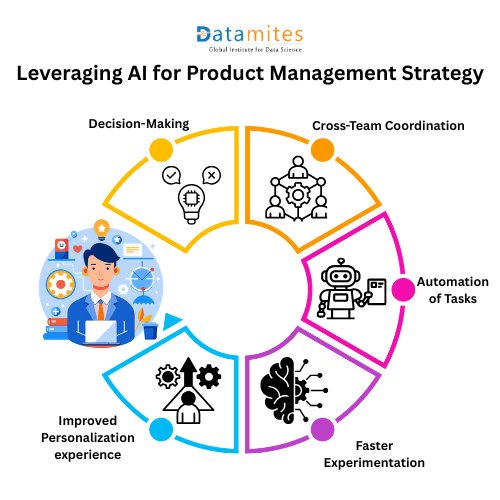
AI drives automation by handling tasks like data analysis, reporting, and customer segmentation, allowing product managers to focus on strategy. It also enhances experimentation through rapid testing and real-time insights, accelerating innovation. Additionally, AI improves personalization using product research tools and product marketing AI tools, enabling tailored user experiences that boost customer satisfaction and retention.
Future Trends of AI in Product Management
The future of product management is increasingly driven by advancements in artificial intelligence, with AI product manager tools becoming essential for smarter and faster decision-making. One key trend is the rise of AI copilots, which assist product managers with real-time insights, workflow automation, and data-backed recommendations throughout the product lifecycle. Moreover,
The global AI market is rapidly expanding, projected to grow from USD 294 billion in 2025 to USD 2.48 trillion by 2034. Businesses and governments invest in AI for smarter decisions. (Source: Fortune Business Insights)
Hyper-personalization is transforming user engagement as advanced AI tools analyze behavior to deliver tailored experiences, boosting satisfaction and retention. Predictive and prescriptive analytics in product strategy tools enable teams to forecast outcomes and take effective actions.
Seamless integration of AI product manager tools unifies data and collaboration, while ethical AI ensures responsible usage. From product research tools to product marketing AI tools, AI is making product management more data-driven, helping organizations innovate faster, improve decisions, and stay competitive.
Refer to the articles below:
- Top Feature Selection Techniques for Data Analysts in 2026
- Seaborn vs Matplotlib: Which Visualization Library Should You Choose in 2026
- Top AI Tools for Data Analysts in 2026
DataMites Institute offers a comprehensive AI Product Manager course designed to help product managers leverage artificial intelligence for smarter, data-driven decision-making. The curriculum covers AI fundamentals, product analytics, and practical applications such as user behavior analysis, feature prioritization, market research, and product performance forecasting. It is part of a broader portfolio that also includes AI programs for HR, Marketing, Healthcare, and Business Leaders.
Learners can choose flexible training options, including online and classroom sessions, along with hands-on, project-based internships to gain real-world product management experience. With globally recognized IABAC certifications, DataMites has a strong presence across 30+ centers in major Indian cities such as Hyderabad, Pune, Chennai, Ahmedabad, Bangalore, Mumbai, Coimbatore, Delhi, Nagpur, and Kochi, delivering industry-focused, career-oriented training for aspiring and experienced product managers.