Why Agentic AI Is the Most In-Demand Skill for Data Scientists in 2026
Discover why Agentic AI is becoming the most in-demand skill for data scientists in 2026. Learn AI agents, tools, frameworks, and real-world applications.
 Swagatam Sinha
Artificial Intelligence has moved far beyond traditional machine learning models that simply analyze data and generate predictions. The latest wave of innovation is Agentic AI, a new generation of intelligent systems capable of making decisions, executing tasks, and interacting with digital environments autonomously.
In simple terms, Agentic AI refers to AI systems that behave like goal-oriented agents rather than passive tools. Instead of waiting for instructions, these systems can plan workflows, retrieve information, interact with software tools, and complete complex tasks with minimal human supervision.
This shift is rapidly transforming industries and creating new demands in the technology workforce. According to Gartner, AI agents are expected to be embedded in 40% of enterprise applications by 2026, compared to less than 5% in 2025. Such rapid adoption highlights how autonomous AI systems are becoming a fundamental component of modern digital infrastructure.
For data scientists, this technological shift represents both a challenge and an opportunity. Traditional skills in data analysis and machine learning remain important, but organizations now expect professionals to build AI systems capable of reasoning, automation, and decision-making.
As a result, Agentic AI has quickly become one of the most valuable skills in the modern data science landscape.
What Is Agentic AI?
Agentic AI refers to artificial intelligence systems that operate as autonomous agents capable of planning, reasoning, and executing tasks to achieve specific goals. Unlike traditional AI models that simply generate predictions or insights, Agentic AI systems can take actions and adapt based on feedback.
In simple terms, Agentic AI combines machine learning, large language models (LLMs), and automation to create AI agents that can perform multi-step workflows independently.
Key Characteristics of Agentic AI
Agentic AI systems typically have several defining capabilities:
- Autonomy: They can perform tasks without constant human intervention.
- Goal-oriented behavior: AI agents work toward achieving specific objectives.
- Planning and reasoning: Agents break complex tasks into smaller steps.
- Learning from feedback: They improve decisions over time.
- Tool integration: They interact with APIs, databases, and external tools.
For example, an Agentic AI system used in data science could:
- Collect and clean datasets automatically
- Perform exploratory data analysis
- Train machine learning models
- Evaluate model performance
- Generate reports and insights
All of this can happen within a single intelligent system.
According to research from MarketsandMarkets, the global AI market is projected to exceed $1 trillion by 2030, with autonomous AI systems and AI agents representing a significant portion of this growth. More specifically, the AI agents market is expected to grow from around $7–8 billion in 2025 to more than $47 billion by 2030, reflecting a compound annual growth rate of approximately 45%.
Refer to these articles:
- How AI is Transforming Customer Analytics in 2026
- Explainable AI: Why Black-Box Models Are Losing Trust
- Will AI Agents Replace Your Next Coworker?
Why Agentic AI Is Trending in 2026
Agentic AI has gained enormous traction due to several technological advancements. Businesses are investing heavily in intelligent automation to increase efficiency, reduce operational costs, and accelerate innovation.
Here are the major factors driving the rise of Agentic AI in 2026.
1. Advancement of Large Language Models
Modern large language models have dramatically improved reasoning and contextual understanding. These capabilities allow AI systems to plan and execute tasks more effectively, making them suitable for autonomous workflows.
2. Demand for Intelligent Automation
Organizations are moving beyond basic automation toward intelligent automation, where AI systems can make decisions rather than just follow predefined rules.
Agentic AI enables businesses to automate complex processes such as:
- customer support
- market analysis
- financial forecasting
- supply chain optimization
3. Growth of AI Agent Frameworks
Several frameworks have made it easier to build AI agents that can interact with tools and perform multi-step tasks. This ecosystem growth has accelerated adoption across industries.
4. Increased Data Complexity
Modern organizations generate massive volumes of data. Traditional analytics methods cannot keep up with the scale and complexity. Agentic AI systems help manage these challenges by automating data processing and analysis.
According to Precedence Research market research, the global Agentic AI market is projected to grow from approximately $6.5 billion in 2026 to more than $134 billion by 2035, expanding at a compound annual growth rate (CAGR) of around 40%.
Why Data Scientists Must Learn Agentic AI
The role of data scientists is rapidly evolving as businesses adopt advanced artificial intelligence technologies. Traditionally, data scientists focused on building predictive models that analyze historical data and generate insights. However, the rise of Agentic AI—autonomous systems capable of planning, reasoning, and executing tasks—has fundamentally changed industry expectations.
Today, organizations want professionals who can design intelligent AI systems that automate workflows, integrate with business tools, and make data-driven decisions independently. Modern data scientists are increasingly expected to build AI-powered automation systems, integrate machine learning models into enterprise applications, develop large language model (LLM)–based tools, and manage AI systems that interact with APIs, databases, and digital platforms.
Recent market research highlights the growing importance of these skills. According to Deloitte’s Technology Predictions report, about 25% of enterprises using generative AI are expected to deploy AI agents by 2025, rising to nearly 50% by 2027 as businesses move toward automation-driven workflows.
Similarly, industry statistics show the AI agents market is projected to grow from about $5.4 billion in 2024 to over $50 billion by 2030, reflecting rapid enterprise adoption.
As organizations increasingly rely on autonomous AI systems, data scientists who understand Agentic AI will gain a significant competitive advantage, positioning themselves for the next generation of AI-driven innovation.
Read to these articles:
- CrewAI vs. AutoGen vs. LangGraph: Which multi-agent framework should you learn in 2026?
- How Knowledge-Augmented Generation (KAG) Is Solving AI Hallucinations
- AI Sovereignty: The New Mandate for Data Governance in the Cloud Era
How Agentic AI Is Transforming Data Science Workflows
Agentic AI is fundamentally changing how data science projects are executed. Instead of relying on manual processes, intelligent agents can manage many aspects of the workflow.
Automated Data Preparation
Data cleaning and preparation typically consume a large portion of a data scientist’s time. AI agents can automate:
- data cleaning
- missing value handling
- feature engineering
- dataset transformation
Intelligent Model Development
Agentic AI systems can automatically experiment with multiple models and optimize performance through automated machine learning techniques.
Continuous Monitoring
AI agents can monitor models in production and automatically retrain them when performance declines.
Automated Insight Generation
Modern AI systems can generate detailed analytical reports, dashboards, and business recommendations.
These capabilities allow data scientists to focus more on strategic thinking and innovation rather than repetitive tasks.
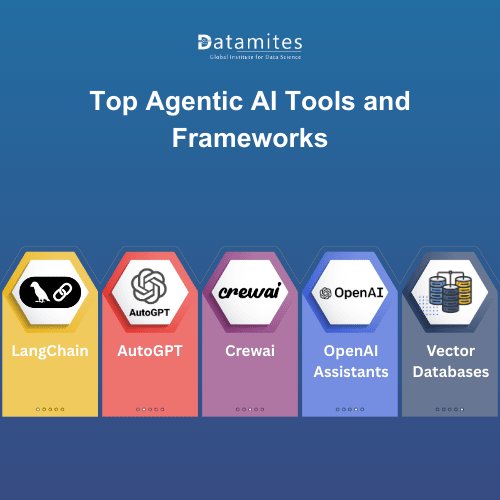
Top Agentic AI Tools and Frameworks Data Scientists Should Learn
To build effective AI agents, data scientists need to understand several key tools and frameworks.
LangChain
LangChain is widely used for building applications powered by large language models. It helps developers create AI agents that interact with data sources and external tools.
AutoGPT
AutoGPT is an autonomous AI agent capable of performing tasks independently based on user goals.
CrewAI
CrewAI allows multiple AI agents to collaborate and perform complex tasks collectively.
OpenAI Assistants
These tools enable developers to create AI systems that interact with APIs, documents, and databases.
Vector Databases
Vector databases such as Pinecone and Weaviate help AI agents retrieve relevant contextual information for decision-making.
Learning these technologies can significantly improve a data scientist’s ability to build autonomous AI systems.
Practical Agentic AI Skills Data Scientists Should Learn
To stay competitive in the evolving AI landscape, data scientists should develop several practical skills.
Key Agentic AI skills include:
- Prompt engineering for AI agents
- LLM application development
- AI workflow automation
- Retrieval-augmented generation (RAG)
- AI agent orchestration
- API integration for AI tools
- Model evaluation and monitoring
- Python programming for AI development
- cloud deployment for AI systems
Mastering these skills will allow professionals to design intelligent AI agents capable of solving real-world problems.
Read to these articles:
- LLMs vs. SLMs: Key Differences and How to Choose the Right Model
- Traditional RAG vs Agentic RAG — What’s the Difference?
- Green AI Guide: Quantization and FinOps to Reduce LLM Costs
Real-World Examples of Agentic AI in Action
Agentic AI is already transforming multiple industries. Several real-world examples highlight how these systems are being used today.
1. Autonomous Customer Support Systems
Many global companies are now using AI agents to automate customer service operations. These systems can understand customer queries, retrieve relevant information from databases, and provide solutions without human intervention.
For example, Shopify introduced an AI assistant called “Sidekick” that helps merchants analyze store performance, generate reports, and answer business questions automatically. The AI agent can retrieve data from the store’s backend and recommend actions such as optimizing product pricing or improving marketing campaigns.
Similarly, companies using Zendesk AI report that intelligent agents can resolve a large percentage of customer support requests automatically, reducing response time and operational costs.
Impact:
- Faster customer response times
- Reduced workload for support teams
- Improved customer satisfaction
2. AI Agents in Software Development
AI coding assistants are evolving into autonomous development agents capable of performing multiple programming tasks.
For instance, GitHub Copilot helps developers write code, suggest functions, and detect bugs. More advanced agent-based systems can even:
- generate code
- test applications
- debug errors
- document software automatically
According to GitHub’s developer survey, developers using AI coding assistants reported up to 55% faster coding productivity.
These AI systems function as developer copilots, helping engineers focus on problem solving rather than repetitive coding tasks.
3. Autonomous Data Analysis Tools
Modern AI analytics tools are becoming increasingly agentic. These systems can automatically analyze datasets and generate insights.
A well-known example is Microsoft Copilot for Power BI. This AI assistant allows users to ask natural language questions such as:
“Which region had the highest sales growth this quarter?”
The system can automatically:
- analyze the data
- generate visualizations
- provide explanations of trends
This significantly reduces the time required for business intelligence analysis.
Impact on data science:
Data scientists can automate repetitive reporting tasks and focus more on strategic analytics.
4. AI Agents in Cybersecurity
Cybersecurity is one of the most important areas where Agentic AI is being deployed.
For example, Darktrace, a cybersecurity company, uses AI agents to detect anomalies in network activity. The system continuously monitors data flows across networks and automatically identifies suspicious patterns that may indicate cyber attacks.
When a threat is detected, the AI agent can automatically respond by:
- isolating compromised devices
- blocking malicious traffic
- alerting security teams
According to Darktrace reports, their AI systems can identify and neutralize threats within seconds, which is much faster than traditional manual analysis.
5. AI Agents in Healthcare Diagnostics
Healthcare is another industry rapidly adopting autonomous AI systems.
For example, Google DeepMind’s medical AI models assist doctors in analyzing medical images such as retinal scans and cancer screening images.
These AI systems can:
- detect early signs of diseases
- recommend treatment options
- assist doctors in diagnosis
In clinical trials, some AI diagnostic tools have achieved accuracy levels comparable to medical specialists, improving early detection of diseases.
6. AI Agents for Financial Market Analysis
Financial institutions increasingly use AI agents to monitor markets and generate investment insights.
Companies such as Bloomberg and BlackRock use advanced AI systems to analyze financial data, news trends, and economic indicators in real time.
These AI agents can:
- track global market changes
- analyze thousands of financial reports
- identify investment opportunities
By automating financial analysis, organizations can make faster and more informed investment decisions.
7. Autonomous Research Assistants
Researchers and analysts are using AI agents to automate the process of gathering and summarizing information.
Tools like Perplexity AI and advanced research agents can scan thousands of documents, academic papers, and reports to generate summaries and insights.
For example, a researcher studying climate change could ask the AI agent to analyze hundreds of studies and produce a structured research summary within minutes.
This dramatically accelerates knowledge discovery.
Expert Insight: The Future of Autonomous AI Systems
Industry experts believe that the future of artificial intelligence lies in autonomous, goal-driven systems capable of performing complex tasks independently.
Research from leading consulting firms suggests that intelligent automation will become a central component of digital transformation strategies. Organizations that successfully integrate AI agents into their operations will likely achieve greater efficiency, innovation, and scalability.
For data scientists, this means the role will evolve beyond traditional analytics toward designing intelligent systems that actively participate in decision-making processes.
The field of data science is undergoing a major transformation, and Agentic AI is at the center of this change. As businesses increasingly adopt autonomous AI systems, the demand for professionals who can design, deploy, and manage AI agents will continue to grow.
For aspiring and experienced data scientists alike, learning Agentic AI is no longer optional—it is becoming a critical skill for staying relevant in the rapidly evolving AI landscape.
By developing expertise in AI agents, automation frameworks, and LLM-powered systems, data scientists can position themselves at the forefront of the next generation of artificial intelligence innovation.
DataMites Institute is a globally recognized training provider offering industry-focused programs in data science, machine learning, and artificial intelligence. The artificial intelligence course in Bangalore by DataMites is designed with hands-on projects, internships, and expert-led training to help learners gain real-world AI skills. The program is accredited by IABAC and aligned with industry standards, helping students and professionals build practical expertise and advance their careers in the growing AI ecosystem.