How Data Scientists Can Build AI Agents Using Python
Learn how data scientists can build AI agents using Python with tools, frameworks, and real-world examples. Discover trends, statistics, and step-by-step guidance.
 Swagatam Sinha
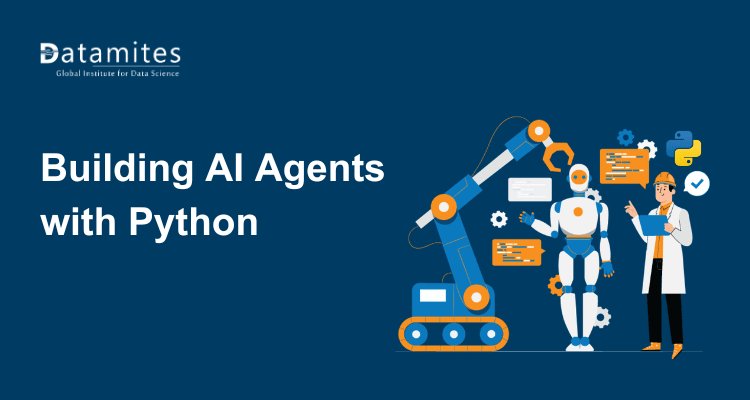
Artificial Intelligence is rapidly evolving from simple predictive models to autonomous systems capable of making decisions and performing tasks independently. These intelligent systems are known as AI agents, and they are becoming a major trend in the AI and data science ecosystem.
In recent years, organizations have started adopting AI agents to automate workflows, analyze data, and improve decision-making processes. According to a market research report by Grand View Research, the global AI agents market was valued at $7.63 billion in 2025 and is expected to reach $182.97 billion by 2033, growing at a CAGR of 49.6%.
This explosive growth shows why data scientists must learn how to build AI agents. Among various programming languages, Python stands out as the most powerful and accessible option for developing these intelligent systems.
In this guide, we will explore how data scientists can build AI agents using Python, the tools required, real-world applications, and future trends shaping the field.
What Are AI Agents?
An AI agent is a software system that can perceive its environment, make decisions, and take actions automatically to achieve a specific goal.
Unlike traditional machine learning models that simply make predictions, AI agents can:
- Perform complex tasks autonomously
- Interact with other software or APIs
- Learn from feedback and improve performance
- Execute multi-step workflows
Simple Example
An AI agent for a data analyst could:
- Collect data from APIs
- Clean and preprocess the dataset
- Train a machine learning model
- Generate insights and reports automatically
This type of automation is what makes AI agents extremely powerful for data-driven organizations.
Read these articles:
- How to Become a Data Scientist With No Experience
- Secure Data Science Pipelines: Preventing Data Leakage and Attacks
- Data Science vs Cyber Security: Which Has Better Future?
Why Data Scientists Should Learn AI Agent Development
The demand for agentic AI systems is increasing rapidly across industries. Companies want AI systems that can analyze information and take actions without constant human input.
According to a report from Precedence Research, the autonomous agents market is expected to grow from $4.35 billion in 2025 to $103.28 billion by 2034, showing massive adoption across industries.
Another emerging trend is the rise of AI-powered enterprise automation. Reports suggest that AI agents may handle up to 40% of enterprise tasks by 2026, highlighting their growing role in business operations.
Benefits for Data Scientists
Learning AI agent development offers several advantages:
- High-demand skill in AI job markets
- Ability to build automated data pipelines
- Opportunity to create AI-driven applications
- Improved productivity through automation
- Better career opportunities in AI engineering and agentic AI
For data scientists looking to stay relevant in the evolving AI landscape, learning how to build AI agents is becoming a critical skill.
Why Python Is the Best Language for Building AI Agents
Python is widely recognized as the leading programming language in data science and artificial intelligence.
According to industry surveys, Python appears in nearly 79.8% of data science job listings, making it the most demanded language in the field.
Key Reasons Python Dominates AI Development
- Simple and readable syntax
- Large ecosystem of AI libraries
- Strong community support
- Integration with machine learning frameworks
- Excellent support for APIs and automation
Python’s ecosystem allows data scientists to quickly prototype and deploy intelligent systems without dealing with complex infrastructure.
Key Technologies Required to Build AI Agents Using Python
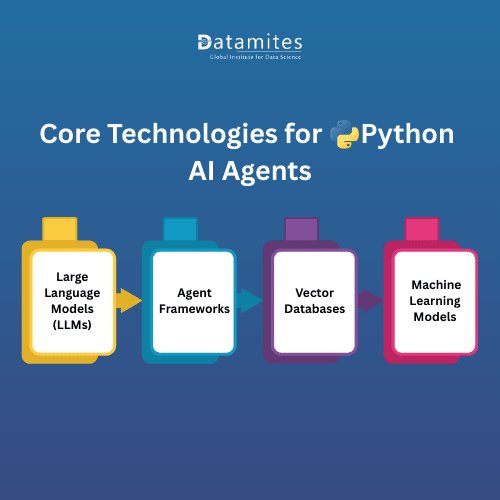
Building AI agents with Python requires a strong understanding of multiple technologies that work together to create intelligent, autonomous systems. From natural language processing to memory systems, each component plays a critical role in how an AI agent thinks, learns, and performs tasks.
In this section, we explore the core technologies required to build AI agents using Python, explained in a simple and practical way
1. Large Language Models (LLMs)
LLMs such as GPT models allow AI agents to understand natural language and generate responses.
These models enable agents to:
- Interpret human instructions
- Analyze text-based data
- Generate insights automatically
2. Agent Frameworks
Agent frameworks help developers build systems that can perform multi-step reasoning.
Popular frameworks include:
- LangChain
- AutoGPT
- CrewAI
- Microsoft AutoGen
These frameworks allow AI agents to plan tasks and interact with external tools.
3. Vector Databases
AI agents often need long-term memory.
Vector databases such as:
- Pinecone
- Weaviate
- FAISS
help store embeddings and retrieve relevant information quickly.
4. Machine Learning Models
Traditional machine learning algorithms are still important for:
- Predictive analytics
- Forecasting
- anomaly detection
Python libraries like Scikit-learn, TensorFlow, and PyTorch make this possible.
Refer to these articles:
- Data Analyst vs Data Scientist vs Data Engineer: Choose the Right Data Career
- Role of Data Science in Smart Cities and Internet of Things (IoT)
- Why Bias, Fairness, and Transparency Are the New Metrics in Data Science
Step-by-Step Guide to Building an AI Agent with Python
Building an AI agent with Python may seem complex, but with the right approach, it becomes a structured and manageable process. This step-by-step guide explains how data scientists and developers can create intelligent AI agents that automate tasks and make data-driven decisions.
Step 1: Define the Agent’s Goal
Start by defining the task your AI agent should perform.
Examples include:
- Customer support automation
- Data analysis assistant
- Research assistant
- Marketing analytics agent
Clear goals help structure the agent’s decision-making process.
Step 2: Choose the Right Tools
Select appropriate tools for development.
Example stack:
- Python
- OpenAI API
- LangChain
- Pandas
- Vector database
This combination allows the agent to process data and make intelligent decisions.
Step 3: Implement the Agent Logic
The agent must follow a structured process.
Typical workflow:
- Receive user input
- Interpret instructions using LLM
- Access data sources
- Perform reasoning
- Execute actions
Example pseudo code:
task = get_user_query()
data = search_database(task)
result = analyze_data(data)
generate_response(result)
This workflow allows the AI agent to complete tasks autonomously.
Step 4: Integrate External Tools
Advanced AI agents interact with external systems.
Examples:
- APIs
- databases
- analytics tools
- cloud services
This makes agents capable of performing real-world tasks.
Step 5: Deploy the AI Agent
Once development is complete, the agent can be deployed using:
- cloud platforms
- web applications
- internal enterprise tools
Deployment enables organizations to scale AI-powered automation.
Best Python Libraries for AI Agent Development
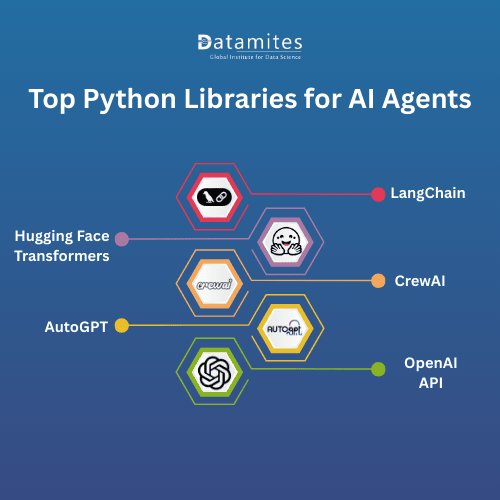
In this section, we explore the top Python libraries for AI agents, along with their key features and use cases.
1. LangChain
LangChain is one of the most widely used frameworks for developing AI-powered applications and agents.
Key Features:
- Seamless LLM integration
- Advanced memory management
- Easy tool and API integration
- Supports multi-step reasoning workflows
LangChain is ideal for building AI agents that require context awareness and complex decision-making.
2. Hugging Face Transformers
Hugging Face Transformers provides a vast collection of pre-trained models for natural language processing (NLP).
Key Features:
- State-of-the-art NLP models
- Supports text generation and summarization
- Enables text classification and sentiment analysis
- Easy integration with Python
It’s perfect for developers who want to build AI agents using pre-trained models without training from scratch.
3. CrewAI
CrewAI is designed for creating multi-agent systems, where multiple AI agents collaborate to complete tasks.
Key Features:
- Multi-agent collaboration
- Task delegation between agents
- Workflow automation
- Role-based agent design
CrewAI is useful for complex applications where different agents handle different responsibilities.
4. AutoGPT
AutoGPT enables autonomous AI systems that can perform tasks independently.
Key Features:
- Breaks complex goals into smaller tasks
- Executes workflows automatically
- Minimal human intervention required
- Goal-oriented task execution
It is ideal for building fully autonomous AI agents.
5. OpenAI API
The OpenAI API provides access to advanced language models that power intelligent AI agents.
Key Features:
- Natural language understanding
- Advanced reasoning capabilities
- Text generation and summarization
- Easy API-based integration
This is one of the most powerful tools for building conversational and decision-making AI agents
Refer to these articles:
- How LLMs Are Transforming Data Science Careers in 2026
- Data Mesh vs Data Fabric in 2026: Choosing the Right Data Architecture
- Databricks vs Snowflake: Which Is Better for Data Science
Real-World Applications of AI Agents
AI agents are already being used across industries to automate tasks and improve efficiency.
1. Data Analytics
AI agents can automatically:
- collect datasets
- analyze trends
- generate insights
This significantly reduces manual work for analysts.
2. Customer Support
Companies use AI agents to handle customer queries through:
- chatbots
- virtual assistants
- automated help systems
3. Marketing Automation
AI agents can:
- analyze user behavior
- optimize campaigns
- generate marketing insights
4. Financial Forecasting
Financial institutions use AI agents to:
- predict market trends
- detect fraud
- manage portfolios
5. Healthcare Analytics
AI agents assist doctors by:
- analyzing patient data
- predicting diseases
- supporting clinical decisions
Future of AI Agents in Data Science
AI agents are expected to become a core component of enterprise AI systems.
Several trends are shaping the future:
Agentic AI
Agentic AI refers to systems that independently plan, reason, and execute tasks.
Multi-Agent Systems
Organizations are beginning to deploy multiple AI agents collaborating together to solve complex problems.
AI Copilots
AI copilots will assist professionals by:
- automating routine tasks
- providing intelligent insights
- improving productivity
Major technology companies are already investing heavily in AI agents and enterprise automation tools, indicating that the next wave of AI innovation will revolve around autonomous systems.
The agentic AI market specifically is projected to rise from $9.1 billion in 2026 to over $139 billion by 2034, showing a CAGR of 40%+. (Source: Fortune Business Insights)
AI agents are rapidly transforming how businesses use artificial intelligence. Instead of relying solely on predictive models, organizations now want intelligent systems capable of autonomous reasoning and task execution.
Python remains the best programming language for building AI agents, thanks to its powerful ecosystem, simple syntax, and extensive AI libraries.
For data scientists, learning how to build AI agents with Python opens the door to exciting career opportunities in:
- AI engineering
- automation systems
- agentic AI development
- intelligent analytics platforms
As the AI agents market continues to grow at an extraordinary pace, professionals who master this technology will play a key role in shaping the future of intelligent systems.
For professionals who want to build strong skills in AI and data science, DataMites Institute offers industry-focused training programs designed for real-world applications. The Data science course in Chennai provided by DataMites helps learners gain practical knowledge in Python, machine learning, and data analytics through hands-on projects and expert mentorship. With structured learning modules and career guidance, DataMites supports aspiring data professionals in developing the technical expertise needed to succeed in today’s data-driven industry.