Can Switching Careers Lead to an AI Engineer Role? Avatansh’s AI Career Success Story
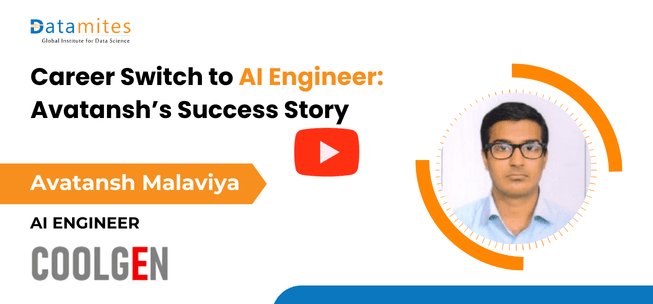
A career switch into Artificial Intelligence is possible with the right skills, dedication, and industry-focused training. Avatansh’s journey highlights how determined learners can successfully transition into an AI Engineer role by building practical knowledge and real-world experience.
 Priyanka BR
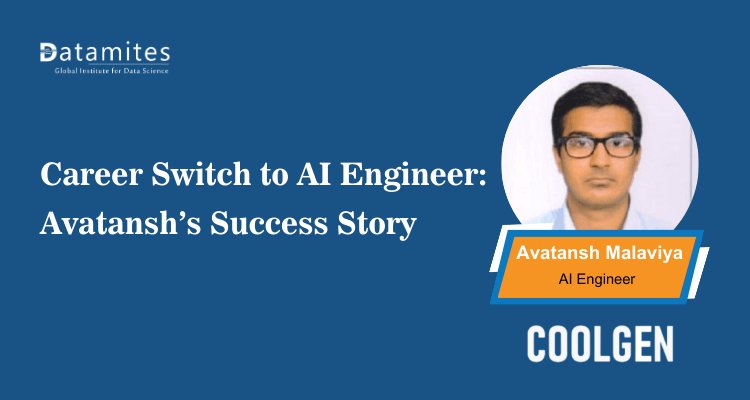
Have you ever wondered how someone can start learning programming from scratch and still build a career in Artificial Intelligence? Meet Avatansh, whose journey shows that with the right guidance, consistent practice, and determination, breaking into the AI industry is possible even for beginners.
Like many aspiring professionals, Avatansh started with limited experience in Python and data science. But through structured learning, hands-on projects, and dedicated preparation at DataMites, he gradually built the technical skills and confidence needed to succeed in the field.
Today, he has successfully stepped into the AI industry as an AI Engineer. His story is a great example of how the right learning path, practical experience, and persistence can transform ambition into a real career opportunity in Artificial Intelligence.
How Avatansh Built His Career as an AI Engineer with DataMites Institute
Breaking into the AI field takes the right skills and consistent practice. Avatansh’s journey highlights how structured training and hands-on projects at DataMites helped him develop strong data science and artificial intelligence skills.
1. Can you briefly introduce yourself and share your recent achievement?
My name is Avatansh, and I recently completed my training in Data Science, AI, and Machine Learning from DataMites. Recently, I achieved an important milestone by securing a position as an AI Engineer at Coolgen Solutions after successfully clearing the interview process.
2. How did your journey in AI and data science begin?
My journey started when I enrolled in a Certified Data Scientist (CDS) course. Initially, I had very limited exposure to programming, so I had to begin learning Python from scratch.
3. Did you have any prior experience with Python before starting the course?
No, I started completely from scratch. During college, we had some exposure to programming, but I had not practiced it seriously. The structured learning materials helped me build strong fundamentals in Python.
4. What learning format did you follow during your course?
I followed a blended learning format, which included:
- Recorded video lectures
- Live webinars
- Python notebooks
- Mock interviews
- Interactive interview preparation sessions
These resources helped me understand both the theoretical and practical aspects of data science and AI.
5. How helpful were the coding sessions and interview preparation classes?
They were extremely helpful. The coding sessions especially improved my problem-solving skills. The interview preparation sessions were interactive and helped me learn how to communicate effectively during interviews.
6. How did you manage your study routine during the learning period?
Most of my time was spent on coding practice. I regularly practiced Python programs and revisited lecture videos when needed.
Sometimes I also replayed the lecture videos while doing other tasks, which helped reinforce the concepts.
7. Did you use external resources like YouTube or other websites for learning?
No, I mainly relied on the course materials, including the videos, notebooks, and practice resources provided during the training. Those materials were comprehensive enough for interview preparation.
8. What projects did you work on during your internship period?
During the internship, I worked on multiple projects including:
- Driver Safety Prediction (Class Imbalance Problem)
- MNIST Digit Classification
- Rice Leaf Disease Detection
- Bank Fraud Detection (Client Project)
These projects helped me gain hands-on experience with real-world machine learning problems.
9. Did you also work on any Generative AI or chatbot-related projects?
Yes. I attended webinars on AI chatbot development and learned how LLMs (Large Language Models) are integrated into chatbot systems.
These sessions were extremely helpful because several interview questions were related to chatbot architecture and LLM integration.
10. How many mock interviews did you attend before the actual interview?
I attended three mock interviews before appearing for the client interview.
Interestingly, the mock interviews were more difficult than the actual interview, which helped me prepare better.
11. What kind of questions were asked during the technical interview?
Most questions were theoretical and focused on fundamentals. Some examples include:
- Difference between classification and regression
- Difference between CNN and RNN
- Data cleaning and data preparation
- Data augmentation
- Concepts related to chatbots and LLMs
Surprisingly, there was no coding round in my interview.
12. Were interview questions based on the projects you completed?
Yes, many questions were based on my projects. For example, when I mentioned building a Generative AI chatbot, the interviewer asked several follow-up questions about:
- LLM integration
- Backend architecture
- Chatbot workflows
Because I had built the project myself, I was able to answer confidently.
13. Did you receive any support for resume building?
Yes, I received feedback on my resume. I was advised to:
- Highlight key projects
- Include accuracy metrics and results
- Avoid listing too many projects
- Use a clean and professional resume format
Quantifying project results made the resume stronger.
14. What kind of work will you be doing in your new role?
The company mainly focuses on LLM-based chatbot development and providing cloud deployment solutions for clients. I am excited to work in these areas and look forward to gaining hands-on experience while building and deploying real-world AI systems.
15. How important is hands-on practice in AI?
Hands-on practice is extremely important. Don’t just watch tutorials, build projects yourself. When you implement something on your own, it improves both your confidence and understanding.
16. What advice would you give to aspiring AI professionals?
My biggest advice would be to focus strongly on the basics. Interviewers often begin with simple foundational questions, such as the difference between classification and regression. If your fundamentals are strong, it becomes much easier to understand advanced concepts and build deeper skills later on.
Refer to these articles:
- Traditional RAG vs Agentic RAG — What’s the Difference?
- Will AI Agents Replace Your Next Coworker? Exploring the Future of Work
- Explainable AI: Why Black-Box Models Are Losing Trust
Avatansh’s Key Takeaways on Launching an AI Engineer Career with DataMites Institute
His journey highlights how a beginner with minimal programming exposure can successfully enter the Artificial Intelligence field through structured learning, practical projects, and focused interview preparation.
- Background: Avatansh started his journey with limited exposure to programming and technology. Like many beginners exploring data science careers, he needed a structured path to build both technical knowledge and practical skills from the ground up.
- Training Decision: To gain industry-relevant skills, he enrolled in a Data Science and AI training program at DataMites, where he followed a blended learning format that included video lectures, webinars, coding practice, and interview preparation sessions.
- Learning Foundation: The program helped him build strong fundamentals in Python programming, machine learning concepts, and core data science techniques. Developing these basics became a crucial step in preparing for technical interviews and real-world problem solving.
- Practice-Oriented Learning: Instead of focusing only on theory, he prioritized coding practice and regularly worked on Python exercises. Continuous hands-on practice helped him strengthen his programming confidence and improve problem-solving ability.
- Project Experience: During the learning and internship phases, he worked on multiple projects such as driver safety prediction involving class imbalance problems, image classification tasks, fraud detection models, and chatbot-related AI applications.
- Exposure to Emerging AI Trends: By attending Generative AI and chatbot development webinars, he gained insights into modern AI technologies such as Large Language Models (LLMs) and their integration into conversational AI systems.
- Interview Preparation: His preparation strategy included revisiting coding notebooks, practicing machine learning concepts, and attending mock interviews. These mock sessions helped him experience realistic interview scenarios and improve his communication skills.
- Career Breakthrough: After completing the projects, internship, and mock interview process, Avatansh successfully entered the AI industry and began his professional journey as an AI Engineer.
- Key Lesson: His story demonstrates that strong fundamentals, consistent practice, project-based learning, and structured training can help aspiring professionals successfully break into the competitive field of Artificial Intelligence.
Refer to these articles:
- How Azwin Successfully Switched His Career to Become an AI Engineer After 5 Years in IT
- How Nakshatra Secured Her First AI Engineer Job as a Fresher
- From B.Tech Graduate to AI/ML Engineer: Shyama’s Inspiring Success Journey
Avatansh’s journey shows that building a career in Artificial Intelligence is possible with the right mindset, consistent practice, and proper guidance. Starting with very little experience in programming, he chose to strengthen his skills through a structured learning program at DataMites, where he learned Python, machine learning concepts, and practical data science techniques through guided training and hands-on practice.
During his learning journey, Avatansh focused on coding practice, real-world projects, and interview preparation. With the growing demand for IT courses and AI skills, he worked on projects like driver safety prediction, image classification, fraud detection, and AI chatbot development. This hands-on experience and consistent preparation helped him build strong technical skills and confidence in the AI field.
DataMites Training Institute offers a comprehensive 9-month Artificial Intelligence course designed to help learners develop strong, industry-ready AI skills. The course focuses on practical tools, real-time projects, and responsible AI practices. The program includes specialized learning paths such as AI Engineer, AI Expert, AI for Product Managers, AI Foundation, and Certified NLP Expert. With globally recognized certifications accredited by IABAC and NASSCOM FutureSkills, DataMites provides hands-on training that prepares students for real-world AI and machine learning careers.
Students who want to build careers in AI in Tamil Nadu can explore an Artificial Intelligence course in Coimbatore, where DataMites offers structured classroom training, industry-oriented projects, and hands-on guidance to help learners develop strong AI and ML skills.
Similarly, professionals aiming to enter the AI field can enroll in Artificial Intelligence classes in Chennai, where DataMites Institute offers offline training centers in key locations such as Anna Nagar, Perungudi, and Guindy. These centers provide convenient access to classroom training, hands-on projects, and expert mentorship for students and working professionals looking to build strong AI and machine learning skills.