From Fresher to Data Analyst: Ayesha’s Inspiring Career Journey
Step into Ayesha’s inspiring journey from a fresher to a successful Data Analyst career in Bangalore. Explore how strong fundamentals in Python and SQL, hands-on projects, and consistent preparation helped her gain job-ready skills and confidently crack interviews in the competitive data analytics industry.
 Kriti Maurya
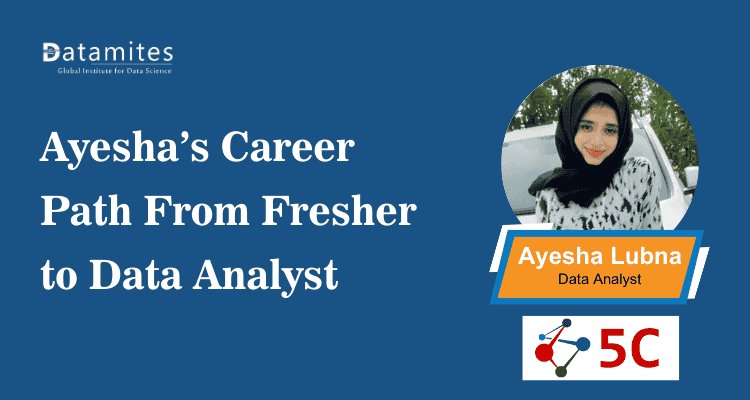
Starting your career in the tech industry as a fresher can feel overwhelming, but with the right skills, focused preparation, and consistent practice, success is within reach. Here is Ayesha’s journey from Information Science graduate to Data Analyst at 5C Network proves that determination and strong fundamentals truly make the difference.
Ayesha’s Inspiring Data Analyst Career Journey
When Ayesha stepped out of college, she knew that choosing the top IT courses in demand would be crucial for her future. With determination, the right guidance, and strong technical skills, she transformed herself from a fresher into a confident Data Analyst, proving that the right direction can truly change a career path.
1. Can you briefly introduce yourself and your background?
Ayesha: I’m Ayesha Lumna. I completed my BE in Information Science and Technology with a CGPA of 8.2. After graduation, I moved to Bangalore with six of my friends to pursue training and an internship in Artificial Intelligence. We completed the course, internship, and placements successfully, and now I’ve secured a job as a Data Analyst at 5C Network.
2. Why did you choose Data Analytics despite having an AI and ML background?
Ayesha: Although I trained in Artificial Intelligence, Machine Learning, and Data Science, I discovered that I truly enjoy data visualization and presenting insights. I love working on dashboards and converting raw data into meaningful business insights. That’s why I chose Data Analytics as my career path.
3. How was your learning experience during the training?
Ayesha: The learning was structured and smooth. We first completed Data Science modules and then moved into AI concepts. After completing the course, we went through mock interviews. I was fortunate to clear the mock interview in my first attempt. The training focused not just on what to do, but why we do it and where it is applied, which built my confidence.
4. Did you have prior knowledge of Python and SQL?
Ayesha: Yes, I had basic exposure to Python during my college semester. However, my real understanding and strong preparation in Python, SQL, Machine Learning, and Statistics happened during the four months of focused training. I practiced deeply and worked on real-world projects.
Refer to the articles below:
- Is the Data Analyst Market Overcrowded
- Correlation vs Covariance for Analysis
- Top 5 Marketing Analytics Projects to Try
5. How important are Python and SQL for a Data Analyst career?
Ayesha:
- Python and SQL are extremely important.
- SQL is non-negotiable because most real-world data resides in databases. It helps in extracting, filtering, and analyzing data efficiently.
- Python is used for data cleaning, automation, logic building, and analysis.
For anyone preparing for a data analyst role, mastering Python and SQL fundamentals is crucial.
6. How did you prepare for interviews?
Ayesha: I focused mainly on:
- Python fundamentals
- SQL queries and joins
- Machine Learning concepts
- Statistics
I practiced scenario-based questions and problem-solving. Consistency mattered more than long study hours. I studied around 2–3 hours daily apart from institute timings, focusing on coding practice and concept clarity.
7. What kind of questions were asked in your Data Analyst interview?
Ayesha: The interview process had multiple rounds:
Round 1 – Assignment Round
- 35 questions including SQL, Statistics, and scenario-based business questions.
- Focused on analytical thinking and decision-making ability.
Round 2 – Technical Round
- SQL queries (joins, filtering, logic building)
- Python fundamentals
- Writing basic programs
Round 3 – Managerial Round
- SQL and statistics basics
- Project explanation (end-to-end)
- Scenario-based problem-solving
They also asked project-related questions such as:
- How did you handle missing data?
- Why did you choose a particular model?
- What metrics did you track?
8. How did you prepare your resume as a fresher?
Ayesha: After clearing the mock interview, we were guided on building an ATS-friendly resume. All the projects mentioned in my resume and data analyst cover letter were from my training program. I ensured I understood each project deeply because interviewers ask detailed project-based questions.
9. How many hours should a fresher study daily to become a Data Analyst?
Ayesha: It’s not about studying for long hours; it’s about consistency.
- 2–3 focused hours daily
- Daily Python and SQL practice
- Revising Machine Learning and Statistics concepts
- Applying concepts to new datasets (from Kaggle or other sources)
- Consistency is more important than long study sessions.
10. What will your role involve at 5C Network?
Ayesha: I will be working in a radiology-based company. My responsibilities include:
- Data cleaning
- Data visualization
- Dashboard building
- Report analysis
- Providing actionable insights
- Working with stakeholders
The goal is to help the business make data-driven decisions.
Key Skills That Helped Ayesha Crack the Data Analyst Job
- Strong foundation in Python and SQL
- Deep understanding of concepts
- Hands-on project experience
- Scenario-based thinking
- Daily consistent practice
- Clear explanation of projects
Key Highlights from Ayesha’s Data Analyst Journey as a Fresher
Ayesha’s journey from DataMites Success Stories highlights the practical strategies and skills required to build a successful career in data analytics. Here are the six most important lessons from her experience:
1. Master Python and SQL as Core Skills
Python and SQL are non-negotiable for data analyst roles. From writing queries to cleaning data and building insights, these technical skills form the foundation of any successful data career.
2. Focus on Concept Clarity Over Memorization
Understanding why and how concepts work is more important than simply memorizing syntax. Deep conceptual clarity on Data Analytics in Business helps in solving real-world business problems and answering scenario-based interview questions confidently.
3. Practice Consistently with Real Datasets
Studying 2–3 focused hours daily is enough if done consistently. Applying concepts to real datasets strengthens understanding and improves problem-solving ability in practical situations.
4. Prepare Through Projects and Mock Interviews
Hands-on projects and mock interviews play a crucial role in cracking placements. Project-based preparation ensures you can explain your work end-to-end, while mock interviews build confidence and reduce interview anxiety.
5. Build an ATS-Friendly, Impactful Resume
A well-structured, optimized resume increases your chances of shortlisting. Highlighting relevant projects, skills for data analyst, and measurable outcomes makes your profile stand out to recruiters.
6. Develop Analytical Thinking and Business Insight
Interviewers test more than just coding skills they evaluate your business thinking and analytical mindset. A genuine passion for data visualization and presenting insights can strongly influence your career direction in data analytics.
Ayesha’s journey proves that with consistent practice, strong fundamentals in Python and SQL, and real-world project experience, any fresher can confidently transition into a successful Data Analyst role and build a rewarding career in the fast-growing field of data analytics.
Refer to the articles below:
- How to Become a Data Analyst in Bangalore
- Bangalore vs Pune: Which is Better for IT Career Growth
- How to Choose Best Institute for Data Analytics in Bangalore
DataMites Institute is a leading IT training provider offering comprehensive Data Analyst courses in Bangalore, along with specialized programs in Data Science, Artificial Intelligence, Machine Learning, Python, and IoT. With a strong emphasis on hands-on training, live projects, internships, and dedicated placement assistance, DataMites ensures learners acquire industry-relevant and job-ready skills. The institute also offers globally recognized certifications accredited by IABAC and NASSCOM FutureSkills, enhancing career opportunities in the competitive tech industry.
Beyond its Data Analytics course in Pune, DataMites provides flexible, industry-aligned learning programs in major cities such as Bangalore, Chennai, Mumbai, Ahmedabad, and Indore, enabling aspiring professionals to build successful careers in analytics and emerging technologies.