From Freshers to Data Analyst Journey of Rushikesh
Explore Rushikesh’s inspiring journey from a fresher to a successful Data Analyst. Discover the skills he learned, challenges he overcame, tools he mastered, and how focused training and hands-on projects helped him build a strong analytics career.
 Kriti Maurya
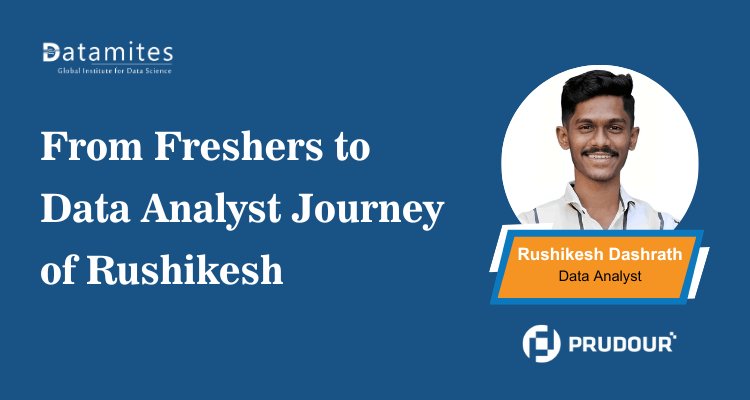
Transitioning from a fresher to a successful Data Analyst requires clarity, the right skill set, and consistent preparation. Rushikesh’s journey showcases how choosing the right career path, mastering core analytics tools, and leveraging mock interviews can help fresh graduates secure opportunities in the competitive analytics field. This real-life success story serves as a roadmap for aspiring Data Analysts who want to build a strong foundation and enter the data industry with confidence.
From Fresher to Data Analyst: Rushikesh’s Inspiring Journey into Analytics
From a fresher to a successful Data Analyst, Rushikesh’s journey highlights how choosing the right IT courses in demand, mastering core analytics tools, and gaining hands-on experience can open doors to promising careers in the fast-growing data analytics industry.
Q1. Can you introduce yourself, Rushikesh?
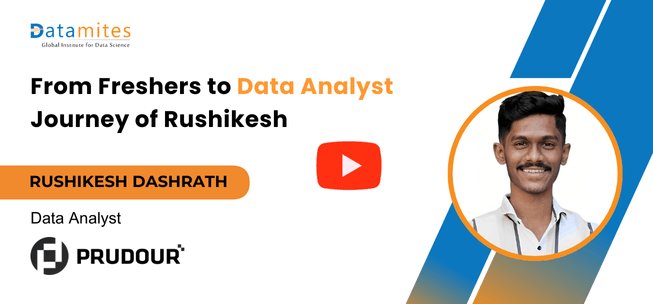
Rushikesh: Thank you for the opportunity. My name is Rushikesh S., and I’m from Pune. I completed my Bachelor’s degree in Computer Science in 2024. After graduation, I joined a Data Analytics program in July 2024 and completed it in January 2025. Within six months, after attending mock interviews and skill preparation, I successfully converted an internship opportunity as a Data Analyst.
Q2. Why did you choose Data Analytics instead of Data Science, despite being from a Computer Science background?
Rushikesh: Although I come from a Computer Science background, I didn’t enjoy deep coding. I was more interested in working with numbers, data, and insights. Data Analytics allowed me to focus on data handling, visualization, and business insights without heavy programming, which made it the right fit for me.
Q3. How many mock interviews did you attend, and how did they help?
Rushikesh: I attended two mock interviews. The first one didn’t go very well, but it helped me identify my gaps. I prepared thoroughly for the second mock interview, which significantly improved my confidence and communication skills. That experience played a major role in preparing me for the real interview.
Q4. What kind of questions were asked during your Data Analyst interview?
Rushikesh: Since it was an internship role, the first round focused mainly on aptitude-based questions. The second round included HR and managerial questions, along with basic Excel-related queries. There were very few technical questions, but Excel knowledge was important.
Refer to the articles below:
- Is the Data Analyst Market Overcrowded? Realistic Job Outlook for 2026
- Why Data Analysts Are Choosing DuckDB for Modern Analytics
- Augmented Analytics Explained
Q5. How did you prepare your resume as a fresher Data Analyst?
Rushikesh: I prepared my resume with the help of the placement assistance team and also used AI tools for refinement. It was a combination of expert guidance and AI feedback to ensure my resume was structured and job-ready.
Q6. Is coding mandatory to become a Data Analyst?
Rushikesh: For entry-level roles, coding is not mandatory. Strong knowledge of Excel and SQL is sufficient to start a career in Data Analytics. However, for higher-level positions, coding skills can be beneficial.
Q7. How important is SQL for a Data Analyst role?
Rushikesh: SQL is extremely important. I would rate it 8 out of 10 in terms of importance. Whether you are a Data Analyst, Data Scientist, or Data Engineer, SQL is a must-have skill.
Q8. What learning strategy would you suggest for beginners in Data Analytics?
Rushikesh: Start with the basics. Begin with Excel, then move to SQL, followed by Power BI. Once you’re comfortable, you can explore Python if required. A strong foundation boosts confidence and improves interview performance.
Q9. What does a Data Analyst do on a day-to-day basis?
Rushikesh: A Data Analyst mainly collects, cleans, and analyzes data. Data cleaning is one of the most time-consuming and important tasks, especially when working with large datasets.
Q10. Do you think AI will replace Data Analysts?
Rushikesh: AI is not replacing Data Analysts; it’s assisting them. It helps automate repetitive tasks and saves time. Like any technology, AI has pros and cons, but if used correctly, it enhances productivity rather than replacing roles.
Q11. Are you planning to learn AI in the future?
Rushikesh: Yes, I plan to learn AI in the future. First, I want to understand my work domain and job requirements. Based on that, I’ll decide how AI can add value to my career growth.
Q12. Where do you see yourself in the next five years?
Rushikesh: I see myself in a Senior Data Analyst role or possibly transitioning into Data Engineering, as it is a growing and impactful field in the data ecosystem.
Q13. What projects did you include in your resume?
Rushikesh: I included projects like Uber Data Analysis, Customer Segmentation, and Profit Analysis. These projects involved tools like Excel, SQL, and Power BI. I particularly enjoyed working on Power BI dashboards.
Q14. What advice would you give to freshers aiming to become Data Analysts?
Rushikesh: Focus on fundamentals, practice real-world projects, attend mock interviews, and don’t fear AI or new tools. Confidence comes from preparation and consistency.
Key Highlights from Rushikesh’s Data Analyst Journey
DataMites Success Stories highlights how the right skills, mindset, and structured preparation can help freshers successfully enter the analytics industry.
- A technical background helps, but strong fundamentals in Excel and SQL are enough to start a Data Analytics career.
- Entry-level Data Analyst roles focus more on data handling and insights than on advanced coding skills.
- Mock interviews and expert-guided resume preparation significantly boost confidence and job readiness.
- Data cleaning and Power BI dashboard creation are core responsibilities in real-world analytics projects.
- AI acts as a productivity enhancer, supporting Data Analysts rather than replacing them.
This proves that with clear fundamentals, practical exposure, and the right guidance, freshers can achieve faster and more confident job transitions into Data Analytics by chosing to data analyst institute in India.
Refer to the articles below:
- Akshay’s Inspiring Journey as a Senior Data Analyst
- Prajwal’s transition from commerce graduate to data analyst
- From System Engineer to Data Analyst: Aishwarya’s Career Transition
DataMites Institute is a premier IT training center offering Data Analyst Courses in Pune, along with specialized programs in Data Science, Artificial Intelligence, Machine Learning, Python, and IoT. Through practical learning, real-time projects, internships, and strong placement support, DataMites equips learners with job-ready skills and globally recognized certifications from IABAC and NASSCOM FutureSkills.
In addition to its Data Analytics Course in Hyderabad, DataMites delivers industry-driven and flexible learning pathways across major cities including Bangalore, Chennai, Pune, Mumbai, Ahmedabad, and Indore, empowering students to build rewarding careers in analytics and emerging digital technologies.