How Azwin Successfully Switched His Career to Become an AI Engineer After 5 Years in IT
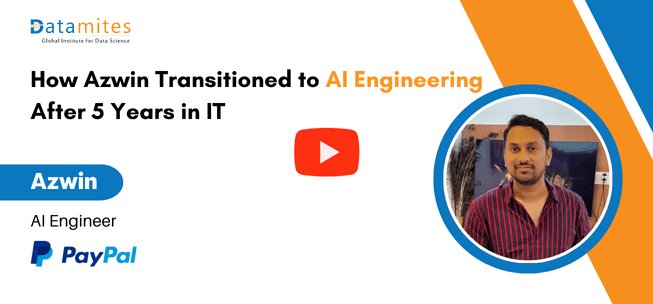
After five years in IT, Azwin transformed his career by mastering Artificial Intelligence skills and securing a role as an AI Engineer. His journey highlights the steps, learning strategies, and determination needed to pivot into a high-demand tech field.
 Priyanka BR
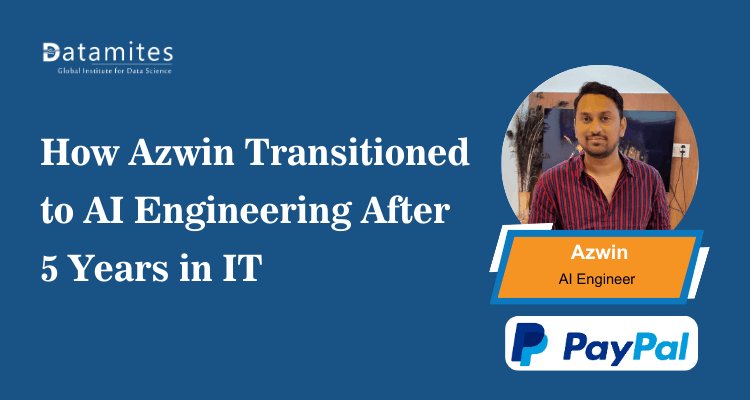
Have you ever thought about switching to Artificial Intelligence after years in IT, but wondered if it’s too late to pivot? Meet Azwin, a tech professional with five years of experience in data analytics and DevOps, who chose to step beyond his comfort zone and build a future in AI engineering. Instead of staying in familiar roles, he decided to realign his career with the growing demand for generative AI and intelligent systems.
The shift was ambitious. Moving from traditional IT responsibilities into advanced AI concepts like machine learning, RAG-based applications, and cloud deployment required focused effort and continuous upskilling. Azwin didn’t just learn theory; he immersed himself in hands-on projects, strengthened his programming foundation, and sharpened his understanding of real-world AI implementation.
The real transformation began when he enrolled in a structured, practical learning program at DataMites. Through guided mentorship, project-driven training, and consistent preparation, he turned his experience into a competitive AI profile. Today, Azwin’s journey stands as proof that with clarity, persistence, and the right guidance, transitioning from IT to an AI Engineer role at PayPal is not just possible, it’s achievable.
How Azwin Transitioned from IT Professional to AI Engineer with DataMites
Azwin’s journey from an experienced IT professional to an AI Engineer highlights the impact of strategic upskilling and guided mentorship. Through DataMites’ structured training and extensive hands-on project experience, he successfully transitioned into advanced Artificial Intelligence roles and transformed his technical background into a future-focused AI career.
1. Can you briefly introduce yourself and your recent career journey?
I recently completed the AI Expert course at DataMites this March. During this time, I worked on more than 12 projects, including a capstone and client projects. I combined self-study with materials provided by DataMites and received guidance from trainers whenever I had doubts. This experience allowed me to successfully transition into an AI Engineer role at PayPal.
2. What was your professional background before moving to AI?
I have five years of IT experience, mostly in data analytics and DevOps. I had some exposure to machine learning through a few classification models, but AI, particularly generative AI, was completely new to me. This career transition involved learning new skills while leveraging my existing IT and programming knowledge.
3. Why did you choose to join DataMites for AI training?
I believe that mastering the fundamentals is crucial for cracking interviews. DataMites provided comprehensive course materials, project guidance, and mentor support. The structured curriculum helped me gain a solid understanding of Artificial Intelligence concepts, which was instrumental in preparing for competitive roles in generative AI.
4. How important were projects in your learning journey?
Projects were vital. I worked on both DataMites projects and independent projects. These ranged from capstone projects to client-based applications. Working on real-world problems enhanced my understanding of AI, allowed me to apply theory in practice, and gave me practical experience to showcase during interviews.
5. What kind of AI projects should beginners focus on?
For beginners, I recommend starting with projects related to generative AI, such as building RAG-based applications or agentic frameworks. Understanding how to integrate machine learning models in real-world applications is key. You can also refer to trainers, YouTube tutorials, and online platforms like Udemy for guidance.
6. How did your previous knowledge in ML and programming help in this transition?
My previous exposure to Python and JavaScript helped me in backend and frontend development. Understanding ML fundamentals provided a base for generative AI concepts. Learning Python deeply, including advanced topics like multi-threading, object-oriented programming, and deployment strategies, was crucial to building production-ready applications.
7. How important is deployment knowledge in AI interviews?
Extremely important. Most interviews I attended focused on deployment processes. Understanding cloud platforms like AWS, GCP, or Azure, and deployment strategies such as blue-green, canary, and rollout deployments, is essential. Companies increasingly deploy AI solutions on the cloud, making these skills highly valuable.
8. What role does programming play in AI today?
Programming remains central, especially Python for backend AI development. Advanced concepts, such as multi-threading and object-oriented programming, are useful for production-level applications. Knowledge of JavaScript or React can help if you aim to become a full-stack AI engineer.
9. How competitive was the interview process?
I attended over 15 interviews and was selected by three companies. The interviews tested fundamentals, project experience, and deployment knowledge. Strong preparation, practice, and clarity about roles helped me succeed in this competitive field.
10. What advice do you have for AI aspirants preparing for interviews?
Focus on fundamentals, practical projects, and deployment skills. Understand generative AI applications, explore agentic frameworks, and gain hands-on experience in building and deploying applications. Preparing on your own and leveraging training support increases your chances of success.
11. Why did you choose a role in fintech specifically?
I had previous experience in fintech and wanted to transition into AI engineering within this industry. Fintech companies operate differently from traditional IT services, requiring knowledge of specialized tools and frameworks. My goal was to combine domain expertise with AI skills for impactful projects.
12. Are you joining a team, and what are your expectations?
Yes, I am joining a large team. I expect to collaborate on generative AI applications and contribute to backend development while leveraging my Python knowledge. Continuous learning and adapting to evolving AI technologies will be part of my journey.
13. Final advice for aspiring AI engineers
AI is rapidly evolving, and staying updated is critical. Focus on fundamentals, hands-on projects, deployment skills, and cloud platforms. Leverage training from reputable institutes like DataMites, practice consistently, and be confident in interviews. Passion, dedication, and structured preparation can make a successful career transition possible.
Refer to these articles:
- What is an AI Agent? Guide to Intelligent Agents in AI
- Learn about the Types of Machine Learning Algorithms
- The Future of Coding: Can AI Replace Software Engineers?
Key Insights from Azwin’s Artificial Intelligence Career Journey
Azwin’s journey into Artificial Intelligence offers more than just a success story. It provides practical inspiration for anyone considering an AI career transition.
- Azwin’s journey highlights how existing IT experience can become a strong foundation for moving into AI. His background in analytics and DevOps supported his transition instead of slowing it down.
- A clear understanding of core machine learning concepts strengthened his confidence. Strong fundamentals made advanced topics like generative AI easier to grasp and apply.
- Staying updated with industry trends, especially in generative AI, positioned him for modern AI engineering roles. Skills in RAG systems and LLM applications aligned well with current hiring demands.
- Working on multiple hands-on projects enhanced his practical understanding. Real-world exposure helped him confidently discuss implementation and problem-solving during interviews.
- Knowledge of deployment and cloud platforms increased his professional value. The ability to move AI models into production reflects industry readiness.
- His fintech background added strategic direction to his career move. Combining domain expertise with AI skills created a focused and competitive profile.
- Strong programming skills, especially in Python and backend development, supported scalable Artificial Intelligence application building. Logical thinking remains essential in AI engineering.
- Consistent preparation and structured learning ultimately led to his success. Clear goals and steady effort resulted in his placement as an AI Engineer at PayPal.
Azwin’s success story shows how an experienced IT professional can confidently transition into Artificial Intelligence through focused upskilling. At a time when many are asking, “Will AI Agents Replace Jobs?”, he chose to see opportunity instead of uncertainty. Rather than fearing automation, he strengthened his machine learning foundation and gained hands-on experience in real-world AI and deployment projects. His journey proves that professionals who adapt and upgrade their skills can grow with AI and stay ahead in an evolving tech landscape.
Refer to these articles:
- How Working Professionals Can Switch to an AI/ML - Mehvish’s AI Career Success Story
- How Nakshatra Secured Her First AI Engineer Job as a Fresher
- How Harsha Transitioned into an AI Product Manager Role? An Inspiring Success Story
Azwin’s transition was strengthened by the structured, hands-on training at DataMites. With expert mentorship, real-world projects, and industry-focused learning, he was able to convert his AI knowledge into practical, job-ready skills. For professionals aiming to move into AI with clarity and confidence, DataMites provides a strong foundation and the right guidance to become industry-ready.
DataMites Training Institute offers comprehensive Artificial Intelligence courses and has 30+ offline centers across India, including Hyderabad, Pune, Bangalore, Chennai, Ahmedabad, Coimbatore, Mumbai, and Delhi. The programs emphasize hands-on learning in Python, Machine Learning, Neural Networks, and leading frameworks like TensorFlow and Keras, along with exposure to cloud platforms and AI ethics. Accredited by IABAC and NASSCOM FutureSkills, DataMites provides placement assistance, internships, and flexible online and classroom training, helping professionals successfully transition into AI careers like Azwin.
Students and professionals in Karnataka can enroll at DataMites for Artificial Intelligence training in Bangalore, offered across three prime locations: Kudlu Gate, BTM Layout, and Marathahalli. These offline centers provide hands-on learning, industry-relevant projects, and dedicated placement support, helping learners develop job-ready AI skills and confidently advance their careers.
Similarly, students in Telangana can attend Artificial Intelligence classes in Hyderabad, available at prime locations in Madhapur and Kukatpally. With hands-on, project-based learning, expert guidance, and dedicated placement support, learners can strengthen their AI skills and confidently begin their careers in Artificial Intelligence.