How GenAI Is Influencing Data Analyst Productivity and Accuracy
Explore how GenAI is transforming data analytics by improving data analyst productivity and accuracy. Learn about AI-powered data analysis, real-world use cases, market insights, and how generative AI drives faster, smarter business decisions.
 Swagatam Sinha
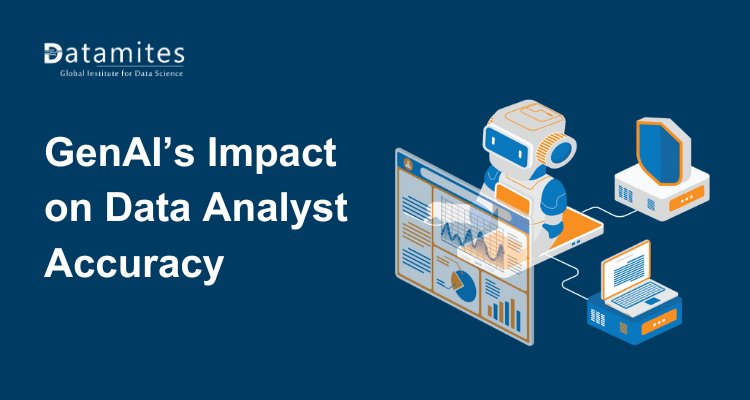
In the modern business environment, data is the new currency. Companies across industries generate massive volumes of information daily, ranging from customer interactions and operational metrics to market trends and social media insights. For data analysts, this represents both opportunity and complexity: extracting meaningful insights quickly and accurately has never been more critical. Generative AI, commonly referred to as GenAI, is rapidly transforming the way data analysts work, enhancing productivity, decision-making, and analytical accuracy.
What is GenAI and Why It Matters in Data Analytics
Generative AI refers to artificial intelligence systems capable of creating, summarizing, and transforming data. Unlike traditional AI, which primarily focuses on prediction or classification, GenAI can generate synthetic data, produce automated reports, and even assist in building predictive models. When applied to data analytics, GenAI empowers analysts to automate routine tasks, uncover hidden patterns, and generate accurate insights faster than ever before.
In practice, GenAI in data analytics allows data professionals to focus on interpreting results and providing actionable recommendations rather than spending time on repetitive tasks. It acts as a force multiplier, enhancing both data analyst productivity and analytical accuracy.
Market research underscores the exponential growth of generative intelligence technologies within analytics. According to a recent industry forecast, the generative AI in analytics market is valued at approximately USD 1.54 billion in 2025 and is projected to grow to around USD 12.45 billion by 2034, expanding at a compound annual growth rate (CAGR) of over 26% through the decade. (Source: Precedence Research)
Another projection estimates AI analytics markets reaching USD 4.56 billion by 2029, driven by strong adoption of automation, machine learning, and natural language processing for business insights.
These numbers reflect not only interest but actual investment and scaling of tools aimed at data‑intensive roles especially in analytics and business intelligence.
For data professionals, the case for adopting GenAI for data analysts is not just theoretical. A recent industry view shows that 85% of analytics teams are already leveraging AI to enhance data processing and insight generation.
Read to these articles:
- Why Data Analysts Are Choosing DuckDB for Modern Analytics
- Augmented Analytics Explained: How AI is Reshaping the Data Analyst Role
- Edge Analytics Explained: Processing Data Where It Matters Most
How GenAI Boosts Productivity for Data Analysts
A key benefit of GenAI is its ability to significantly improve productivity. Traditional data workflows involve several time-intensive steps, such as cleaning datasets, consolidating information, building visualizations, and preparing reports. With data analyst productivity tools powered by GenAI, many of these processes can be automated.
For example:
- Automated Data Cleaning and Preparation: Tools powered by GenAI can detect inconsistencies, missing values, or outliers in datasets automatically. This reduces human error and saves hours of manual effort.
- Natural Language Querying: Analysts can interact with data using plain language instead of complex SQL or Python queries, making data exploration faster and more intuitive.
- Automated Dashboards and Reporting: AI-assisted platforms can generate real-time visualizations and reports, helping decision-makers access insights immediately.
Companies adopting GenAI for faster data insights report measurable improvements in productivity. Analysts can now handle more complex projects in less time, enabling businesses to make data-driven decisions faster.
Modern data analyst productivity tools powered by GenAI automate much of that work. Analysts can now:
- Automatically clean and normalize datasets.
- Generate dashboards and reports within minutes.
- Use natural language questions to query data without coding complexity.
- Schedule automated insight delivery across teams.
A study by Capgemini Institute found organizations using GenAI tools reported almost 8% gains in overall productivity year‑over‑year, highlighting measurable operational impacts beyond early experiments. Research
In countries with strong tech sectors, the productivity impact is even more compelling. An EY India survey projected that the integration of generative technologies could boost productivity in India’s $254‑billion software industry by up to 45% over the next five years, with many enterprises already moving beyond pilot phases into large‑scale operations.
Improving Accuracy and Reliability in Data Analysis
Accuracy is critical in analytics because poor insights can lead to costly business mistakes. AI-powered data analysis tools improve reliability by reducing human error and identifying patterns that might be missed manually. Generative AI models can validate findings, detect anomalies, and simulate different scenarios, providing a more robust analytical framework.
Key ways GenAI improves accuracy include:
- Predictive Analytics with AI: By analyzing historical data, AI models can forecast trends, demand, or risk factors more accurately. This supports proactive decision-making rather than reactive problem-solving.
- Data Validation and Anomaly Detection: AI tools automatically flag unusual data points or inconsistencies, ensuring cleaner datasets and higher-quality insights.
- Scenario Simulation: GenAI enables analysts to test multiple business scenarios, evaluate potential outcomes, and make decisions grounded in evidence rather than intuition.
With these capabilities, organizations can increase productivity with AI in analytics while simultaneously improving the accuracy of data analysis.
Improving analytical accuracy is as critical as boosting speed. Traditional methods are often limited by human bias or sheer data volume. With AI for analytics, predictive models incorporate machine learning to recognize patterns humans might miss.
Market data shows 62% of data scientists report AI significantly enhances predictive accuracy, and 68% of teams note improvements in handling unstructured data (e.g., text, social media feeds), which were historically difficult to analyze.
Refer to these articles:
- How to Learn SQL for Data Analysis
- The Future of Coding: Can AI Replace Software Engineers?
- Will Polars Replace Pandas?
Automation and Efficiency in Data Analytics
Automation is one of the most tangible benefits of GenAI. Automation in data analytics allows analysts to offload repetitive tasks, such as data extraction, transformation, and report generation. This ensures consistency, reduces the risk of human error, and accelerates the delivery of insights.
- AI-Assisted Data Reporting: Reports and dashboards can be updated automatically with fresh data, enabling real-time decision-making.
- Predictive Maintenance and Operations: In manufacturing, AI can predict equipment failures based on historical sensor data, minimizing downtime and improving operational efficiency.
- Financial Risk Assessment: Banks and financial firms use GenAI models to detect fraudulent activities and assess risk factors quickly and accurately.
Overall, data analytics efficiency improves as AI handles routine work, allowing analysts to focus on higher-value tasks such as interpreting insights, strategy development, and consulting with stakeholders.
GenAI’s Impact on Decision-Making
Data analysis is ultimately about informed decision-making. By integrating GenAI impact on decision making, organizations can access actionable insights faster and make smarter, evidence-based decisions. Generative AI models enhance strategic planning across industries:
- Retail: Personalized recommendations, dynamic pricing, and inventory optimization are enhanced through AI-driven analysis.
- Healthcare: Patient data analytics improves clinical decision-making, resource allocation, and predictive modeling for patient outcomes.
- Finance: Real-time transaction monitoring and fraud detection become more effective, enabling proactive measures to protect assets.
By leveraging generative AI for business intelligence, organizations gain a competitive advantage, as decisions are based on comprehensive, accurate, and timely data.
Choosing the Right AI Tools for Data Analysts
The effectiveness of GenAI depends on selecting the right tools. Best AI tools for data analysts integrate seamlessly with existing workflows, supporting data cleaning, visualization, reporting, and predictive modeling. Features to consider include:
- Natural language interfaces for querying data.
- Automated report and dashboard generation.
- Predictive modeling and scenario simulation capabilities.
- Integration with existing data storage and BI tools.
Adopting data analyst AI software can enhance workflow efficiency and accuracy while equipping teams with the ability to generate deeper insights faster.
Refer to these articles:
- Data Scientist vs ML Engineer vs AI Engineer
- Data Engineer vs Analytics Engineer vs Data Analyst
- Top 7 Data Science Job Roles in 2026 You Should Know
Real-World Applications of GenAI in Analytics
The adoption of GenAI is already yielding tangible benefits across industries:
1. Financial Services
Global banks and financial services firms now use AI‑powered data analysis to detect fraud, manage risk, and forecast market movements. For example:
- Fraud detection models trained on vast transactional data identify suspicious patterns in real time.
- Predictive analysis tools forecast customer credit risk with higher precision.
- Automated reporting tools generate executive dashboards daily, freeing analysts from repetitive work.
This improves not just productivity but accuracy of predictions, leading to better decisions on lending, compliance, and risk mitigation.
2. Retail and Consumer Insights
Large retailers harness GenAI for customer segmentation and demand forecasting. AI models analyze purchase history, web behavior, and seasonal trends to generate predictive recommendations once a process that took weeks now delivered in hours.
A field experiment in online retail showed that GenAI enhancements increased productivity by improving conversion rates by up to 16.3% in experimental settings, directly linking AI‑driven analytics with revenue impact.
3. Healthcare and Life Sciences
Healthcare organizations use predictive analytics with AI for patient outcome modeling and resource planning. Analysts combine clinical, operational, and demographic data to forecast patient admissions or detect trends in treatment effectiveness all with higher confidence and reduced manual intervention.
These examples highlight how Generative AI in data analysis is not just a concept but a practical tool for driving productivity and accuracy.
Despite strong growth and clear benefits, real‑world deployment of generative analytics is not without hurdles. A recent study from MIT found that as many as 95% of generative AI projects fail to deliver measurable business impact, often due to poor integration with existing workflows and lack of customization. (Source: The Times of India)
This highlights that AI implementation success depends not just on tool capability but on integration, governance, and skilled talent especially in roles like data analyst, where domain knowledge cannot be fully automated.
The Future of GenAI in Data Analytics
As GenAI technologies continue to evolve, data analysts will have unprecedented capabilities at their disposal. Future applications may include:
- Advanced AI-Assisted Decision Support: Automated recommendations based on predictive models.
- Hyper-Personalized Analytics: Tailored insights for individual business units or customer segments.
- Full End-to-End Automation: From raw data ingestion to insights and strategic recommendations.
Organizations that embrace GenAI early will gain a competitive edge, leveraging AI-assisted data reporting, data analyst AI software, and machine learning for data analysts to extract maximum value from their data.
Looking forward, the GenAI in data analytics domain is set to grow both in scale and complexity. Predictions suggest predictive analytics using generative systems could grow from USD 1.4 billion in 2024 to over USD 8.4 billion by 2030, driven by demand for real‑time analytics and enhanced forecasting. (Source: Grand View Research)
Generative AI is transforming the landscape of data analytics, improving productivity, accuracy, and decision-making for data analysts. By adopting GenAI in data analytics, businesses can automate routine tasks, generate faster insights, and reduce errors. From AI-powered data analysis to predictive analytics with AI, organizations across industries are experiencing measurable gains in operational efficiency and strategic capability.
For modern data analysts, embracing GenAI is essential. With the right AI tools for business intelligence, analysts can enhance data analysis accuracy, increase productivity, and deliver actionable insights that drive meaningful business outcomes.
At DataMites, we empower aspiring professionals to become skilled data analysts with our Data Analyst courses in Coimbatore. Our programs focus on practical learning, covering AI-powered data analysis, GenAI tools, and real-world analytics applications, helping learners enhance productivity and accuracy in every project they handle.
With hands-on training, live projects, and expert guidance, DataMites ensures students are industry-ready. Our courses equip learners with the skills to leverage GenAI for faster insights, effective reporting, and smarter business decisions, preparing them for a successful career in today’s data-driven world.