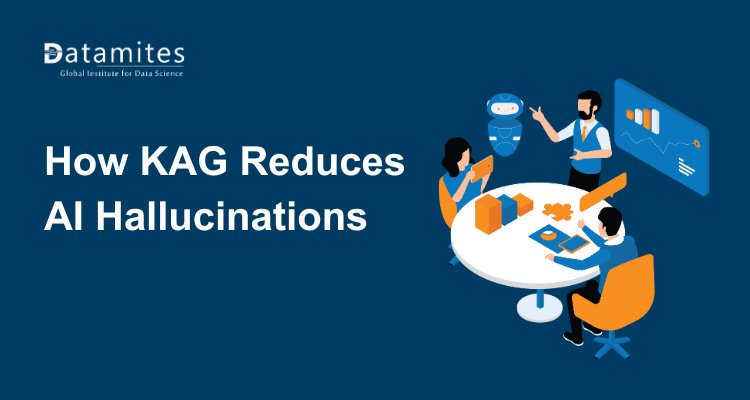
How Knowledge-Augmented Generation (KAG) Is Solving AI Hallucinations
Learn how Knowledge-Augmented Generation (KAG) reduces AI hallucinations by grounding LLMs in verified knowledge. Explore KAG architecture, real-world use cases, market research, and enterprise-ready strategies for building trustworthy AI systems.
 Swagatam Sinha
Generative AI has moved from experimental labs into real-world business workflows at an astonishing pace. From content creation and customer support to analytics and software development, large language models (LLMs) are now deeply embedded in enterprise systems. However, this rapid adoption has surfaced a critical challenge that cannot be ignored: the AI hallucination problem.
AI hallucinations occur when models generate information that sounds confident and fluent but is factually incorrect, outdated, or entirely fabricated. For consumer use cases, this may be inconvenient. For enterprises, healthcare, finance, or legal systems, hallucinations can be dangerous and costly.
This is where Knowledge-Augmented Generation (KAG) is emerging as a powerful and practical solution. By grounding generative models in structured, verified knowledge, KAG is reshaping how we build trustworthy AI systems and enterprise-ready generative AI.
This article explores how Knowledge-Augmented Generation works, why it matters, and how it is becoming one of the best methods to fix AI hallucinations.
Understanding the AI Hallucination Problem
Before diving into solutions, it’s important to understand why hallucinations happen in the first place.
Large language models are trained to predict the next word based on patterns in massive datasets. They do not inherently “know” facts in the human sense. Instead, they rely on statistical correlations learned during training. When prompted with incomplete, ambiguous, or unfamiliar information, models often fill gaps with plausible-sounding but incorrect answers.
This creates several issues:
- Fabricated facts and references
- Incorrect technical or medical advice
- Confident but misleading explanations
- Inconsistent responses across similar queries
As organizations scale AI usage, reducing AI hallucinations becomes essential for maintaining credibility, compliance, and user trust.
The global generative-AI market estimated USD 16.87 billion in 2024, with forecasts to reach ~USD 109.37 billion by 2030 (high CAGR), and an intermediate estimate of ~USD 22.2 billion in 2025 reported in the summary. This growth fuels enterprise demand for reliable, auditable model solutions like KAG. (Source: Grand View Research)
What Is Knowledge-Augmented Generation (KAG)?
Knowledge-Augmented Generation (KAG) is an advanced approach that enhances generative AI by integrating explicit knowledge sources directly into the generation process.
Instead of relying solely on learned patterns, knowledge-augmented AI models consult structured, authoritative knowledge such as:
- Knowledge graphs
- Enterprise databases
- Domain ontologies
- Verified documents and policies
This allows the model to generate responses that are not only fluent but also factually grounded.
In simple terms, KAG ensures that AI responses are based on what is known, not just what sounds right.
Read to these articles:
- AI Sovereignty: The New Mandate for Data Governance in the Cloud Era
- LLMs vs. SLMs: Key Differences and How to Choose the Right Model
- Traditional RAG vs Agentic RAG
How Does Knowledge-Augmented Generation Work?
To understand how Knowledge-Augmented Generation works, it helps to look at its core components.
1. Knowledge Layer
At the foundation lies a structured knowledge source. This may include:
- Knowledge graphs mapping entities and relationships
- Curated enterprise datasets
- Regulatory or policy documents
- Domain-specific facts and rules
This layer represents verified truth.
2. Knowledge Retrieval and Reasoning
When a user submits a prompt, the system identifies relevant knowledge elements related to the query. Unlike simple document retrieval, KAG often performs semantic reasoning, understanding relationships between entities and concepts.
This step is crucial for knowledge-grounded generation.
3. Generative Model Integration
The retrieved knowledge is then injected into the LLM’s context. The model generates responses while being constrained or guided by the provided facts.
This architecture ensures the output aligns with verified knowledge, significantly improving reliability.
KAG Architecture: A High-Level View
A typical KAG architecture includes:
- Input processing and intent detection
- Knowledge retrieval or reasoning engine
- Knowledge graph or structured data layer
- LLM generation layer
- Validation or confidence scoring
This layered approach enables enterprise AI accuracy by separating knowledge management from language generation, allowing each to be optimized independently.
Retrieval-Augmented vs Knowledge-Augmented Generation
One common question is the difference between retrieval-augmented vs knowledge-augmented generation.
Retrieval-Augmented Generation (RAG)
Retrieval-Augmented Generation pulls relevant documents or text chunks from a corpus and feeds them into the model as context. While effective, it has limitations:
- Retrieved text may contain errors
- No understanding of relationships between facts
- Limited reasoning capabilities
- Dependency on prompt length
Knowledge-Augmented Generation (KAG)
Knowledge-Augmented Generation goes further by using structured knowledge rather than raw text. This enables:
- Logical reasoning across entities
- Fact validation
- Consistency across responses
- Better handling of complex queries
In a KAG vs RAG comparison, KAG clearly excels in high-stakes and enterprise scenarios where accuracy matters more than surface-level relevance.
Read to these articles:
- The Future of Coding: Can AI Replace Software Engineers?
- Green AI Guide: Quantization and FinOps to Reduce LLM Costs
- Will Polars Replace Pandas? The Truth About Python’s New Data Library
How Knowledge-Augmented Generation Reduces AI Hallucinations
Knowledge-Augmented Generation directly addresses the root causes of hallucinations through multiple mechanisms:
- Grounding responses in verified knowledge
- Constraining generation paths using factual relationships
- Reducing reliance on probabilistic guessing
- Ensuring consistency across outputs
These capabilities make KAG one of the most effective AI hallucination mitigation techniques available today.
Best Methods to Fix AI Hallucinations
While no single approach is perfect, the following methods consistently improve results:
- Knowledge-Augmented Generation for factual grounding
- Human-curated knowledge graphs
- Model confidence scoring and uncertainty detection
- Prompt validation and context controls
- Continuous feedback and knowledge updates
Among these, KAG stands out as the most scalable AI hallucinations solution for enterprise deployments.
Improve LLM Accuracy With Knowledge Graphs
One of the most powerful aspects of Knowledge-Augmented Generation is its ability to improve LLM accuracy with knowledge graphs.
Knowledge graphs represent facts as entities and relationships, allowing AI systems to:
- Understand context beyond keywords
- Resolve ambiguity
- Perform multi-hop reasoning
- Maintain factual consistency
For example, in healthcare or finance, this ensures AI responses align with regulations, policies, and domain logic.
Knowledge graphs are a key enabling technology for KAG. Market estimates place the knowledge graph market around USD 1.06–1.18 billion in 2024, with projections showing rapid multi-year growth (CAGR often reported in the 25–36% range) as enterprises invest in graph engines to power search, recommendations, and KAG-style reasoning. The proliferation of knowledge graphs directly supports adoption of KAG pipelines. (Source: Markets and Markets)
Real-World Implementations of Knowledge-Augmented Generation (KAG)
These real-world examples from leading technology providers and enterprises demonstrate how Knowledge-Augmented Generation frameworks are being applied in production to reduce AI hallucinations, improve factual accuracy, and ensure trust, traceability, and compliance in enterprise and regulated environments.
1) Ant Group - KAG in e-Government and e-Health Q&A
The Ant Group research team published “KAG: Boosting LLMs in Professional Domains via Knowledge Augmented Generation”, describing a production-minded KAG framework that combines knowledge graphs and vector retrieval with hybrid logical reasoning. The paper reports substantial accuracy gains versus RAG baselines on multi-hop benchmarks and describes successful internal deployments for E-Government and E-Health question-answering, where structured domain rules and provenance materially reduced hallucinations.
2) Google Cloud / Glance - Gemini + Knowledge Graph for content intelligence
Glance and Google Cloud built a content knowledge graph that feeds Gemini Enterprise models to power content discovery and contextual search. The solution shows how combining a knowledge graph with a large model improves precision, entity linking, and provenance in content retrieval and recommendations typical KAG benefits (grounding, relationship-aware retrieval). (Source: Google Cloud)
3) Neo4j - LLM-friendly knowledge-graph tooling for production
Neo4j released an LLM Knowledge Graph Builder and retriever features to help teams create knowledge graphs directly from enterprise content and use them together with LLMs. The tooling explicitly targets production scenarios where a maintained knowledge layer reduces hallucination risk for search, assistants, and analytics.
4) Google / Gemini Enterprise - knowledge graph as an enterprise search layer
Google documents how a knowledge graph can power Gemini Enterprise use cases by linking people, content, and interactions into a single semantic layer that the model consults before answering. The documented pattern improves contextual accuracy and supports auditability.
5) IBM - knowledge-driven discovery for enterprise question answering
IBM’s Watson/Discovery portfolio and watsonx products are widely used to combine structured metadata and document retrieval for enterprise Q&A and analytics. IBM’s product pages and case notes highlight use cases where structured enterprise knowledge and controlled discovery reduce incorrect answers and speed decision-making.
Read to these articles:
- Data Scientist vs ML Engineer vs AI Engineer
- Data Engineer vs Analytics Engineer vs Data Analyst
- Data Mesh vs Data Fabric
Enterprise-Ready Generative AI With Knowledge-Augmented Generation
Enterprises demand systems that are explainable, auditable, and compliant. KAG supports this by:
- Separating knowledge from language generation
- Enabling updates without retraining models
- Supporting governance and traceability
- Improving trust and accountability
As a result, KAG is foundational for enterprise-ready generative AI.
Gartner projected worldwide generative AI spending of USD 644 billion in 2025 (a rapid year-over-year increase), signaling heavy enterprise investment in production AI and the governance around it. High spend and risk exposure increase the value of hallucination-mitigation techniques like KAG.
AI hallucinations are not a minor flaw; they are a fundamental challenge that must be addressed for AI to succeed in real-world applications. Knowledge-Augmented Generation (KAG) provides a clear, scalable, and enterprise-friendly solution by grounding generative models in verified knowledge.
By improving accuracy, consistency, and trust, KAG is shaping the next generation of trustworthy AI systems. For organizations seeking to deploy reliable generative AI models, KAG is no longer optional it is essential.
To support professionals aiming to build practical AI expertise, DataMites Institute offers industry-focused Artificial Intelligence courses in Ahmedabad. These programs are designed to help learners understand real-world AI challenges, including accuracy, trust, and responsible AI adoption, through hands-on training and expert-led instruction.
With a strong emphasis on applied learning, DataMites equips students and working professionals with skills aligned to enterprise AI needs, helping them stay relevant in a rapidly evolving artificial intelligence landscape.