LLM Fine-Tuning vs Prompt Engineering: Which Is Better?
Explore LLM fine-tuning vs prompt engineering with real examples, statistics, and expert insights to understand which method works best for AI optimization.
 Swagatam Sinha
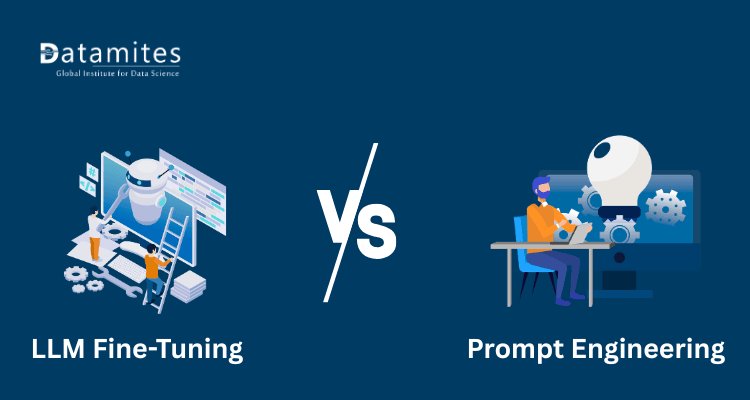
Artificial Intelligence has rapidly evolved with the rise of Large Language Models (LLMs) that power tools such as chatbots, virtual assistants, and intelligent automation platforms. These models are capable of understanding human language, generating content, answering questions, and even assisting in complex decision-making tasks. However, to make these models perform better for specific use cases, developers often rely on two major techniques: LLM Fine-Tuning and Prompt Engineering.
Both approaches help improve the performance of language models, but they work in very different ways. While prompt engineering focuses on designing better instructions for the model, fine-tuning involves retraining the model on specialized datasets. This leads to a common question among AI developers and businesses: LLM Fine-Tuning vs Prompt Engineering — which is better?
In this article, we will explore how these two techniques work, their advantages and limitations, and when each approach is the best choice for optimizing large language models.
What Are Large Language Models (LLMs)?
Large Language Models are advanced artificial intelligence systems trained on massive datasets of text to understand and generate human language. They rely on deep learning architectures, particularly transformer models, to process language patterns and context.
Popular LLM applications include:
- AI chatbots and conversational assistants
- Content generation tools
- Automated coding assistants
- Customer support automation
- Knowledge retrieval systems
These models learn general language patterns during training, but they often require customization to perform well in specific industries or tasks. This is where prompt engineering and LLM fine-tuning techniques become important.
Read these articles:
- Why Agentic AI Is the Most In-Demand Skill for Data Scientists in 2026
- How AI is Transforming Customer Analytics in 2026
- Explainable AI: Why Black-Box Models Are Losing Trust
What is Prompt Engineering?
Prompt engineering is the practice of crafting clear and effective instructions (prompts) that guide a large language model to produce accurate and relevant responses. Instead of retraining the model, developers simply modify the input prompts to improve the output.
This approach has become widely popular because it is fast, cost-effective, and easy to implement.
For example:
Instead of asking a model:
“Explain machine learning.”
A better prompt would be:
“Explain machine learning in simple terms for beginners with an example from healthcare.”
The improved prompt provides context and clarity, which helps the model generate more precise answers.
Growth of the Prompt Engineering Market
Prompt engineering has emerged as a major new skill in the AI industry.
According to recent market research:
- The prompt engineering market was valued at approximately $380 billion in 2024.
- It is expected to reach $505 billion in 2025.
- By 2034, the market could grow to over $6.5 trillion, with a CAGR of about 32.9%. (Source: Precedence Research)
This massive growth reflects the increasing reliance on generative AI across industries such as:
- marketing
- customer service
- software development
- financial services
As organizations integrate AI tools into their workflows, the demand for prompt engineering expertise continues to rise.
Key Techniques in Prompt Engineering
Several prompt engineering techniques help optimize LLM responses:
1. Zero-Shot Prompting
The model performs a task without prior examples.
Example:
“Summarize this article in three bullet points.”
2. Few-Shot Prompting
The prompt includes examples that guide the model.
Example:
Providing two examples of text summaries before asking the model to summarize another document.
3. Chain-of-Thought Prompting
Encourages the model to reason step by step before producing an answer.
4. Role-Based Prompting
Assigns a role to the model.
Example:
“Act as a financial advisor and explain investment diversification.”
These techniques significantly improve the quality of AI-generated responses without modifying the underlying model.
Advantages of Prompt Engineering
Prompt engineering offers several benefits for developers and businesses.
Cost-effective
It does not require expensive model retraining or large datasets.
Quick implementation
Prompts can be modified instantly without complex engineering work.
Flexible
The same model can perform multiple tasks simply by changing prompts.
Lower technical barrier
Even non-developers can design effective prompts with basic understanding.
Because of these advantages, prompt engineering has become one of the most widely used methods for large language model optimization.
Refer to these articles:
- Will AI Agents Replace Your Next Coworker? Exploring the Future of Work
- CrewAI vs. AutoGen vs. LangGraph: Which multi-agent framework should you learn in 2026?
- How Knowledge-Augmented Generation (KAG) Is Solving AI Hallucinations
Limitations of Prompt Engineering
Despite its advantages, prompt engineering also has certain limitations.
Limited customization
Prompts cannot fully adapt a model to very specialized domains.
Inconsistent outputs
Different prompts may generate inconsistent responses.
Prompt sensitivity
Small changes in wording may significantly affect results.
Context limitations
Very long prompts may exceed model context limits.
For highly specialized tasks such as medical analysis or financial prediction, prompt engineering alone may not be sufficient.
What is LLM Fine-Tuning?
LLM fine-tuning is the process of retraining a pre-trained language model on a smaller, specialized dataset to improve its performance in a specific domain or task.
Instead of modifying prompts, developers adjust the model’s internal parameters using domain-specific data.
For example:
A general LLM trained on internet data may not fully understand legal terminology. By fine-tuning the model on legal documents, contracts, and case studies, it becomes more capable of assisting lawyers or legal researchers.
This process allows organizations to create custom AI models tailored to their industry needs.
Growth of the LLM Market
The broader large language model market is also expanding rapidly.
Recent industry reports indicate:
- The global LLM market is projected to grow from $19.12 billion in 2025 to over $135 billion by 2035. (Source: Global growth insights)
- Approximately 66% of software development companies now use AI coding assistants powered by large language models.
- Around 52% of mid-sized enterprises report productivity improvements of more than 30% after adopting LLM-based systems.
These statistics highlight the increasing role of AI models in enterprise productivity and automation.
How Fine-Tuning Works
Fine-tuning typically follows these steps:
Select a base LLM
Choose a pre-trained language model.
Prepare domain-specific data
Collect and clean relevant datasets.
Train the model further
Adjust the model parameters using the new dataset.
Evaluate performance
Test the model on real-world tasks.
Deploy the optimized model
Fine-tuning helps the model learn new patterns that were not included in its original training data.
Benefits of LLM Fine-Tuning
Fine-tuning provides several advantages for AI applications.
High accuracy
Models become highly specialized for specific tasks.
Domain expertise
Fine-tuned models understand industry terminology and context.
Better consistency
Outputs become more reliable and aligned with specific use cases.
Improved automation
Businesses can deploy AI systems that perform complex workflows.
Because of these benefits, many organizations rely on fine-tuning when building enterprise AI solutions.
Challenges of LLM Fine-Tuning
However, fine-tuning also comes with certain challenges.
Higher cost
Training models requires computing resources and infrastructure.
Data requirements
High-quality domain datasets are needed.
Technical complexity
Fine-tuning requires machine learning expertise.
Maintenance
Models may need periodic retraining as data evolves.
For smaller projects or quick implementations, fine-tuning may not always be the most practical option.
LLM Fine-Tuning vs Prompt Engineering
Below is a comparison that highlights the key differences between the two approaches.
| Feature | Prompt Engineering | LLM Fine-Tuning |
| Method | Adjust prompts to guide responses | Retrain model with new data |
| Cost | Low | High |
| Implementation speed | Fast | Slower |
| Technical complexity | Low to moderate | High |
| Customization level | Limited | Very high |
| Data requirement | Minimal | Large datasets required |
| Best use case | General tasks | Domain-specific tasks |
Both methods serve different purposes, and the choice depends on project requirements.
When Should You Use Prompt Engineering?
Prompt engineering works best in scenarios where quick results are needed without heavy infrastructure.
Common use cases include:
- Content generation and writing assistance
- Customer support chatbots
- Data summarization tools
- Educational AI assistants
- Marketing automation
In these applications, prompt optimization can significantly improve the quality of responses without retraining the model.
When Should You Choose Fine-Tuning?
Fine-tuning becomes the better option when organizations require specialized AI systems.
Examples include:
Healthcare AI systems
Medical diagnosis assistants require models trained on medical datasets.
Legal research tools
Law firms need models that understand legal language and case law.
Financial analysis platforms
Financial institutions require models trained on market data and financial documents.
Enterprise automation
Large companies often fine-tune models for internal workflows.
In these situations, prompt engineering alone may not deliver the required accuracy.
Refer to these articles:
- AI Sovereignty: The New Mandate for Data Governance in the Cloud Era
- LLMs vs. SLMs: Key Differences and How to Choose the Right Model
- Traditional RAG vs Agentic RAG — What’s the Difference?
Which One Is Better for Businesses and AI Developers?
The answer depends on the project goals.
Prompt engineering is ideal for:
- Rapid prototyping
- Low-budget projects
- Multi-purpose AI applications
Fine-tuning is ideal for:
- Industry-specific AI solutions
- High-accuracy requirements
- Large-scale enterprise systems
In practice, many organizations combine both techniques. Developers first use prompt engineering to test ideas and later apply fine-tuning to improve performance.
This hybrid approach provides both flexibility and precision.
Real-World Examples of Prompt Engineering and LLM Fine-Tuning
Understanding how companies apply these techniques in real-world scenarios helps clarify the difference between prompt engineering and fine-tuning.
1. Financial Services: AI Tax Automation
Large consulting firms are already using prompt engineering to automate complex documentation workflows.
For example, KPMG Australia developed an AI system called TaxBot to generate tax advice and financial documentation. The system was built using large language models combined with structured prompts and internal tax knowledge. During development, engineers created a 100-page prompt framework that guides the AI in generating professional tax reports.
The result was significant efficiency improvements—tasks that previously took two weeks can now be completed in a single day with AI assistance.
This example shows how prompt engineering can dramatically improve productivity without retraining the model.
2. Healthcare AI Systems
Healthcare organizations often require higher accuracy and domain expertise. In these cases, fine-tuning is typically preferred.
For example, AI models trained on medical datasets are used for:
- Medical diagnosis assistance
- Clinical documentation automation
- Drug discovery research
Academic research evaluating LLM strategies for mental health analysis found that fine-tuned models achieved up to 91% accuracy, significantly outperforming prompt-based approaches in complex classification tasks.
This demonstrates why industries with strict accuracy requirements rely more heavily on LLM fine-tuning.
3. Software Development and Coding Assistants
Technology companies frequently combine both techniques.
Research comparing prompt engineering and fine-tuning in software engineering tasks found that:
- Fine-tuned models performed 16–28% better in code generation tasks
- Prompt-optimized models sometimes performed better for documentation and comment generation.
This suggests that different tasks may require different optimization approaches, even within the same industry.
The debate between LLM Fine-Tuning vs Prompt Engineering is not about choosing a single winner. Both techniques play a critical role in optimizing large language models for real-world applications.
Prompt engineering provides a quick and flexible way to guide AI models without retraining them. It is ideal for general tasks, content generation, and rapid experimentation.
Fine-tuning, on the other hand, enables deep customization by training models on specialized datasets. This approach is essential for industries that require high accuracy and domain expertise.
For many organizations, the best strategy is to combine both methods. By leveraging prompt engineering for flexibility and fine-tuning for specialization, businesses can build powerful AI systems that deliver reliable and intelligent outcomes.
As artificial intelligence continues to advance, understanding these optimization techniques will become an essential skill for data scientists, AI developers, and technology leaders.
DataMites Institute is a globally recognized training provider known for its industry-focused programs in Data Science, Machine Learning, and Artificial Intelligence. DataMites institute offers a comprehensive Artificial Intelligence Course in Chennai designed for students and working professionals who want to build strong AI skills. The program includes hands-on projects, expert mentorship, internship opportunities, and placement assistance, helping learners gain practical experience and prepare for real-world AI careers.