Rohit’s Inspiring Journey from Banking to Research Analyst
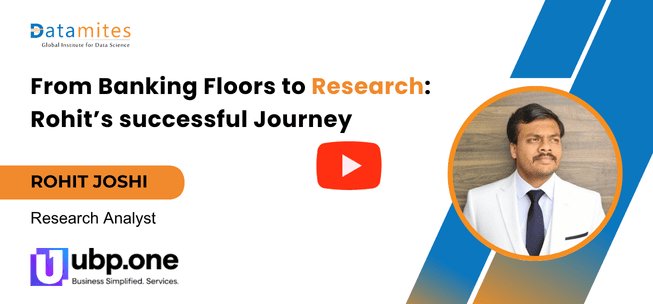
Rohit’s Inspiring Journey from Banking to Research Analyst highlights how consistent learning, practical projects, and strong fundamentals helped him transition from a non-technical background into data analytics.
 Kriti Maurya
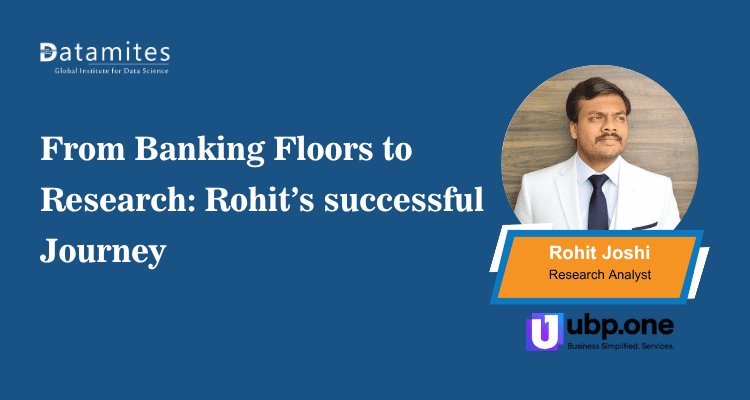
Rohit’s inspiring journey from a banking professional to a Research Analyst in the data analytics domain. Through a structured question-and-answer format, it explores his learning experience, challenges, project work, interview preparation, and career transition. It also provides valuable insights and practical tips for aspiring data analysts, especially those from non-technical backgrounds aiming to build a successful career in data science and analytics.
Rohit’s Journey of Professional Upskilling into Analytics
Rohit’s journey of professional upskilling into data analytics highlights how the right IT courses in Ahmedabad can transform a career. Coming from a non-technical background, he leveraged structured learning and consistent practice to enter the data domain. His experience reflects the growing importance of industry-focused This journey serves as inspiration for aspiring professionals looking to transition into data analytics through practical and career-oriented learning.
1. Can you introduce yourself and your background?
Rohit:
I completed my Bachelor’s degree in Mechanical Engineering in 2021 and later pursued an MBA in Finance. After that, I worked as an Assistant Manager in the banking sector for about a year. However, I wanted to move into a future-focused field, so I decided to transition into data science and analytics.
2. Why did you choose data science and analytics?
Rohit:
I realized that data science and AI are future-driven technologies with great career potential. I wanted to build a strong and promising future, so I chose this field. I specifically opted for offline training to get better guidance and a personal learning experience.
3. How was your learning experience as a non-technical student?
Rohit:
Coming from a mechanical background, coding was quite challenging initially. I spent the first 1–2 months focusing on Python. I dedicated around 4–5 hours daily to learning, including self-study beyond the course, especially in AI-related topics.
4. Which subjects were most challenging and which did you enjoy the most?
Rohit:
Coding, especially Python, was the most challenging due to my non-technical background. However, as I practiced more, it became interesting and rewarding.
5. How many projects did you complete during your course?
Rohit:
I completed around 5 projects provided by the institute, including a client project. Additionally, I worked on projects independently through online platforms like YouTube.
Refer to the Articles Below:
- How internship boost data analyst career in Delhi for freshers
- Top Tech Skills for Data Analytics Careers in Delhi
- Top Industries Hiring Data Analysts in Delhi
6. Can you share your interview experience?
Rohit:
I attended multiple interviews for data science roles but faced challenges due to my non-technical background. Eventually, I decided to start with a data analytics role as a Research Analyst, which is a stepping stone toward becoming a data scientist.
7. What kind of questions were asked in interviews?
Rohit:
Most interviews had:
- Aptitude round
- Technical round (Python, SQL, Power BI)
- HR round
Some companies asked MCQs, while others required coding. Writing code on paper without execution tools was particularly challenging.
8. Were projects important during the interview process?
Rohit:
Yes, especially in HR rounds. Interviewers asked detailed questions about projects, including alternative approaches and problem-solving strategies. Knowing projects end-to-end is very important.
9. Which tools are most important for data analytics?
Answer:
For data analytics:
- Excel
- Power BI
For data science:
- Python
- SQL
These are essential tools to focus on for career growth.
10. What tips would you give to beginners?
Rohit:
- Practice Python and SQL daily (1–2 hours)
- Participate in coding platforms like HackerRank
- Focus on logic-building, not just coding
- Learn emerging technologies like AI, LLMs, and prompt engineering
- Don’t limit yourself to tools like NumPy and Pandas keep evolving
Refer to the Articles Below:
- How to Become a Data Analyst With No Experience
- Introduction to ETL in Data Analytics
- 6 Innovative Ways to Leverage AI in Data Analytics
Key Findings from Rohit’s Journey as a Research Analyst
Rohit’s journey is one of the inspiring DataMites Success Stories, showcasing how dedication can transform a career path. His transition from a non-technical background to data analytics highlights the power of consistent learning and practical exposure. This introduction captures the key insights that can guide aspiring professionals toward a successful analytics career.
- Transitioning from a non-technical background to data analytics is possible with consistent effort: Rohit’s journey proves that even without a technical background, entering data analytics is achievable. With determination and the right learning approach, foundational skills can be built over time. Consistency and patience are the key drivers of such successful transitions.
- Daily practice (4–5 hours) plays a crucial role in skill development: Regular practice helps in strengthening concepts and improving problem-solving abilities. Rohit dedicated several hours daily, which accelerated his learning curve. This disciplined approach is essential to gain confidence in technical skills
- Python is initially challenging but becomes easier with practice: For beginners, especially from non-technical backgrounds, Python for Data Analysis can seem difficult at first. However, continuous hands-on practice helps in understanding logic and syntax better. Over time, it becomes one of the most valuable and manageable tools.
- Real-world projects significantly improve interview performance: Working on projects helps in applying theoretical knowledge to practical scenarios. Rohit’s multiple projects gave him confidence and clarity during interviews. Employers often assess project experience to evaluate real-world problem-solving skills.
- Strong knowledge of Excel and Power BI is essential for analytics roles: These tools are widely used in the data analytics industry for data handling and visualization. Rohit emphasized their importance during interviews and job preparation. Mastering them can greatly enhance employability in analytics roles.
- Continuous learning (AI, LLMs, prompt engineering) is critical for long-term growth: The data field is constantly evolving with new technologies and trends. Rohit highlighted the importance of staying updated beyond core tools. Learning advanced concepts like AI and prompt engineering ensures sustained career growth.
Rohit’s journey clearly demonstrates that with dedication and consistent effort, transitioning into data analytics is achievable for anyone. His experience highlights the importance of practical learning, strong fundamentals, and continuous skill development. By focusing on the right tools and gaining real-world exposure, aspiring professionals can improve their career prospects. Overall, this story serves as motivation for learners to stay persistent and embrace growth in the evolving data analytics field.
Refer to the Articles Below:
- From Fresher to Data Analyst: Ayesha’s Path to Success
- Leveling Up : Naveen’s Advancement as a Data Analyst
- Fresher to Analyst Alpesh’s Inspiring Data Story
DataMites Global Training Institute is a premier IT training provider delivering in-depth Data Analytics courses in Delhi, along with advanced courses in Data Science, Artificial Intelligence, Machine Learning, Python, and IoT. By focusing on experiential training with real-time projects, internship opportunities, and structured placement guidance, the institute prepares students for real-world job roles and awards internationally valued certifications approved by IABAC and NASSCOM FutureSkills
In addition to its Data Analytics course in Ahmedabad, DataMites conducts flexible, career-focused training across major hubs such as Bangalore, Chennai, Pune, Mumbai, and Indore, enabling aspiring professionals to build successful careers in analytics and emerging technologies.