Should I Choose Data Science or Artificial Intelligence (AI) for My Career?
Artificial Intelligence is set to transform businesses by automating routine tasks, improving decision making, and delivering more personalized customer experiences. As AI technologies advance, businesses can leverage smarter insights, greater efficiency, and innovative solutions to achieve sustainable growth.
 Shiva PS
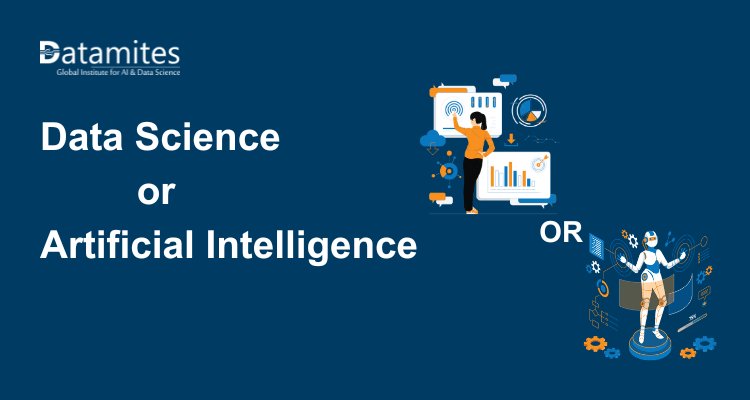
Data Science and Artificial Intelligence are the buzz words that are commonly quoted when someone starts talking about their career. Last few years have not only shaped up the job roles in Data Science, Artificial Intelligence and Machine Learning, along with, it has also opened up doors for doubts and confusions. You may be a young grad fresh out of college or someone who’s deeply involved in the tech world aspiring to change your career path, one query that pops up is which is a better career choice “Data Science or Artificial Intelligence”?
Well, we are here to help you find an answer to this question.
Data Science or Artificial Intelligence career:
We are pretty sure, by now, you already knew what Data Science is all about and what Artificial Intelligence is.
Shall we do a quick refresh?
Data Science is working on huge chunks of raw data and deriving at insights that benefit the Business whereas Artificial Intelligence is about creating intelligent machines that work and think like us.
Data Science is a new “Mine”:
Ever since the digital revolution, a gigantic amount of data is being produced every millisecond and taking the technology industry by storm. In fact, it is apt to quote here that there are no longer mines to dig gold and diamonds but we have a new type of mines now and that is “Data mines” which is being dug to get analyzed and drive business decisions to foster innovation and development.
Organizations are increasingly reliant on data and looking for skilled experts who can be an immense benefit for them. The World Economic Forum's Future of Jobs Report 2025 identifies Big Data Specialists and AI and Machine Learning Specialists among the fastest-growing job roles through 2030, while AI and big data rank as the fastest-growing skill areas.
Artificial Intelligence is ubiquitous now:
For years, Artificial intelligence has been considered as a joke and a commonly used “storyline” in Sci-fi movies. The moment we speak of AI all we remember is “Arnold Schwarzenegger” the so-called Robot from the future is fighting with his machine gun to protect John Connor. This shows that AI has ruled the film industry for years and has bought so much excitement in our minds however only the recent years, have proved to be lucky for its entry in the actual Tech industry. Though its entry was a little late, we can feel its ubiquitous presence now.
AI-powered assistants and generative AI tools, personalized recommendations on platforms such as Netflix and Amazon, and AI-powered search and productivity applications demonstrate how deeply artificial intelligence is integrated into everyday digital experiences.
According to Fortune Business Insights, the global artificial intelligence market was valued at USD 294.16 billion in 2025 and is projected to reach USD 375.93 billion in 2026 and USD 2,480.05 billion by 2034, growing at a CAGR of 26.60%; North America held the largest market share at 31.80% in 2025.
What is the nature of work and needed skills of Data Science and Artificial Intelligence fields?
We have a clear idea about what Data Science and Artificial Intelligence is all about. Let’s see what is the nature of work of both the fields.
A Data scientist is the one who needs to mine out the value from the data after proactively fetching form various resources and analyzing it. The mined-out value is used to find out how the business performs and also helpful in building AI tools and techniques that automate certain processes of the organization. So, as a Data Scientist, your work typically includes performing statistical analysis and applying data mining techniques.
Core skills needed for a Data Scientist:
- Strong statistical and analytical skills
- Proficiency in Python and SQL
- Knowledge of Data Science tools and techniques
- Understanding of data modeling and machine learning
- Domain knowledge and problem-solving skills
If you choose to be an artificial intelligence specialist, your job involves automation, robotics and the use of sophisticated computer software and programs to build high-quality prediction systems that can be integrated into the products of your company.
In 2026, Data Scientists can also benefit from skills in SQL, cloud platforms, machine learning operations, generative AI and responsible AI practices.
Core skills needed for a job in Artificial Intelligence:
- Strong mathematical and statistical skills
- Proficiency in Python and AI programming
- Knowledge of Machine Learning and Deep Learning
- Familiarity with AI frameworks such as PyTorch and TensorFlow
- Understanding of Generative AI and Large Language Models (LLMs)
- Knowledge of cloud platforms and MLOps
Data Science vs Artificial Intelligence: Key Differences
| Factor | Data Science | Artificial Intelligence |
| Primary focus | Extracting insights and supporting decisions using data | Building systems that perform intelligent tasks |
| Core skills | Statistics, Python, SQL, data analysis, machine learning | Python, mathematics, machine learning, deep learning, GenAI |
| Typical work | Data analysis, experimentation, modeling, visualization | Model development, automation, AI applications, intelligent systems |
| Common roles | Data Scientist, Data Analyst, ML Scientist | AI Engineer, ML Engineer, AI Specialist |
| Best suited for | People who enjoy analyzing data and solving business problems | People interested in building intelligent systems and AI applications |
Data Science vs AI Career Scope
Both Data Science and Artificial Intelligence offer strong career opportunities in 2026, but their roles and applications are increasingly overlapping. The World Economic Forum identifies AI and big data among the fastest-growing skill areas through 2030, while AI and Machine Learning Specialists and Big Data Specialists are among the fastest-growing roles.
Data Science remains important for data analysis, experimentation, statistical modeling, and preparing and evaluating data for AI systems. At the same time, Generative AI and large language models are expanding opportunities for AI-focused roles in areas such as automation, intelligent applications, and AI engineering.
Therefore, AI has not replaced Data Science. The better career choice depends on whether you prefer analyzing data and solving business problems or building intelligent systems and AI applications.
What do you aim for?
Many IT professionals often wish to scale up their career by transitioning into a most lucrative Data Science or Artificial intelligence career. Honestly, you should think of your interest first before looking at its monetary benefits. Because, both the fields are equally competitive and pay you well and so you need to find where your interest lies.
Now, ask yourself. Will I be interested in playing with a vast amount of data using my statistical ability and technical skills? So, if you are basically a data-oriented personality who loves to juggle a vast amount of data and gain valuable insights for your organization then a Data Science career is the best choice. Rather, if your interest and aim lie in developing the software for robots and systems for automation then you have to choose Artificial Intelligence.
The boundary between Data Science and AI is also becoming less distinct, as many Data Scientists now work with machine learning, generative AI and automated analytics, while AI professionals increasingly rely on data engineering and statistical methods.
What’s the good news for those who are looking to upskill themselves?
The good news is that upskilling yourself for both the fields has become easier than ever before. DataMites™, a high-quality training provider who is delivering highly curated and specialized courses through top-class industry experts at affordable prices. The courses are flexible and available through online training, self-learning and classroom training. Being designed in such a way that our courses not only focusing on the theory part students will also provide ample opportunities to gather hands-on experience with real industry projects. Starting from basic concepts to advanced level specialization courses are available in Data Science and Artificial intelligence.
Key highlights of DataMites™ Courses:
- We are accredited by the International Association of Business Analytics Certifications (IABAC) and NASSCOM FutureSkills for providing international certificates for Data Science professionals.
- The best Learning approach that has been designed with industry experts which go in a step by step process of theory, hands-on, case study, project, and Model deployment.
- Our DataMites™ Courses come with 10 capstone projects and 1 client projects that help our participants to gain real-time skills for a smooth transition to work after training.
- Our faculties and mentors are highly knowledgeable and experienced.
- A special PAT (placement assist) team to help our candidates to get placed in prestigious companies.
- 1-year access to all resources that help you to clear any doubt even after you complete your course with us.
By now you would have decided which field will suit you. Isn’t it? It’s time to make the correct choice for your courses as well.
The DataMites AI Training is a 9-month program covering Python, Machine Learning, Deep Learning, Generative AI, LLMs, and AI model development. With 200,000+ learners trained and 40+ offline centers, DataMites provides practical projects, mentor guidance, and career-focused learning.
The DataMites Data Science course is an 8-month program covering Python, SQL, statistics, Machine Learning, data analysis, visualization, and predictive modeling. Learners gain practical experience through projects and case studies designed around real-world Data Science applications.