The Role of AI in Finance
Explore the role of AI in finance, from fraud detection and risk management to personalized banking and algorithmic trading. Discover how AI is transforming financial services, enhancing efficiency, and driving smarter decision-making in a data-driven economy.
 Kriti Maurya
Artificial Intelligence is revolutionizing industries across the globe, and the financial sector is no exception. From automating routine processes to delivering deep predictive insights, AI in finance has emerged as a transformative force that is reshaping how financial institutions operate, serve customers, and manage risks. As digital transformation accelerates, the role of AI in finance continues to expand, enabling organizations to become more efficient, data-driven, and customer-centric.
Here will explores the evolving landscape of AI and finance, highlighting its impact, applications, real-world use cases, and career opportunities for aspiring professionals.
Impact of AI in Finance Industry
The impact of AI in finance is profound and multi-dimensional. Financial institutions are increasingly adopting AI-driven technologies to enhance operational efficiency, improve decision-making, and deliver personalized customer experiences.
One of the most significant effects of AI in the finance industry is automation. Tasks such as data entry, transaction processing, and compliance checks are now handled by intelligent systems, reducing human error and operational costs. This automation allows financial professionals to focus on strategic activities that require critical thinking and creativity.
KPMG global AI in finance report highlights rapid adoption, with 71% of companies using AI in finance. It is transforming areas like accounting, risk, and planning, improving efficiency, accuracy, and decision-making across 2,900 firms worldwide. However, many AI initiatives fall short due to unclear use-case strategies and a lack of alignment in internal skills.
Additionally, AI in financial services has enhanced risk management. Machine learning algorithms can analyze vast datasets in real time, identifying patterns and anomalies that may indicate fraud or financial risks. This proactive approach helps institutions mitigate losses and ensure regulatory compliance.
Another key impact is improved customer experience. AI-powered chatbots and virtual assistants provide 24/7 support, answering queries, and offering financial advice. These systems learn from user interactions, continuously improving their responses and creating a more personalized banking experience.
Refer to the articles below:
- Key Challenges in Implementing AI in Marketing
- The Rise and Evolution of AI in Healthcare
- AI Product Development Life Cycle Explained
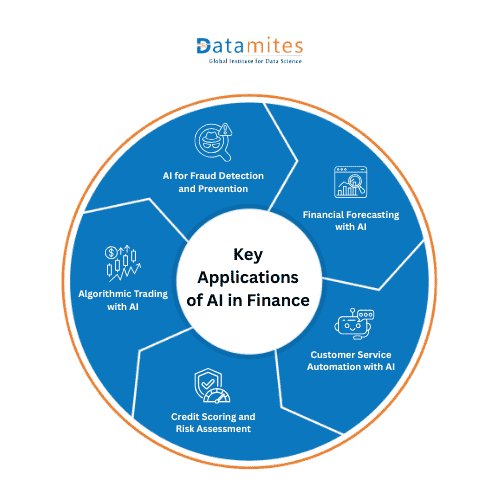
Key Applications of AI in Finance
The role of AI in finance is best understood through its diverse applications across various financial functions. These applications are driving innovation and efficiency in the sector.
1. AI for Fraud Detection and Prevention
AI systems use advanced algorithms to detect unusual transaction patterns, helping prevent fraudulent activities. By analyzing historical data and user behavior, AI can identify potential threats in real time.
2. Algorithmic Trading with AI
In the realm of investment, AI in finance enables algorithmic trading, where machines execute trades based on predefined criteria. These systems can process market data at high speeds, making decisions faster than human traders.
3. Credit Scoring and Risk Assessment
Traditional credit scoring models are being replaced by AI-driven systems that consider a wider range of variables. This leads to more accurate risk assessments and inclusive lending practices.
4. Customer Service Automation with AI
AI-powered chatbots and voice assistants are transforming customer service in AI and finance, providing instant responses and reducing the need for human intervention.
5. Financial Forecasting with AI
AI models can predict market trends, customer behavior, and financial outcomes by analyzing historical data. This enables better planning and decision-making for financial institutions.
AI Transforming Financial Sector
The phrase AI transforming the financial sector is not just a trend, it reflects a fundamental shift in how financial systems operate. AI technologies are enabling institutions to move from reactive to proactive strategies.
For instance, predictive analytics allows banks to anticipate customer needs and offer tailored products. This level of personalization enhances customer satisfaction and loyalty. Moreover, AI-driven insights help organizations identify new market opportunities and optimize their services.
In addition, AI in the finance industry is fostering innovation through the development of new financial products and services. Fintech companies are leveraging AI to create solutions such as robo-advisors, digital wallets, and automated investment platforms.
The transformation is also evident in regulatory compliance. AI tools can monitor transactions and ensure adherence to regulations, reducing the risk of penalties and enhancing transparency.
Key AI Use Cases in Finance
Understanding AI use cases in finance provides a clearer picture of its real-world impact. Here are some prominent examples:
- Personalized Banking: AI analyzes customer data to deliver tailored financial recommendations, including investments and savings plans. Banks leverage AI to enhance customer engagement and retention through hyper-personalization.
Market reports indicate that over 70% of financial institutions are investing in AI-driven personalization to improve customer experience. - Fraud Detection: AI systems monitor transactions in real time to identify suspicious patterns and prevent fraud.
Machine learning models continuously evolve to detect new and complex fraud techniques.
According to industry reports, AI-based fraud detection can reduce financial fraud losses by up to 40–50%. - Wealth Management: Robo-advisors use AI to provide automated, data-driven investment advice. They assess risk tolerance and financial goals to optimize portfolio management.
The global robo-advisory market is projected to exceed $2 trillion in assets under management in the coming years. - Loan Processing: AI streamlines loan approvals by evaluating applicant data quickly and accurately. It improves credit scoring by incorporating alternative data sources.
Reports suggest AI can reduce loan processing time by up to 70% while improving approval accuracy. - Regulatory Compliance: AI tools automate compliance by monitoring transactions and generating real-time reports. They help institutions stay aligned with evolving financial regulations.
Market studies show that AI-driven compliance solutions can cut operational costs by up to 30% while enhancing accuracy.
These insights highlight how AI in financial services is driving efficiency, accuracy, and improved customer satisfaction.
Additionally, AI automates routine tasks, allowing advisors to focus on building relationships and understanding client needs. This combination of technology and human expertise creates a more effective and customer-centric approach.
In essence, AI in financial services empowers professionals to perform at their best, enhancing both productivity and client satisfaction.
How to Build a Career in AI for Finance
With the growing importance of AI and finance, there is a rising demand for professionals who can bridge the gap between technology and financial services. Building a career in this field requires a combination of technical skills, domain knowledge, and practical experience.
1. Develop a Strong Foundation
Start by gaining a solid understanding of finance concepts such as accounting, investment analysis, and risk management. At the same time, build technical skills in programming languages like Python and R.
2. Learn AI and Machine Learning
To excel in the role of AI in finance, it is essential to learn machine learning algorithms, data analysis techniques, and top AI tools for beginner. Online courses and certifications can help you acquire these skills.
3. Gain Practical Experience
Work on real-world projects related to AI use cases in finance, such as fraud detection, predictive analytics, and algorithmic trading. Internships and hands-on experience are crucial for building expertise.
4. Stay Updated with Industry Trends
The field of AI in the finance industry is constantly evolving. Stay informed about the latest developments, tools, and technologies to remain competitive.
5. Build a Professional Network
Connect with industry professionals, attend webinars, and participate in forums related to AI in financial services. Networking can open up new opportunities and help you learn from experts.
6. Pursue Specialized Roles
Career opportunities in this field include AI Engineer, Data Scientist, Financial Analyst, Risk Analyst, and Quantitative Analyst. Choose a role that aligns with your interests and skills.
The role of data analysis in finance is transforming the industry in unprecedented ways. From enhancing operational efficiency to improving customer experiences, AI in finance is driving innovation and growth across the sector. As AI and finance continue to evolve, organizations that embrace these technologies will gain a competitive edge.
While AI offers numerous benefits, it is important to remember that human expertise remains essential. The collaboration between AI systems and human professionals creates a powerful synergy that drives success in the financial sector.
Refer to the articles below:
- LLM Fine-Tuning vs Prompt Engineering: Which Is Better
- How AI is Transforming Customer Analytics in 2026
- Explainable AI: Why Black‑Box Models Are Losing Trust
For aspiring professionals, the rise of AI for Finance course presents exciting career opportunities. By developing the right skills and staying updated with industry trends, you can build a successful career in this dynamic and rapidly growing field. AI in financial services is not just a technological advancement it is a strategic enabler that is shaping the future of finance.
DataMites Bangalore offers a comprehensive AI for Finance course designed to help finance professionals leverage artificial intelligence for smarter, data-driven decision-making. The program covers AI fundamentals, financial analytics, and practical applications in risk management, fraud detection, investment analysis, and financial forecasting. It is part of a broader portfolio that includes AI programs for AI for HR, AI Marketing, AI for Healthcare, and AI for Business Leaders.
Learners can choose flexible formats, including online and classroom training, along with real-time project-based internships for hands-on experience. With globally recognized certifications from IABAC, DataMites Institute operates 30+ centers across major Indian cities, inclusding Hyderabad, Pune, Chennai, Ahmedabad, Bangalore, Mumbai, Coimbatore, Delhi, Nagpur, and Kochi delivering industry-focused training.