Top AI Tools for Data Analysts in 2026
Top AI tools for data analysts in 2026 with latest trends, tools, and market insights. Learn how AI is transforming data analytics.
 Swagatam Sinha
Data analysis is no longer just about dashboards and spreadsheets. In 2026, the role of a data analyst is evolving into something far more strategic. Analysts are now expected to extract insights faster, predict outcomes, and support real-time decision-making.
This shift is largely driven by artificial intelligence.
According to a 2026 report by Deloitte, organizations worldwide are rapidly scaling AI adoption, with over 3,200 global leaders confirming that AI is now central to business strategy.
At the same time, global AI investment is skyrocketing. A 2026 industry report shows that AI spending is expected to cross $3.3 trillion by 2029, growing at a CAGR of over 22%.
This transformation is redefining how analysts work and the tools they use.
Why AI Tools Are Essential for Data Analysts in 2026
Modern data analysts face three major challenges:
- Massive data volumes
- Real-time decision requirements
- Demand for predictive insights
AI tools address all three.
Instead of manually cleaning data or building models from scratch, analysts now rely on AI for:
- Automated data preparation
- Natural language queries
- Predictive modeling
- Instant visualization
A recent industry study shows that AI-assisted workflows can significantly increase output while maintaining quality, with over 63% of companies already using AI tools in development and analytics workflows. (Business Insider)
This means one thing: AI tools are no longer optional they are a core skill.
According to Grand View Research AI Market Report, the AI market is projected to grow at a 30.6% CAGR through 2033, indicating rapid innovation and tool evolution.
Refer to these articles:
- AI Agents for Data Analysis: Tools and Use Cases
- SQL vs Python for Data Analytics in 2026
- How Looker, Tableau, and Power BI Are Revolutionizing Data Analytics
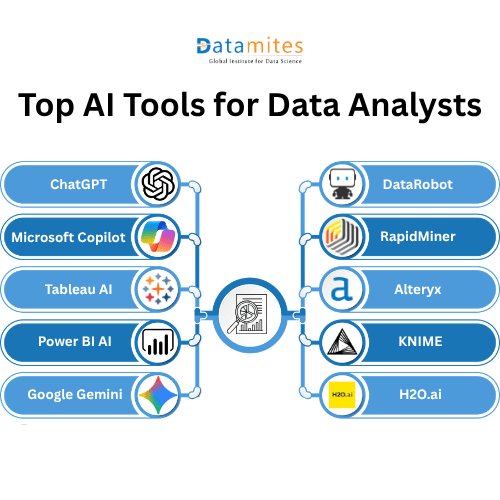
Top AI Tools for Data Analysts in 2026
Artificial intelligence is redefining how data analysts work in 2026. From automating repetitive tasks to delivering predictive insights, modern AI tools help analysts make faster, smarter, and more data-driven decisions. Below is a detailed, breakdown of the top AI tools every data analyst should consider.
1. ChatGPT for Data Analysis
A leading AI assistant that enables analysts to interact with data using natural language, making complex analysis simple and efficient.
Key Features:
- Generates Python and SQL queries instantly
- Performs exploratory data analysis (EDA)
- Creates summaries, insights, and reports automatically
- Supports data visualization guidance
Use Case:
Upload a dataset and ask: “Identify customer churn patterns and visualize key trends.” ChatGPT can clean data, analyze it, and suggest visualizations.
Best For: Quick analysis, automation, and report generation
2. Microsoft Copilot
An AI-powered assistant integrated across Excel, Power BI, and other Microsoft tools, enhancing productivity within enterprise workflows.
Key Features:
- Automated insights directly in spreadsheets
- Intelligent formula and code suggestions
- Workflow automation across Microsoft apps
- Seamless integration with business data
Use Case:
Analyze large Excel datasets and generate insights or formulas automatically without manual effort.
Best For: Enterprise users and Excel-based analytics
3. Tableau AI
A powerful data visualization platform enhanced with AI to uncover insights through interactive dashboards.
Key Features:
- AI-driven predictive analytics
- Natural language queries (Ask Data)
- Smart and interactive dashboards
- Automated insight generation
Use Case:
Create dashboards that automatically highlight sales trends and forecast future performance.
Best For: Data visualization and business intelligence
4. Power BI AI
A robust business intelligence tool with built-in AI capabilities for real-time analytics and reporting.
Key Features:
- Real-time data dashboards
- AI-powered insights and forecasting
- Integration with Azure AI services
- Custom data models and reports
Use Case:
Monitor real-time KPIs and generate predictive insights for business performance.
Best For: Enterprise reporting and dashboarding
5. Google Gemini
A next-generation AI model designed for advanced analytics, automation, and multimodal data processing.
Key Features:
- Multimodal capabilities (text, code, images)
- Advanced reasoning and analytics
- Code generation and debugging
- Integration with Google ecosystem
Use Case:
Analyze structured and unstructured datasets while generating code for deeper insights.
Best For: Advanced AI-driven analytics and automation
6. DataRobot
An enterprise-grade AI platform that automates machine learning workflows and predictive modeling.
Key Features:
- Automated machine learning (AutoML)
- Model deployment and monitoring
- Predictive analytics and forecasting
- Time-series analysis
Use Case:
Build and deploy predictive models to forecast customer behavior or sales trends.
Best For: Predictive analytics and enterprise AI
7. RapidMiner
A no-code/low-code platform that allows users to build analytics workflows without extensive programming knowledge.
Key Features:
- Drag-and-drop workflow builder
- Data preparation and cleaning
- Built-in machine learning models
- Visual analytics tools
Use Case:
Design end-to-end data pipelines without writing code.
Best For: Beginners and non-technical users
8. Alteryx
A widely used platform for data blending, preparation, and advanced analytics automation.
Key Features:
- Automated data workflows
- Predictive and spatial analytics
- Data blending from multiple sources
- Integration with BI tools
Use Case:
Combine multiple data sources and automate repetitive data processing tasks.
Best For: Data engineering and analytics automation
9. KNIME
An open-source analytics platform offering flexibility and scalability for data science workflows.
Key Features:
- Visual workflow design
- Machine learning integration
- Data transformation and ETL
- Extensive plugin ecosystem
Use Case:
Build scalable data workflows and integrate machine learning models visually.
Best For: Flexible and scalable analytics solutions
10. H2O.ai
A scalable AI platform designed for building and deploying machine learning models at enterprise scale.
Key Features:
- AutoML for faster model development
- Real-time predictions
- Distributed machine learning
- High-performance computing support
Use Case:
Develop large-scale machine learning models for fraud detection or demand forecasting.
Best For: Large-scale machine learning and enterprise AI
Refer to these articles:
- Is the Data Analyst Market Overcrowded?
- How GenAI Is Influencing Data Analyst Productivity and Accuracy
- Why Data Analysts Are Choosing DuckDB for Modern Analytics
Key Trends Shaping AI Tools for Data Analysts in 2026
Below are the most important trends every data analyst and organization should understand.
1. Rise of Agentic AI
Agentic AI enables systems to operate independently and handle complete workflows with minimal human input. Unlike traditional tools, these systems use multi-agent architectures to automate tasks such as data collection, cleaning, analysis, and reporting in a continuous loop.
Key Uses:
- Automated data pipelines
- Predictive modeling
- Business intelligence reporting
According to The Times of India, enterprises are adopting multi-agent AI to improve efficiency and reduce manual effort.
2. Natural Language Analytics
Natural language analytics allows users to interact with data using simple, conversational queries. Modern tools can translate everyday questions into complex queries, removing the need for SQL or coding skills.
Key Benefits:
- Data democratization
- Faster decision-making
- Reduced dependency on analysts
- Platforms like Microsoft Power BI are already integrating advanced NLP features.
Market Insight:
A 2026 study by Forrester states that organizations using natural language analytics see up to a 35% increase in data adoption among non-technical teams.
3. Real-Time Analytics
Real-time analytics enables organizations to process and act on data instantly instead of relying on batch processing. AI-powered streaming systems help businesses respond quickly to market changes and customer behavior.
Key Benefits:
- Instant anomaly detection
- Faster decisions
- Improved customer experience
According to IDC, global spending on real-time analytics solutions is expected to exceed $110 billion by 2026.
4. Data Security and Governance
With the rapid adoption of AI tools, data security and governance have become critical priorities for organizations worldwide.
AI systems often process large volumes of sensitive data, increasing the risk of data breaches, compliance violations, and misuse. As a result, companies are focusing on implementing robust governance frameworks, including data encryption, access control, and ethical AI policies.
Key focus areas include:
- Regulatory compliance (GDPR, data protection laws)
- Secure data pipelines
- Transparent and explainable AI models
A 2026 report cited by IT Pro highlights that organizations are facing rising challenges related to data exposure and privacy risks due to increased AI adoption.
Refer to these articles:
- Augmented Analytics Explained: How AI is Reshaping the Data Analyst Role
- Edge Analytics Explained: Processing Data Where It Matters Most
- Data Engineer vs Analytics Engineer vs Data Analyst
How to Choose the Right AI Tool as a Data Analyst
Selecting the right AI tool improves productivity, accuracy, and decision-making. Analysts should evaluate tools based on skill level, data complexity, use case, and integration rather than trends.
1. Skill Level
Choosing a tool that matches your expertise ensures faster adoption and better results.
Beginners (No-code / Low-code):
Easy-to-use tools with drag-and-drop features help create dashboards, basic forecasts, and reports without coding.
Intermediate Users:
Tools with both GUI and Python/R support enable data cleaning, feature engineering, and moderate modeling.
Advanced Users:
Fully customizable platforms allow building AI models, managing pipelines, and handling complex workflows.
2. Data Complexity
The size and type of data determine the right tool.
Small Datasets:
Spreadsheet-based or lightweight tools are sufficient for quick analysis.
Medium Datasets:
Tools supporting SQL, APIs, and cloud storage handle mixed data efficiently.
Large & Complex Datasets:
Enterprise platforms are needed for big data, real-time processing, and unstructured data.
Why It Matters:
The data analytics market is projected to grow from $104.39 billion (2026) to $495.87 billion (2034) (Source: Fortune Business Insights), increasing demand for scalable tools.
3. Use Case (Purpose-Driven Selection)
Choose tools based on your goal.
Data Visualization:
Best for dashboards, reports, and KPIs.
Prediction & Machine Learning:
Useful for forecasting, anomaly detection, and predictive models.
Data Exploration & Conversational AI:
Enables quick insights using natural language queries.
Industry Trend:
About 72% of organizations use AI in at least one function, showing growing adoption.
4. Integration with Existing Stack
Tools must work seamlessly with your ecosystem.
Data Compatibility:
Should connect with databases, APIs, and cloud platforms.
Workflow Integration:
Must align with BI tools and data warehouses.
Automation & Scalability:
Enables efficient pipelines and reduces manual effort.
Why It Matters:
The global AI market is expected to reach $539.45 billion in 2026, driven by integration and scalability needs.
Choosing the right AI tool as a data analyst is a strategic decision that directly impacts efficiency, insight generation, and long-term career growth. Instead of following trends, analysts should focus on aligning tools with their skill level, data complexity, specific use cases, and integration needs.
As the AI and data analytics markets continue to grow rapidly, adopting the right tool can help you stay competitive, automate repetitive tasks, and deliver faster, data-driven decisions. The key is to select a solution that not only meets your current requirements but can also scale with evolving business and technological demands.
In a fast-changing data landscape, the best AI tool is not the most advanced one—it is the one that fits seamlessly into your workflow and helps you generate meaningful insights with confidence.
DataMites Institute is a leading training provider known for industry-focused programs in data science and analytics. It offers hands-on learning, real-world projects, and expert mentorship to help learners build practical skills aligned with current market demands.
The institute provides flexible learning options, globally recognized certifications, and strong career support. If you are planning to enroll in a Data Analyst Course in Chennai, DataMites offers a structured pathway to gain in-demand skills and advance your analytics career.