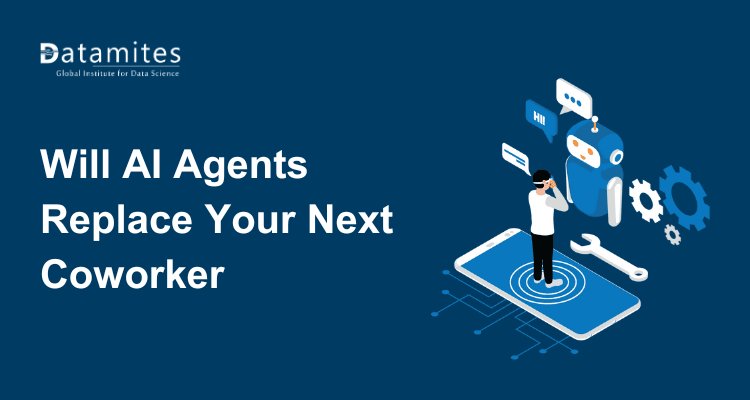
Will AI Agents Replace Your Next Coworker? Exploring the Future of Work
Explore how AI agents in the workplace are transforming jobs, productivity, and the future of work. Learn which roles are at risk, emerging career opportunities, and strategies to stay relevant. Includes real market insights, statistics, and expert guidance for professionals and businesses.
 Swagatam Sinha
The modern workplace is changing faster than at any point in history. Tasks that once required entire teams can now be completed in minutes with the help of intelligent systems. From automated customer support to AI-powered data analysis, AI agents in the workplace are no longer a futuristic idea—they are already here. This rapid shift has triggered a common and pressing question across industries: will AI take over jobs, or will it simply change how we work?
This blog explores the real impact of AI agents on jobs, skills, and the future of work. Instead of fear-driven narratives, we will focus on facts, real-world use cases, and practical insights to help professionals, students, and business leaders understand what lies ahead.
What Are AI Agents?
AI agents are autonomous or semi-autonomous systems designed to perform tasks, make decisions, and interact with other systems or humans with minimal supervision. Unlike traditional software that follows fixed rules, AI agents can learn from data, adapt to new situations, and improve over time.
In simple terms:
- AI tools assist with specific tasks (for example, spell checkers or recommendation engines).
- AI copilots support humans by suggesting actions or insights.
- AI agents go a step further by independently executing workflows, coordinating tasks, and responding to changing conditions.
This evolution is what makes AI agents especially relevant to discussions about AI replacing jobs.
Read these articles:
- The Future of Coding: Can AI Replace Software Engineers?
- Green AI Guide: Quantization and FinOps to Reduce LLM Costs
- Traditional RAG vs Agentic RAG
AI Agents in the Workplace: What’s Happening Today?
AI adoption is no longer confined to technology companies. Organizations across sectors are embedding AI agents into daily operations to improve efficiency and reduce costs.
1. IT and Software Development
AI agents now:
- Write and review code
- Detect bugs and security vulnerabilities
- Automate testing and deployment
Developers are not being replaced, but their productivity has increased significantly, allowing teams to focus on system design and innovation.
2. Customer Support
Chatbots and AI agents handle:
- Common customer queries
- Ticket routing
- 24/7 support across channels
Human agents step in for complex or emotionally sensitive cases, improving overall customer experience.
3. Marketing and Content
AI agents assist with:
- Campaign optimization
- Audience segmentation
- Performance analysis
Marketers still control strategy and creativity, while AI handles repetitive analysis.
4. Data Analytics
AI agents:
- Clean and process large datasets
- Generate dashboards and insights
- Detect trends in real time
This reduces manual work and accelerates decision-making.
5. HR and Operations
AI agents help with:
- Resume screening
- Interview scheduling
- Workforce planning
Human judgment remains critical for hiring decisions and employee engagement.
These examples show that AI agents in the workplace are primarily automating tasks, not entire roles.
McKinsey & Company reports that 78% of organizations have adopted AI in at least one business function, highlighting how quickly AI is becoming part of everyday workplace operations. That’s up from 55% just a few years prior, showing accelerated adoption across industries.
A 2025 survey from Gartner reveals that 81% of marketing technology leaders are piloting or have implemented AI agents in their teams, signaling widespread interest even if full business impact is still forming.
Another workplace AI adoption study notes that 40% of employees now use AI at work, nearly doubling in just two years, with daily and weekly engagement increasing significantly.
AI Replacing Jobs: Myth or Reality?
The fear that AI replacing jobs will lead to mass unemployment is understandable but incomplete. History shows that technological revolutions eliminate some roles while creating new ones.
The Reality:
- Jobs based on repetitive, rule-based tasks are most vulnerable.
- Roles requiring creativity, emotional intelligence, and strategic thinking are far more resilient.
- Many jobs are evolving rather than disappearing.
The more accurate question is not “Will AI take over jobs?” but “Which parts of jobs will AI take over?”
The World Economic Forum’s 2025 Future of Jobs Report projects that 92 million jobs could be displaced by AI by 2030, but 170 million new roles will be created, resulting in a net gain of 78 million jobs globally.
Broader projections suggest up to 300 million jobs worldwide could be lost to automation, particularly in task-heavy roles, representing nearly 9.1% of all jobs globally.
Jobs Most Likely to Be Affected by AI
AI agents are especially effective where tasks are predictable and data-driven.
Higher Risk Roles:
- Data entry operators
- Basic accounting and bookkeeping roles
- Telemarketers
- Routine administrative assistants
In these roles, AI can handle a large portion of the workload faster and with fewer errors.
Refer to these articles:
- LLMs vs. SLMs: Key Differences and How to Choose the Right Model
- AI Sovereignty: The New Mandate for Data Governance in the Cloud Era
- How Knowledge-Augmented Generation (KAG) Is Solving AI Hallucinations
Jobs Least Likely to Be Replaced
Roles that rely heavily on human judgment and interaction remain difficult to automate.
Lower Risk Roles:
- Healthcare professionals
- Teachers and trainers
- Product managers
- Researchers and strategists
- Creative professionals
AI may support these roles, but it cannot fully replace the human element involved.
Will AI Take Over Jobs or Transform Them?
Evidence strongly suggests transformation rather than replacement. In many organizations, AI agents act as “digital coworkers” that handle repetitive work so humans can focus on higher-value tasks.
For example:
- A recruiter spends less time screening resumes and more time evaluating candidate fit.
- A financial analyst focuses on interpretation rather than data preparation.
- A manager uses AI insights to inform decisions but makes the final call independently.
This change is accelerating human–AI collaboration, boosting productivity while still keeping people essential to the process.
Contrary to doomsday predictions, many analysts and corporate leaders see AI enhancing human capacities rather than erasing them entirely.
AI agents are powerful tools that minimize manual effort and significantly enhance productivity.
McKinsey’s research suggests that AI could generate $4.4 trillion in productivity gains across the global economy, a figure that reveals transformative potential rather than simple job loss.
New Roles Created by AI Agents
As AI adoption grows, new job categories are emerging, including
- AI operations specialists
- Prompt engineers
- AI ethics and governance professionals
- Automation consultants
- AI trainers and auditors
These roles did not exist a decade ago and highlight how innovation creates opportunities alongside disruption.
Essential Skills to Remain Relevant in the Age of AI
Professionals need to adapt to succeed in workplaces increasingly shaped by AI agents.
Key Skills for the Future:
- AI literacy: Understanding how AI works and where it adds value
- Critical thinking: Analyzing AI outputs critically instead of accepting them without question
- Domain expertise: Industry knowledge that AI cannot easily replicate
- Creativity and problem-solving: Skills rooted in human experience
- Adaptability: Willingness to learn and evolve with technology
Continuous learning is no longer optional; it’s crucial for advancing your career.
Refer to these articles:
- CrewAI vs. AutoGen vs. LangGraph: Which multi-agent framework should you learn in 2026?
- How LLMs Are Transforming Data Science Careers in 2026
- Why Bias, Fairness, and Transparency Are the New Metrics in Data Science
The Future of Employment: Insights for 2030
Looking ahead, several trends are becoming clear:
- AI agents will become a standard part of most digital tools.
- Hybrid roles that integrate technical and business capabilities will be in high demand.
- Lifelong learning will replace traditional career paths.
- Organizations will value adaptability over static expertise.
Rather than a workplace without humans, the future points toward smarter, more collaborative environments.
Practical Advice for Professionals and Businesses
Practical steps taken today by individuals and organizations will determine who thrives in an AI-driven workplace and who struggles to keep pace.
For Employees and Students:
- Learn how AI is used in your field.
- Focus on skills that complement automation.
- View AI as a productivity ally rather than a competitor.
For Business Leaders:
- Invest in responsible AI adoption.
- Train employees to work alongside AI agents.
- Redesign roles instead of eliminating them outright.
Being an early adopter provides a notable competitive benefit.
AI agents are undeniably reshaping how work gets done. Although the idea of AI replacing jobs is a legitimate concern for some task-oriented roles, the overall picture is more nuanced. In most cases, AI in the workplace tends to take over specific tasks rather than entire jobs, while also generating new opportunities along the way.
So, will AI take over jobs?
In some cases, yes, but far more often, AI will change jobs, enhance productivity, and redefine what meaningful work looks like.
The future of work won’t be humans competing against AI; it will be humans working alongside AI, and those who harness this partnership will define the careers of tomorrow.
DataMites Institute plays a key role in preparing professionals for the AI-driven future of work. With industry-aligned programs in data science, artificial intelligence, machine learning, and artificial intelligence training in Bangalore, DataMites focuses on practical skills, real-world projects, and hands-on learning that match current market demands.
By combining expert-led training, globally recognized certifications, and career support, DataMites helps learners build AI-ready skills and stay relevant in a workplace increasingly shaped by AI agents and automation.