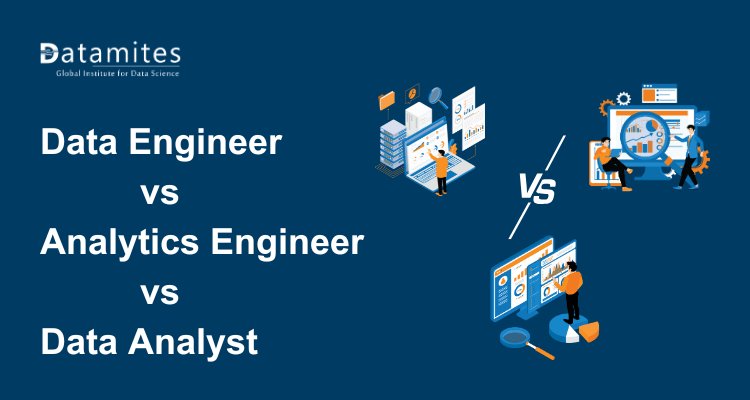
Data Engineer vs Analytics Engineer vs Data Analyst
Compare Data Engineer, Analytics Engineer, and Data Analyst roles, salaries, and skills. Find the best data career path in 2025 and how to get trained.
 Swagatam Sinha
Over the past decade, data has become the new currency powering decision-making, product innovation, automation, and artificial intelligence. According to the latest report from the U.S. Bureau of Labor Statistics (2025), data and AI-related occupations are projected to grow by 35% by 2032, making them one of the fastest-growing fields globally. This surge in demand has created multiple specialized career tracks within the data ecosystem most notably, the roles of Data Engineer, Analytics Engineer, and Data Analyst.
While these titles may sound similar, they represent very different responsibilities, skill sets, and career outcomes. As organizations continue adopting cloud platforms, big data frameworks, and advanced analytics solutions, understanding these differences becomes incredibly important for aspiring professionals and companies building high-performance data teams.
Understanding the Modern Data Landscape
Before diving into the differences, it's important to understand how data flows inside an organization. The modern data lifecycle looks like this:
- Raw data is collected
- Data pipelines move and store the data
- Data is cleaned, modeled, and transformed
- Insights are generated and visualized
Each stage is handled by a different role:
| Stage | Responsibility | Role |
| Collecting/Storing Data | Building pipelines & infrastructure | Data Engineer |
| Transforming & Modeling Data | Making data analytics-ready | Analytics Engineer |
| Interpreting Data | Insights, reporting & business decisions | Data Analyst |
This workflow explains why all three are essential and why companies now prefer specialized professionals rather than one generalist role.
Read to these articles:
- How to Learn SQL for Data Analysis
- Why Synthetic Data Is the Future of GDPR Compliance
- Data Scientist vs ML Engineer vs AI Engineer
The Data Engineer: The Architect & Pipeline Builder
Data Engineers are the backbone of the data world. Their expertise lies in computer science, system architecture, and ensuring data is collected, stored, and made accessible at scale.
Key Responsibilities of a Data Engineer
- Develop and maintain ETL/ELT pipelines
- Manage cloud platforms, data warehouses and data lakes.
- Optimize data architecture for performance and scalability
- Ensure security, governance, and data integrity
Data Engineer Tools & Technologies
- Python, SQL
- Apache Spark, Kafka, Airflow
- AWS, GCP, Azure
- Snowflake, Redshift, Databricks
Industry Trend (2026): The shift to Lakehouse Architecture and DataOps, focusing on automated deployment and monitoring of data pipelines.
Data Engineering is considered the foundational layer. As Rostyslav Fedynyshyn notes, “The companies winning with AI aren’t the ones with the biggest budgets. They’re the ones who got their data organized first.”
A report from Analytics India Magazine (2024) revealed the data engineering market in India is growing at ~33.8% CAGR, driven by cloud adoption and AI workloads.
The Analytics Engineer: The Data Model Curator
The Analytics Engineer is the essential bridge between raw data engineering and consumer-facing analysis. This role emerged from the need for clean, trusted, and testable data models.
Key Responsibilities of Analytics Engineer
- Build and maintain data models
- Write clean SQL & transformation logic
- Establish data quality testing and documentation
- Enable self-service analytics
Analytics Engineer Tools & Technologies
- dbt (core differentiator)
- SQL, Git
- Snowflake, BigQuery, Redshift
- Airbyte, Fivetran
Industry Trend (2026): Implementing Data Mesh architectures, which treats data as a product, making the Analytics Engineer the Domain Data Owner. This has made the role a high-demand career path in 2026.
According to the 2025 dbt Labs Report, analytics engineering adoption grew by 42% year-over-year, especially in AI-driven organizations needing quality and governance.
Read to these articles:
- Will Polars Replace Pandas?
- How to Become a Data Analyst With No Experience
- Data Science Vs Data Analytics
The Data Analyst: The Storyteller & Decision Translator
Data Analysts are the business translators. They take the perfectly structured data delivered by the engineers and modelers and extract actionable insights that drive executive decisions.
Key Responsibilities of Data Analyst
- Query datasets using SQL
- Build dashboards and analytical reports
- Identify business trends, patterns, and risks
- Communicate insights to stakeholders
Data Analyst Tools & Technologies
- Power BI / Tableau / Looker
- SQL, Excel
- Python (optional but valuable)
Industry Trend (2026): Moving into Decision Intelligence. The focus is shifting from "What happened?" (Descriptive) to "What should we do next?" (Prescriptive).
Data Engineer vs Analytics Engineer vs Data Analyst: Role Comparison
Here is a snapshot of how these roles stack up against each other.
| Feature | Data Engineer | Analytics Engineer | Data Analyst |
| Primary Goal | Build & Optimize Pipelines | Clean, Model & Document Data | Visualize & Interpret Insights |
| Key Output | Reliable Infrastructure | Clean Data Tables (Data Marts) | Dashboards & Business Strategy |
| Top Tools | Spark, Kafka, Airflow, AWS/Azure | dbt (data build tool), Snowflake, BigQuery | Power BI, Tableau, Excel, Python |
| Coding Level | High (Python, Scala, Java) | Medium (Advanced SQL, Jinja) | Low/Medium (SQL, DAX) |
| Data Focus | Raw / Unstructured Data | Modeled / Transformed Data | Aggregated / Business Data |
| Avg. Salary (India) | ₹8 – 20 LPA | ₹10 – 22 LPA | ₹5 – 12 LPA |
| Avg. Salary (US) | $115k – $160k | $120k – $170k | $75k – $110k |
(Source: Aggregated data from Glassdoor, AmbitionBox, and 2025 Industry Reports)
The World Economic Forum (2025) includes all three roles in the Top 10 fastest growing tech careers globally.
How AI is Changing These Roles in 2025
The biggest question we get is: "Will AI replace these jobs?"
The short answer is No, but it is changing them. According to the McKinsey Technology Trends Outlook, AI is shifting from replacing roles to augmenting them.
For Data Engineers: AI (like GitHub Copilot) is writing 40% of the boilerplate code for pipelines. This means Engineers must now focus more on System Architecture and less on basic coding.
For Data Analysts: Tools like ChatGPT and Gemini can now generate SQL queries and basic charts. The "new" Data Analyst must focus on Data Storytelling and Business Acumen skills that AI cannot easily replicate.
The Verdict: AI is automating the boring parts of these jobs, allowing you to focus on the high-value strategic work.
According to Gartner's Data & AI Forecast (2025), 80% of companies will invest in analytics engineering and automated data pipelines to support AI adoption.
According to Fortune Business Insights, a 2025 market-size report, the global data pipeline market is projected to grow from USD 12.26 billion in 2025 to USD 43.61 billion by 2032, at a CAGR of 19.9%.
Refer to these articles:
- Data Engineer vs Data Analyst
- 6 Innovative Ways to Leverage AI in Data Analytics
- Data Lakehouse: Transforming Analytics with Unified Data
Which Career Path Should You Choose?
If you are still undecided, use this simple checklist to pick your lane:
Choose Data Engineering if:
- You enjoy building things from scratch.
- You are interested in Cloud Computing (AWS, Azure, GCP).
- You prefer dealing with code and servers rather than clients and meetings.
- Keywords to learn: ETL, Pipelines, Hadoop, Spark, Scala.
Choose Analytics Engineering if:
- You are a SQL wizard and love optimized code.
- You like bridging the gap between technical teams and business teams.
- You are frustrated by "messy data" and want to fix it at the source.
- Keywords to learn: dbt, Data Modeling, Snowflake, Version Control.
Choose Data Analytics if:
- You love solving puzzles and answering "Why?"
- You are visual and enjoy creating designs (Dashboards).
- You want to work directly with business leaders to drive strategy.
- Keywords to learn: Data Visualization, Statistics, Python for Data Science, Business Intelligence.
The good news is that these roles are interconnected, meaning transitioning between them with experience is very realistic.
The most in-demand professionals in 2026 will be those who possess cross-functional skills: an Analyst who understands Data Modeling (AE skills) or an Engineer who understands Data Governance.
Whether you choose to become a Data Engineer, Analytics Engineer, or Data Analyst, the future of data careers is bright, driven by AI, cloud computing, and automation.
The best role depends on your skills, interests, and long-term goals and with the right training and experience, transitioning between these roles is highly possible.
At DataMites, our mission is to help learners build successful careers in the data industry through expert-led, practical training programs. Our courses are designed to meet real-world industry needs, ensuring learners gain the confidence and skills required to excel.
We offer highly recommended Data Analyst Courses in Pune, along with globally recognized certifications, live projects, and dedicated career support. Learners benefit from hands-on experience, mock interviews, and internship opportunities aligned with the latest industry trends.
To make learning accessible and flexible, DataMites provides offline training centers in major cities including Ahmedabad, Bangalore, Hyderabad, Chennai, Coimbatore, Mumbai, Delhi, Nagpur, and more. This ensures students receive the right blend of online convenience and classroom experience.
Join DataMites and kickstart your journey toward becoming a highly skilled data professional with training that matches the evolving demands of today's technology-driven world.