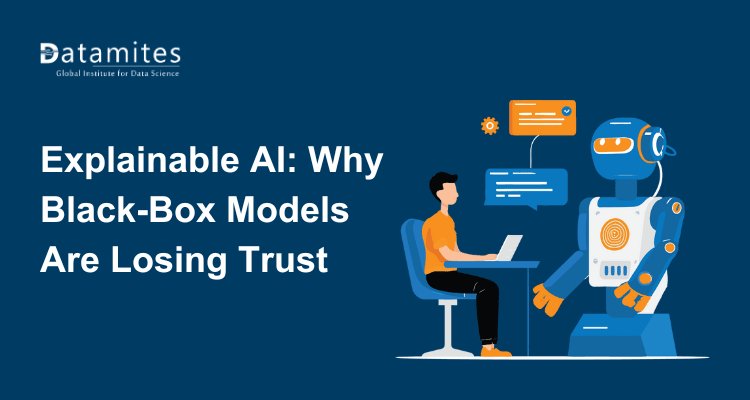
Explainable AI: Why Black‑Box Models Are Losing Trust
Explore why black-box AI models are losing trust and how Explainable AI improves transparency, fairness, and accountability across industries with real-world insights.
 Swagatam Sinha
Artificial Intelligence (AI) has transformed multiple industries by enabling advanced predictions, automation, and data‑driven decision‑making. However, many high‑performing AI systems, especially deep neural networks and complex machine learning models, act as “black‑box” systems, offering little insight into how they arrive at decisions. This opacity creates distrust among users, regulators, and stakeholders because the reasoning behind decisions such as medical diagnoses or loan approvals cannot be clearly traced or explained. Explainable AI (XAI) has emerged as a crucial approach for making these systems more transparent and trustworthy.
According to a large global study by KPMG and the University of Melbourne surveying 48,340 workers across 47 countries, 57% of employees admitted to hiding their use of AI at work, while 66% do not verify AI outputs before using them highlighting significant trust and governance gaps in AI deployment.
What is Explainable AI?
Explainable AI refers to a set of methods and techniques that make the internal logic of machine learning models understandable to humans. The goal of XAI is to open the “black box,” showing how inputs influence outputs and why specific predictions are made. This is essential for ensuring that AI systems are interpretable, ethical, and aligned with human values. XAI is widely discussed in both academic and industry contexts as more organizations adopt AI for critical decision‑making.
In contrast, black‑box models like deep neural networks and ensemble methods such as random forests can yield highly accurate results but do not reveal how they weigh inputs to make decisions, which creates barriers to trust and accountability.
Read these articles:
- Data Scientist vs ML Engineer vs AI Engineer: Which Career Path Is Right for You?
- How Generative AI is Changing the Role of Data Scientists
- The Future of Coding: Can AI Replace Software Engineers?
Why Black‑Box Models Are Losing Trust
Black‑box models have faced increasing scrutiny from regulators, practitioners, and users for several key reasons:
- Openness and Accountability: Black‑box AI does not provide clear explanations for decisions, making it difficult for stakeholders to understand why a particular outcome was reached. This lack of transparency is critical in high‑stakes applications like healthcare and finance, where understanding the decision process is essential.
- Ethical and Legal Concerns: Regulations like the General Data Protection Regulation (GDPR) in Europe require that automated decisions affecting individuals be explainable. Without interpretability, organizations risk non‑compliance and legal challenges.
- Bias and Fairness: Black‑box systems may inadvertently embed biases within their decision logic. Without explanation, these biases remain hidden, leading to unfair outcomes that harm individuals or groups.
- Risk Management: Opaque models make it difficult to detect errors, security vulnerabilities, or poor model behavior (for example, susceptibility to adversarial attacks), increasing operational risk.
These issues have led many organizations to prioritize AI model transparency and explainability, fostering trust and broad adoption.
Research highlights that AI systems must be trustworthy for widespread adoption. According to McKinsey, while 91% of executives acknowledge the potential of AI, only a minority feel their organizations are well‑prepared to implement AI responsibly and with explainability in mind, an essential factor for trust.
Benefits of Explainable AI
Explainable AI offers several tangible advantages over black‑box models:
Improved Decision‑Making: When users understand how a model arrives at a decision, they can better interpret its outputs and incorporate human judgment where needed.
Ethical AI and Policy Compliance: XAI supports ethical AI practices by reducing hidden biases and providing explanations that align with fairness standards. It also helps organizations comply with AI regulations such as the EU AI Act.
Stakeholder Trust: Transparency encourages greater trust from end users, domain experts, and customers, which increases adoption in sensitive fields like medicine and finance.
Model Debugging and Monitoring: Explainability tools help data scientists uncover issues like data leakage or feature misuse, allowing for more effective model validation and maintenance.
The global Explainable AI market is projected to grow from approximately $7.79 billion in 2024 to over $21 billion by 2030, at an estimated CAGR of 18% as organizations in healthcare, finance, and government sectors adopt XAI solutions for trustworthy AI systems. (source: Grand View Research)
Refer to these articles:
- Green AI Guide: Quantization and FinOps to Reduce LLM Costs
- Traditional RAG vs Agentic RAG — What’s the Difference?
- AI Sovereignty: The New Mandate for Data Governance in the Cloud Era
Explainable AI Techniques
Several advanced techniques have been developed to explain how complex models make decisions:
- SHAP (SHapley Additive exPlanations): Based on cooperative game theory, SHAP assigns each feature an importance value for a prediction. SHAP values provide a consistent and theoretically sound explanation of model behavior but can be computationally intensive for large datasets.
- LIME (Local Interpretable Model‑agnostic Explanations): LIME creates a simplified local model around a specific prediction to approximate how a complex model behaves. While useful for individual explanations, it may produce inconsistent results across runs.
- Feature Importance and Permutation Methods: These methods measure how changes to a feature affect model performance, highlighting which features most influence predictions.
- Counterfactual Explanations: These involve asking “what if” questions (e.g., how the input would need to change to alter a prediction), providing intuitive insights into model behavior.
These techniques can be applied to both global explanations (understanding overall model behavior) and local explanations (interpretation of individual predictions).
Read to these articles:
- How Knowledge-Augmented Generation (KAG) Is Solving AI Hallucinations
- CrewAI vs. AutoGen vs. LangGraph: Which multi-agent framework should you learn in 2026?
- Will AI Agents Replace Your Next Coworker? Exploring the Future of Work
Real‑World Examples and Case Studies of Explainable AI
Explainable AI is already being applied across critical industries to improve transparency, build user trust, and ensure responsible decision-making in high-impact, real-world scenarios.
Healthcare – AI for Diagnosis:
In healthcare, black‑box models have been used for tasks like disease prediction from medical imaging, but clinicians often hesitate to trust them because they cannot explain the reasoning behind specific diagnoses. Explainable AI tools such as SHAP and saliency maps have helped clinicians understand which features (e.g., specific image regions or lab values) led to a predicted diagnosis. This transparency increases clinicians’ confidence and allows them to integrate AI insights into patient care.
Finance – Loan Decision Models:
Financial institutions use complex AI models for credit risk assessment and loan approvals. However, the lack of explainability has raised concerns about fairness and discrimination against protected classes. Incorporating XAI methods, like LIME and SHAP, enables banks to illustrate why a particular applicant was approved or rejected, improving transparency and reducing regulatory risk.
These examples demonstrate how moving from black‑box AI toward Explainable AI enables better stakeholder trust and compliance with ethical standards.
Cybersecurity Alerts
Explainable AI in security systems can highlight why certain network activities were flagged as threats. For instance, SHAP explanation plots can show which traffic features triggered alerts, enabling analysts to validate true positives and reduce false alarms significantly.
Challenges in Explainable AI
Despite its advantages, implementing Explainable AI comes with challenges:
- Trade‑off Between Accuracy and Interpretability: Simplifying models for explainability sometimes reduces their predictive performance. In some cases, combining interpretable models with black‑box systems is necessary to balance performance with transparency.
- Computational Complexity: Techniques like SHAP can be resource‑intensive, especially for large datasets and complex models.
- Oversimplification Risks: Simplified explanations may hide important model behavior or lead to overconfidence in decisions if not properly evaluated.
Future of Explainable AI
Explainability will play a central role in the next generation of AI systems, particularly as regulations evolve and AI becomes more integrated into critical sectors. Industries are increasingly adopting XAI frameworks to build trust with users and align AI decisions with ethical and legal standards. Continued research is expanding techniques and standards for more robust, reliable explanations.
Market projections suggest the Explainable AI industry will continue its strong growth trajectory, with some forecasts estimating the market could reach between USD 22 billion and USD 39.6 billion by the early 2030s, depending on regulatory adoption and industry demand for transparency solutions. This sustained expansion reflects how explainability is becoming a strategic priority rather than a niche capability. (Source: DataM Intelligence)
As AI systems become more prevalent in decision‑making roles, the need for transparent, interpretable models has never been greater. Explainable AI addresses the limitations of black‑box models by making decision logic understandable, thereby improving trustworthiness, ethical compliance, and adoption in high‑stakes environments. Organizations and researchers must continue investing in XAI to ensure that AI systems not only deliver accurate predictions but also uphold accountability and fairness.
DataMites Institute is a leading training provider in Data Science and Artificial Intelligence, backed by over 11 years of industry trust and academic excellence. With a strong focus on practical learning and career-oriented programs, DataMites has successfully trained 1,50,000+ learners worldwide, supporting professionals in building future-ready skills across data-driven domains.
With a growing presence of 20+ training centers across India, including Bangalore, Chennai, Hyderabad, Pune, Coimbatore, Mumbai, Delhi, Nagpur, and more, DataMites delivers flexible and industry-aligned learning paths. The Artificial Intelligence Course in Bangalore is designed to meet current market needs, combining hands-on projects, expert mentorship, and globally recognized certifications.