How AI Is Changing the Future of Product Development Strategy
Explore how AI is transforming the future of product development strategy through data-driven insights, faster innovation cycles, predictive analytics, and value-based product development, enabling businesses to build smarter, customer-centric products and stay competitive.
 Kriti Maurya
Artificial Intelligence (AI) is rapidly reshaping industries, and its impact on product innovation is especially profound. As organizations aim to stay competitive in an increasingly digital economy, integrating AI into the product development process is no longer optional it’s essential. From ideation to launch and iteration, AI is enabling smarter, faster, and more efficient workflows.
Here, we will explore how AI is transforming modern product strategies, with a focus on value-based product development and its role in shaping the future of product development. We also examine real-world applications in product development, practical strategies for leaders, and upcoming trends that businesses must prepare for.
How AI is changing product development
AI is fundamentally redefining how companies approach the product development process. Traditionally, product development relied heavily on manual research, intuition, and trial-and-error methods. Today, AI-driven systems analyze massive datasets in real time, providing actionable insights that significantly reduce uncertainty.
The Product Design and Development market is projected to grow from USD 13.49 billion in 2025 to USD 14.27 billion in 2026, reaching USD 18.61 billion by 2031, expanding at a CAGR of 5.45% during 2026–2031.(Source: Mordor Intelligence )
One of the most important shifts is the move toward value-based product development. AI helps organizations understand customer needs more deeply by analyzing behavior patterns, feedback loops, and market signals. This allows teams to prioritize features that deliver real value rather than relying on assumptions.
Another key transformation lies in automation. AI tools streamline repetitive tasks such as market analysis, testing, and performance monitoring. These applications in product development free up teams to focus on innovation and strategy instead of operational overhead.
Additionally, AI enhances collaboration across teams. With intelligent dashboards and predictive analytics, cross-functional teams can align more effectively. Role and responsibility of Product Managers, designers, and engineers include work from a shared data-driven perspective, improving decision-making throughout the product development process.
Ultimately, AI is shifting product development from a reactive approach to a proactive one. Companies can now anticipate trends, identify risks early, and adapt quickly to key factors that define the future of product development.
Must read articles:
- Key Challenges in Implementing AI in Marketing
- Top Use Cases for AI in Finance
- Top AI Tools in HR Transforming Tech Companies
Future Trends and What’s Next in the Industry
As AI continues to evolve, its impact on the future of product development will only grow stronger. Several emerging trends are shaping the next phase of innovation.
1. Hyper-Personalization
AI will enable products to adapt to individual user preferences in real time. These advanced applications in product development will create highly personalized experiences, increasing customer engagement and loyalty.
2. Autonomous Product Development
AI systems are becoming capable of managing entire stages of the product development lifecycle with minimal human intervention. From ideation to testing, automation will streamline workflows and reduce costs.
3. Integration of AI with IoT and Edge Computing
The convergence of AI with Internet of Things (IoT) and edge computing will unlock new possibilities. Products will become smarter, more responsive, and capable of real-time decision-making.
This integration will play a significant role in the future of product development, enabling innovative solutions across industries.
4. Ethical AI and Responsible Innovation
As AI adoption increases, ethical considerations will become more important. Companies must ensure transparency, fairness, and accountability in their AI-driven applications in product development.
5. AI-Driven Innovation Ecosystems
Organizations will increasingly collaborate within AI-driven ecosystems, sharing data and insights to accelerate innovation. This collaborative approach will redefine the product development process, making it more interconnected and efficient.
AI is not just a technological advancement it is a strategic enabler that is transforming how products are developed, delivered, and improved. By integrating AI, the future of product development in organizations can unlock new levels of efficiency, innovation, and customer value.
AI Product Strategies for Startup Founders and Product Leaders
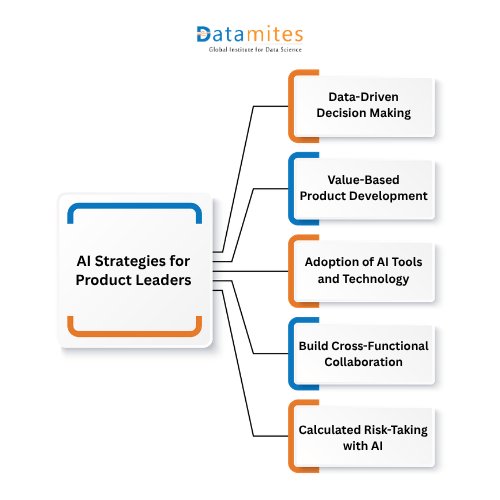
For startups and design leaders, leveraging AI effectively can be a game-changer. However, success requires a strategic approach with clear vision, value baesd product, adoption of technology and calculated risk that aligns AI capabilities with business goals.
1. Embrace Data-Driven Decision Making
Startups should prioritize data as a core asset. AI thrives on data, and its effectiveness depends on the quality and quantity of information available. By integrating AI into the product development process, founders can make informed decisions that reduce risk and improve outcomes.
2. Focus on Value-Based Product Development
Rather than building feature-heavy products, leaders should adopt value-based product development principles. AI helps identify which features deliver the most value to users, ensuring that resources are allocated efficiently.
This approach not only improves customer satisfaction but also enhances scalability, which is crucial for startups aiming to grow in the future of the product development landscape.
3. Adoption of AI Tools and Technology for Rapid Prototyping
AI-powered prototyping tools allow startups to test ideas quickly and cost-effectively. These applications in product development enable teams to validate concepts before investing heavily in development.
Rapid prototyping reduces time-to-market and increases the likelihood of success, giving startups a competitive edge.
4. Build Cross-Functional Collaboration
AI product manager tools facilitate better communication between teams by providing shared insights and dashboards. Design leaders should encourage collaboration across departments to maximize the benefits of AI in the product development process.
5. Invest in Talent and Skills with clear vision
While AI tools are powerful, their effectiveness depends on the people using them. Startups should invest in training and hiring talent with expertise in AI, data analytics, and product strategy.
6. Calculated Risk-Taking with AI
A calculated approach ensures AI initiatives are aligned with core business goals and measurable outcomes. It helps organizations minimize risk while maximizing value from AI-driven decisions.
This ensures that AI is used effectively to drive value-based product development and long-term growth.
Key Areas Where AI Transforms Product Development
AI’s influence spans multiple stages of the product development process, offering transformative capabilities that enhance efficiency and innovation.
1. Market Research and Customer Insights
AI-powered tools analyze vast amounts of customer data from various sources, including social media, reviews, and usage patterns. These applications in product development provide deep insights into customer preferences, enabling teams to design products that truly resonate with users.
By supporting value-based product development, AI ensures that product features align with actual customer needs rather than assumptions. This reduces the risk of product failure and improves market fit.
2. Product Design and Prototyping
AI-driven design tools are revolutionizing how products are conceptualized. Generative design algorithms can create multiple design variations based on predefined constraints, allowing teams to explore innovative solutions quickly.
These applications in product development significantly shorten design cycles and improve efficiency. Designers can focus on refining ideas while AI handles repetitive design iterations, accelerating the overall product development process.
3. Predictive Analytics and Decision-Making
Predictive analytics is one of the most powerful contributions of AI. By analyzing historical and real-time data, AI can forecast market trends, customer behavior, and product performance.
This capability supports value-based product development by helping teams prioritize features and investments that deliver maximum value. It also reduces uncertainty, enabling more confident decision-making throughout the product development process.
4. Testing and Quality Assurance
AI automates testing processes, identifying bugs and performance issues faster than traditional methods. Machine learning models can simulate user interactions, ensuring that products meet quality standards before launch.
These applications in product development not only improve product reliability but also reduce time-to-market. Faster testing cycles allow companies to iterate quickly, which is essential in the future of product development.
5. Continuous Improvement and Feedback Loops
AI enables continuous monitoring of product performance after launch. By analyzing user feedback and usage data, companies can identify areas for improvement and implement updates in real time.
6. Launch optimization and post-launch insights
AI continues to add value after a product reaches the market. It can monitor adoption rates, track customer behavior, and identify drop-off points in real time. These applications in product development help organizations refine their go-to-market strategy and improve retention. Post-launch intelligence is essential to value-based product development because it reveals whether a product is truly delivering the intended value.
This iterative approach aligns with value-based product development, ensuring that products evolve based on actual user needs. It also strengthens the overall product development process, making it more adaptive and responsive.
Must read articles:
- What is Artificial Narrow Intelligence
- Traditional AI vs Generative AI: Key Differences Examples and Use Cases
- What Are Graph Neural Networks
The shift toward value-based product development ensures that products are built with a clear focus on delivering meaningful outcomes for users. At the same time, the evolving applications in product development are driving continuous improvement and adaptability.
DataMites Institute offers a comprehensive AI for Product Managers aimed at empowering professionals to incorporate artificial intelligence into modern product strategy and decision-making. The program covers core AI concepts along with practical applications, featuring specialized tracks such as AI Product Management, AI for HR & People Analytics, AI for Finance, AI for Marketing, AI for Healthcare, and Generative AI for Business Leaders.
Learners can choose from flexible learning modes, including online sessions, classroom training, or case-based internship programs for hands-on experience. The course is accredited by IABAC, and the Certified AI Professional in Product Management certification holds global recognition. DataMites has a strong presence across major Indian cities, including Hyderabad, Ahmedabad, Chennai, Bangalore, Pune, Mumbai, and Coimbatore.