Silpa’s Journey from Data Science Expertise to Leadership
Silpa’s path from skilled data scientist to influential leader shows how technical mastery, strategic thinking, and strong communication can shape impactful leadership in a data-driven world.
 Prerana B A
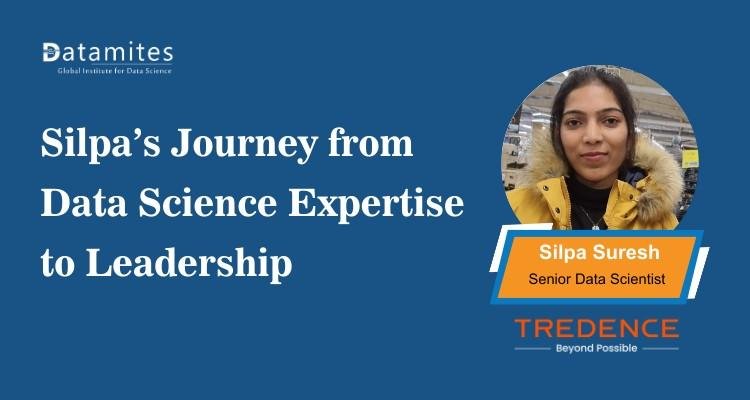
Shilpa’s career story highlights how continuous learning and practical experience can transform technical expertise into leadership opportunities. Starting with strong hands-on exposure in data science, she focused on strengthening her fundamentals, improving practical skills, and staying aligned with evolving industry trends. Through structured upskilling and consistent learning, she prepared herself for greater responsibilities and long-term career growth.
Her journey reflects the reality many professionals face in today’s fast-changing technology landscape, where continuous learning and industry-relevant skills are essential for career advancement. By gaining practical exposure and refining her analytical abilities, Shilpa successfully moved toward a leadership-level role. This DataMites Success Story offers valuable inspiration for aspiring data science professionals aiming to build a successful and future-focused career.
Silpa’s Successful Growth in Her Data Science Career with DataMites
Discover how Silpa strengthened her data science expertise through structured training, hands-on projects, and expert mentorship, helping her sharpen fundamentals, build confidence, and step into a higher-responsibility role.
1. Can you introduce yourself and your professional background?
My name is Silpa Suresh. I have around 6.9 years of experience working in Data Science-related roles. I worked with Infosys and Accenture, where I explored forecasting models and machine learning applications. Later, I joined DataMites for a structured Data Science brush-up course to improve my skills and switch to a stronger role.
2. Why did you decide to join a Data Science course despite having experience?
My goal was to strengthen fundamentals and upgrade my technical depth. Even with experience, structured learning helped me refresh concepts, improve practical knowledge, and prepare for better career opportunities.
3. How long was your course and what did you learn from it?
It was a six-month program. I gained clarity in fundamentals, core concepts, and hands-on learning. The structured curriculum helped rebuild strong basics.
4. Did projects play an important role in your learning?
Yes. After the course, I completed around six projects. Working on multiple datasets helped me strengthen problem-solving ability and practical confidence.
5. How did you transition to your new job role?
After completing projects, I started applying for roles and recently secured a position as a Data Scientist Associate Manager in a product-focused company.
6. What advice would you give to students from non-technical backgrounds?
Background doesn’t matter if you’re willing to learn. Dedicate at least 2–3 hours daily. Whatever is taught in class covers only part of the knowledge — the rest comes from self-study and practice.
7. What was your personal study strategy after each class?
I followed a checklist approach. After every class, I reviewed topics at home, researched further, clarified doubts, and practiced until I understood the concept clearly.
8. How can AI tools help students learn faster?
AI platforms like OpenAI’s ChatGPT are extremely useful. If you ask clear questions, you can get explanations, mock questions, and deeper insights. The more you explore, the more you learn.
9. How did you prepare for Data Science interviews?
First, I prepared my resume carefully and understood every point in it. Then I practiced likely interview questions based on my profile and job description. Daily practice was key.
10. How many questions did you practice per day?
I practiced around 20–30 questions daily, covering fundamentals, machine learning concepts, programming logic, and database queries.
Refer to these articles:
- What Is Regression Analysis in Data Science? A Beginner’s Guide
- Binomial Distribution: A Beginner’s Guide for Data Science
- How Generative AI is Changing the Role of Data Scientists
11. What is the typical interview process for Data Science roles?
Usually there are three rounds:
- Round 1: Technical fundamentals + practical coding tasks
- Round 2: Scenario-based problem solving and decision making
- Round 3: HR discussion focusing on communication and clarity
12. Do large IT companies focus more on basics or advanced topics?
Many large companies such as Tata Consultancy Services emphasize strong fundamentals. Candidates often focus too much on advanced topics and forget the basics.
13. How important is communication for Data Scientists?
Very important. Even if you know the solution, you must explain it clearly. Data Scientists need to communicate insights to stakeholders effectively.
14. How is your current work environment?
The work culture is supportive and employee-focused. Leadership is approachable, and the company invests in employee growth. That makes it easier to learn and perform well.
15. What kind of projects should students choose while learning?
Don’t pick projects just to finish them. Choose projects where you can explore new concepts. If you don’t know something, that’s exactly the project you should try.
16. How should students approach project execution?
At every step, ask:
- Why am I using this method?
- Are there alternatives?
- What happens if I change the approach?
Exploration matters more than completion.
17. Which tools should beginners focus on first?
Start with one beginner-friendly programming language, basic database querying, and understanding machine learning workflow structure. That foundation is enough to begin.
18. What is the best way to build confidence before interviews?
Attend interviews even if you’re unsure. Each interview improves confidence and shows where you need improvement.
19. Can students reach out to professionals for guidance?
Yes, networking platforms like LinkedIn are useful. You can connect with professionals, ask questions, and learn from their experiences.
Key Takeaways from Shilpa’s Data Science Journey
Here are the most important lessons and insights from her experience that can guide anyone looking to strengthen their skills and advance their career in Data Science:
- Strong fundamentals are essential for long-term success in Data Science, even for experienced professionals.
- Experience at companies like Infosys and Accenture helped build her initial technical exposure.
- Structured upskilling through DataMites helped her refresh concepts and prepare for career advancement.
- Hands-on projects are critical for improving real-world problem-solving skills and confidence.
- Daily self-study (2–3 hours) greatly accelerates learning and skill mastery.
- Interview success depends on understanding your resume deeply and practicing questions consistently.
- Most Data Science hiring processes include technical, scenario-based, and HR rounds.
- Communication skills are as important as technical knowledge for Data Scientists.
- Students should choose exploratory projects that teach new concepts instead of selecting easy ones.
- Professional networking platforms like LinkedIn help in guidance, connections, and career opportunities
Shilpa’s journey shows that real success in Data Science comes from continuous learning, strong fundamentals, and the courage to step beyond comfort zones. By combining structured upskilling, hands-on projects, and consistent interview preparation, she transformed experience into leadership readiness. Her story reminds aspiring professionals that growth is not about where you start, but how deliberately you build skills, confidence, and clarity over time. With the right mindset and persistence, moving from technical expertise to impactful leadership is absolutely achievable.
Refer to these articles:
- Sathish’s Inspiring Journey to Becoming a Data Scientist
- Junaid’s Path from MLOps Engineer to Senior Data Scientist
- Siddharth Journey From Beginner to Data Science Professional
If you’re beginning your journey in data science or considering a career move, let Shilpa’s story inspire your next step. Start with strong fundamentals, work consistently on practical projects, and keep sharpening your skills. With the global data science platform market projected to grow from USD 15.2 billion in 2024 to USD 144.9 billion by 2033 (IMARC Group), the opportunity is massive. As businesses increasingly rely on data-driven decision-making, the demand for skilled data science professionals continues to rise, making data science one of the leading career paths and among the leading IT courses in Pune today.
Shilpa’s transition into a stronger and more advanced data science role was driven by structured learning and focused upskilling at DataMites. With nearly seven years of experience, she joined to strengthen her foundations, deepen her expertise in Python, Machine Learning, SQL, and applied modeling, and position herself for career growth through data science courses in Pune. Through hands-on projects, guided mentorship, and interview-focused preparation, she successfully moved into the role of Associate Manager in Data Science. Backed by globally recognized certifications such as IABAC and NASSCOM FutureSkills, the program helped her bridge the gap between knowledge and career advancement.
Whether you are a fresher, a working professional aiming for career growth like Shilpa, or someone planning a career transition, the right training can accelerate your progress. With both online and offline learning options available across major cities, including data scientist training in Mumbai, Delhi, Bangalore, Pune, Chennai, Ahmedabad, Coimbatore, Hyderabad, and Kolkata, structured data science programs make quality education more accessible. Shilpa’s journey proves that with discipline, practical exposure, and the right mentorship, building a successful career in data science is not only possible but also a smart, future-focused decision.