How Data Analysts Solve The Complex Business Challenges
Discover how data analysts solve complex business challenges using data-driven insights, predictive analytics, and visualization tools. Learn how analytics improves decision-making, operational efficiency, customer experience, and business growth across industries.
 Kriti Maurya
From customer interactions and sales reports to supply chain activities and online behavior, businesses rely heavily on data to guide operations and long-term strategies. Data analytics for business leverage data from customer interactions, sales reports, supply chains, and digital platforms to guide strategic decisions.
Through Data-driven decision making, organizations can identify trends, forecast demand, optimize operations, and reduce risks. Industries such as healthcare, finance, retail, and manufacturing increasingly depend on analytics to remain competitive, making data analysts vital contributors to modern business growth and long-term success.
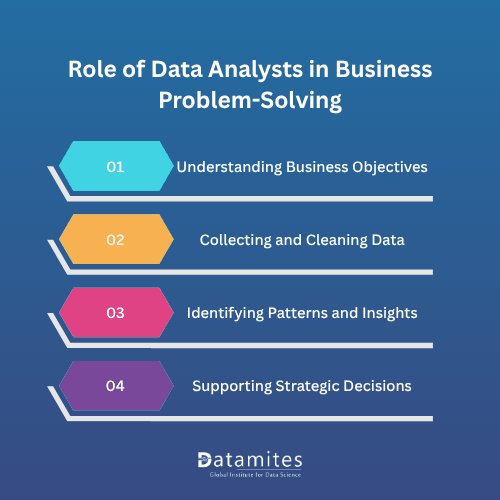
The Role of Data Analysts in Business Problem-Solving
One of the primary responsibilities of data analysts is identifying business problems and uncovering solutions through analytical thinking. Businesses often face challenges related to declining sales, customer retention, operational inefficiencies, inventory management, or market competition.
1. Understanding Business Objectives
Before analyzing data, analysts first understand the company’s goals and operational challenges. For example, data analytics in retail industry experiencing reduced customer engagement may require analysis of purchase behavior, website traffic, and customer feedback.
By aligning analytical strategies with business objectives, Data Analysts solve business challenges more effectively and deliver measurable outcomes.
2. Collecting and Cleaning Data
Data collected from multiple sources is often incomplete, inconsistent, or duplicated. Data analysts clean and organize information to ensure accuracy and reliability. High-quality data is critical because poor data can lead to incorrect business decisions.
This stage is essential for effective Data-driven decision making, as businesses rely on accurate information to plan strategies and allocate resources efficiently.
3. Identifying Patterns and Insights
Once data is prepared, analysts use statistical methods and visualization tools to identify patterns, correlations, and trends.
For instance, an e-commerce company may discover that customers abandon shopping carts due to high delivery costs. Such insights allow businesses to redesign pricing strategies and improve customer satisfaction.
4. Supporting Strategic Decisions
A major advantage of data analytics for business is the ability to support evidence-based decision-making. Data analysts provide reports, dashboards, and predictive models that help business leaders make informed choices.
Companies increasingly rely on Business forecasting using data to anticipate future trends, estimate demand, and minimize risks.
Read the articles below:
- MBA vs MCA: Which Career is Better for Data Analytics in Hyderabad
- Why BSc Students are Choosing a Career in Data Analytics in Hyderabad
- Data Analyst Vs Business Analyst Career in Hyderabad
How Data Analysts Solve Different Types of Business Challenges
Business environments are constantly evolving, and organizations encounter various operational and strategic challenges. Data analysts contribute significantly by offering analytical solutions tailored to specific business needs.
1. Improving Customer Experience with analytics
Customer satisfaction is one of the most important factors influencing business success. Data analysts evaluate customer behavior, purchase history, and feedback to identify improvement opportunities.
Using Predictive analytics for business, organizations can anticipate customer preferences and personalize experiences.
By analyzing customer data, businesses can:
- Improve personalization
- Enhance customer retention
- Reduce churn rates
- Optimize marketing campaigns
- Increase customer loyalty
As a result, Data Analysts solve business challenges related to customer engagement and brand loyalty.
2. Optimizing Operational Efficiency
Many organizations struggle with inefficiencies that increase costs and reduce productivity. Data analysts examine operational data to identify bottlenecks and process delays.
For example, manufacturing companies use analytics to monitor production timelines, equipment performance, and inventory levels. Logistics firms analyze delivery routes and transportation costs to improve efficiency.
Through Data-driven decision making, companies can:
- Reduce operational costs
- Improve resource allocation
- Streamline workflows
- Enhance productivity
- Minimize downtime
This makes data analytics for business an essential tool for operational excellence.
3. Managing Financial Risks to meet business goals
Financial institutions and businesses use data analytics in finance for Business forecasting using data to detect fraud, assess credit risks, and monitor financial performance. Data analysts examine transaction patterns and financial records to identify anomalies and suspicious activities.
Banks and insurance companies heavily depend on Predictive analytics for business to estimate future risks and improve financial planning. Predictive models help organizations reduce losses and maintain regulatory compliance.
4. Enhancing Marketing Strategies
Marketing teams use data analytics for business to generate large volumes of campaign data through digital platforms, social media, and customer interactions. Data analysts help marketers understand campaign performance and customer engagement metrics.
This enables businesses to:
- Target the right audience
- Optimize advertising budgets
- Improve conversion rates
- Create personalized campaigns
- Measure marketing effectiveness
As competition increases across industries, companies rely heavily on Data-driven decision making to build stronger marketing strategies.
5. Supply Chain and Inventory Management
Business forecasting using data helps companies optimize inventory, reduce supply chain disruptions, improve logistics efficiency, and minimize operational costs effectively.
With the help of analytics, organizations can:
- Improve demand forecasting
- Enhance supplier coordination
- Reduce inventory costs
- Minimize delays
- Improve overall supply chain visibility
6. Human Resource and Workforce Analytics for smooth workflow
Human resource departments also benefit from data analytics. Analysts examine employee performance, retention rates, recruitment patterns, and workplace satisfaction data.
Organizations use workforce analytics to:
- Improve hiring decisions
- Predict employee turnover
- Enhance workforce productivity
- Identify training needs
- Strengthen employee engagement
This demonstrates how Data Analysts solve business challenges beyond technical and financial domains.
Top Technologies and Tools Used by Data Analysts
The effectiveness of a data analyst depends largely on their ability to use modern analytical technologies and tools. According to the India Brand Equity Foundation, India’s data analytics market is projected to grow at a CAGR of 33.6%, reaching USD 21,286.4 million by 2030.
Businesses expect analysts to work with large datasets, automate processes, and create interactive visualizations.
1. Microsoft Excel for forecasting
Excel remains one of the most widely used tools in data analytics for business. Analysts use it for:
- Data cleaning
- Pivot tables
- Basic statistical analysis
- Reporting
- Dashboard creation
Its accessibility makes it valuable for beginners and professionals alike.
2. SQL for database management
SQL is essential for managing and retrieving data from databases. Businesses store vast amounts of information in relational databases, and analysts use SQL to extract meaningful insights efficiently.
SQL skills are fundamental for any data analyst in business, particularly when handling enterprise-scale data systems.
3. Python Programming for analysis
Python is one of the most popular programming languages to master data science due to its simplicity and versatility. Analysts use Python for:
- Data analysis
- Machine learning
- Automation
- Data visualization
- Predictive modeling
Libraries such as Pandas, NumPy, and Matplotlib make Python highly effective for Predictive analytics for business.
4. Power BI and Tableau for data visualization
Data Visualization tools such as Power BI and Tableau help analysts present complex data in an understandable format. Businesses use dashboards to monitor key performance indicators and track organizational performance in real time.
These tools support Data-driven decision making by enabling executives to interpret insights quickly.
5. R Programming for interpretation
R is widely used for statistical analysis and advanced data modeling. Analysts working in research-intensive industries often use R for predictive analytics and statistical forecasting.
6. Cloud Platforms for data storage
Modern organizations increasingly use cloud-based analytics platforms such as:
- AWS
- Microsoft Azure
- Google Cloud Platform
These technologies support scalable analytics, real-time processing, and secure data storage for large enterprises.
7. Artificial Intelligence and Machine Learning Tools for automation
AI-driven tools are transforming data analytics for business by automating complex processes and improving prediction accuracy. Machine learning models can identify patterns that traditional analytics methods may overlook.
Businesses use these technologies for:
- Fraud detection
- Customer recommendations
- Predictive maintenance
- Sales forecasting
- Sentiment analysis
The integration of AI with analytics continues to expand the impact of data analysts across industries.
How to Build a Career in Data Analytics
The demand for data analytics professionals is growing rapidly as organizations continue adopting digital technologies. Building a successful career in this field requires a combination of technical expertise, analytical thinking, and business understanding.
1. Learn Core Analytical Skills
Aspiring professionals should begin by learning:
- Statistics
- Data interpretation
- SQL
- Excel
- Python or R
- Data visualization tools
Strong problem-solving abilities are equally important for understanding business challenges.
2. Gain Hands-On Experience with projects
Practical experience plays a major role in becoming a successful data analyst in business. Working on real-world projects helps learners understand how analytics is applied in different industries.
Students can build portfolios using:
- Public datasets
- Internship projects
- Case studies
- Liveassignments
3. Understand Business Fundamentals for insights
Data analysts must understand how businesses operate. Knowledge of marketing, finance, operations, and customer behavior helps analysts provide more relevant insights.
This business understanding strengthens the role of Data Analysts solve business challenges across departments.
4. Earn Certifications to excel in career
Professional certifications can improve credibility and job opportunities. Certifications in:
- Data Analytics
- Power BI
- Python
- SQL
- Cloud Computing
- Machine Learning
can help candidates stand out in competitive job markets.
5. Stay Updated with the latest Industry Trends
The analytics industry evolves rapidly due to advancements in AI, automation, and cloud technologies. Professionals should continuously update their skills and stay informed about emerging data analyst tools and technologies.
The Future of Data Analytics in Business
The future of business is becoming increasingly data-driven, with organizations investing in advanced data analyst course in India and top technologies to improve innovation and competitiveness. Technologies like artificial intelligence, machine learning, and real-time analytics are transforming how companies operate and make decisions.
According to Gartner, over 85% of business applications are projected to depend on real-time data processing, making database optimization crucial for modern enterprises.
Read the articles below:
- Data Management Strategies for Forecasting Accuracy in 2026
- Top 5 Marketing Analytics Projects to Try
- Correlation vs Covariance for Analysis
Businesses are relying more on Predictive analytics for business and Business forecasting using data to manage risks and customer demands effectively. A skilled data analyst in business plays a vital role in enabling data-driven decision making, helping organizations improve efficiency, enhance customer experiences, and achieve sustainable growth through data analytics for business. From customer experience optimization to financial forecasting and operational improvement, Data Analysts solve business challenges by enabling smarter and faster decision-making.
DataMites Institute focuses on delivering industry-relevant training programs that help learners develop strong analytical, technical, and problem-solving skills. The institute offers specialized courses in Data Analytics courses in Chennai, Data Science, Artificial Intelligence, and Machine Learning, along with globally recognized certifications accredited by organizations such as IABAC and NASSCOM FutureSkills.
With a strong emphasis on practical learning, DataMites provides hands-on projects, internship opportunities, and placement support through both online and classroom training formats. The institute has established a significant presence for Data Analytics Course in Hyderabad and operates training centers across major Indian cities including Chennai, Pune, Mumbai, Kolkata, Coimbatore, Ahmedabad, and Chandigarh, making high-quality technology education accessible to aspiring professionals across the country.