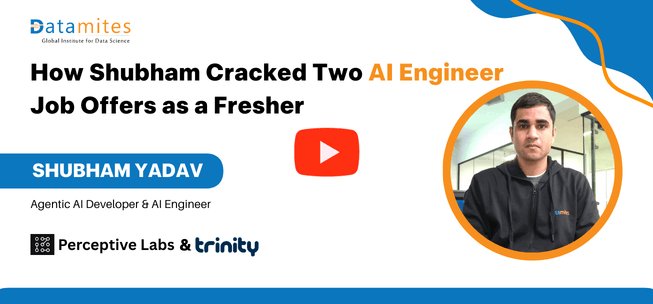
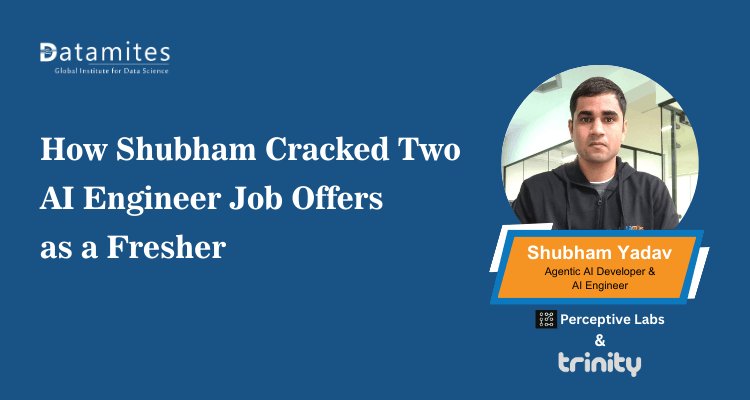
How Shubham Cracked Two AI Engineer Job Offers as a Fresher
A fresher’s inspiring journey of how Shubham secured two Artificial Intelligence Engineer job offers through the right skills, focused learning, and strategic preparation. The story highlights the practical steps, mindset, and training that helped him confidently enter the AI industry.
 Priyanka BR
Have you ever wondered how someone can change direction and still build a successful career in Artificial Intelligence? Shubham’s journey is a great example. After graduating in Electronics and Communication Engineering, he initially spent several years preparing for the GATE examination. Over time, he realized he wanted to pursue a different path and explore the rapidly growing field of AI and data science.
To build the right skills, he joined DataMites Institute, where he began learning Python, machine learning, and practical AI concepts through structured training and hands-on projects. Starting with limited exposure to programming, Shubham focused on consistent practice and strengthening his fundamentals.
With the right guidance and determination, his efforts eventually paid off, helping him secure two AI career offers as a fresher, showing that with the right learning approach and persistence, transitioning into the AI industry is achievable.
How Shubham Started His AI Career with DataMites Institute
Shubham’s journey highlights how a determined engineering graduate shifted from GATE preparation to Artificial Intelligence, building practical skills through structured training at DataMites and beginning his path toward an Artificial Intelligence career.
1. Can you briefly introduce your educational background and how your career journey began?
I graduated in 2022 with a degree in Electronics and Communication Engineering. After graduating, I spent around three years preparing for the GATE examination. Eventually, I realized that I wanted to explore a different career direction. That is when I decided to move to Bangalore and start learning data science and artificial intelligence through a structured training program.
2. How did your journey in data science and AI training begin?
After moving to Bangalore, I joined a Certified Data Scientist program. Initially, I started with online classes and later converted to offline training. During this period, I interacted with several mentors and instructors who helped me understand the fundamentals of data science and machine learning.
3. Which career opportunities were secured after completing the interview process?
After clearing the mock interview, the placement team helped refine the resume, leading to interview opportunities with multiple companies. After attending several interviews and progressing through the final rounds, two roles were secured: Agentic AI Developer at Perceptive Labs and AI Engineer at Trinity Mobility.
4. How did your interest in AI engineering develop after learning data science?
After completing the core data science concepts, I started exploring advanced topics on my own. I began learning about Large Language Models, Agentic AI systems, Retrieval-Augmented Generation, and vector databases. These areas helped me expand my knowledge beyond traditional machine learning.
5. How difficult was programming when you first started learning it?
Initially, coding was quite challenging. When I started working with Kaggle notebooks, it felt overwhelming. Many coding concepts and structures were new to me.
6. What strategy did you follow to improve your programming skills?
Instead of writing everything from scratch, I followed a reverse learning approach. I studied notebooks written by top Kaggle contributors. I observed how they structured their projects and implemented models. After understanding their approach, I tried implementing similar ideas on my own. Gradually, I started developing my own project ideas.
7. How important was mentorship during your learning journey?
Mentorship played a very important role. The instructors explained frameworks like Scikit-learn and machine learning tools in a very simple way. Within a few weeks, I became comfortable working with these frameworks because of their clear explanations and guidance.
8. Did you participate in mock interviews during your preparation?
Yes, after completing my capstone and client projects, I participated in mock interviews. I cleared the mock interview in my first attempt, which gave me confidence for real industry interviews.
9. What topics were covered during the mock interview?
The mock interview mainly focused on Python programming, machine learning theory, SQL scripting, and some mathematical concepts related to statistics and machine learning algorithms. Questions about logistic regression and statistical reasoning were also included.
10. Did interviewers allow the use of AI tools during coding tests?
In some cases, when I struggled to write certain code segments, the interviewer allowed me to use AI tools for assistance. The focus was more on understanding the logic and demonstrating problem-solving ability rather than simply memorizing code.
11. What types of questions were asked during technical interviews?
Technical interviews covered a wide range of topics, including AI frameworks, deep learning concepts, and natural language processing. Questions were asked about RAG architecture, LangChain framework, LlamaIndex, deep learning training methods, dropout techniques, backpropagation, and NLP fundamentals such as chunking and data processing.
12. Were analytical problem-solving questions also asked?
Yes, one interviewer asked an analytical question about a horse tied with a rope near a pond. The question tested logical reasoning rather than programming knowledge. The key was understanding whether the rope was fixed to a peg or free at one end.
13. Do you think the boundaries between AI, machine learning, and data science roles are changing?
Yes, the distinction between these roles is gradually becoming less clear. Data scientists, machine learning engineers, and AI engineers are expected to understand multiple technologies. Professionals need to continuously update their knowledge and adapt to industry changes.
14. What are your career goals for the next few years?
Artificial Intelligence is evolving rapidly, so it is important to keep learning. My focus is to continuously improve my technical knowledge, work on new projects, and stay updated with industry developments while building experience in the AI field.
Refer to these articles:
- Why Agentic AI Is the Most In-Demand Skill for Data Scientists in 2026
- How AI is Transforming Customer Analytics in 2026
- Will AI Agents Replace Your Next Coworker? Exploring the Future of Work
Shubham’s Key Takeaways on Starting an AI Career with DataMites Institute
His journey shows how consistent learning, practical exposure, and strong fundamentals can help graduates transition into the Artificial Intelligence industry even without a direct software background.
- Background: Shubham graduated in 2022 with a degree in Electronics and Communication Engineering. After preparing for the GATE exam for several years, he decided to shift his career toward Artificial Intelligence and data science.
- Career Transition Decision: To gain the required technical skills, he moved to Bangalore and enrolled in the Certified Data Scientist program at DataMites, aiming to build a structured learning path in AI and data science.
- Learning Foundation: The program helped him understand the fundamentals of Python programming, machine learning, and data science concepts, which formed the base for his technical growth.
- Self-Driven Learning: Along with the course curriculum, he explored advanced topics such as Large Language Models, agent-based AI systems, Retrieval Augmented Generation, and vector databases.
- Practical Coding Approach: To improve coding skills, he studied Kaggle notebooks created by experienced data scientists and then practiced implementing similar solutions on his own.
- Project Experience: Working on capstone and practical projects helped him apply theoretical concepts and gain hands-on experience with real-world data science workflows.
- Interview Preparation: He prepared for interviews by revising Python, machine learning theory, SQL, and statistics while also participating in mock interview sessions.
- Industry Interview Exposure: During interviews, he faced both analytical and technical questions covering AI frameworks, deep learning concepts, and natural language processing topics.
- Career Breakthrough: His preparation and project experience helped him secure roles as an Agentic AI Developer at Perceptive Labs and an AI Engineer at Trinity Mobility.
- Key Lesson: His journey highlights that strong fundamentals, consistent coding practice, and continuous learning can help aspiring professionals successfully build a career in Artificial Intelligence.
Shubham’s journey highlights how determination, continuous learning, and the right guidance can help someone transition into the Artificial Intelligence field. After graduating in Electronics and Communication Engineering, he initially spent several years preparing for the GATE examination. He decided to explore a career in data science and AI.
Refer to these articles:
- Can an Electronics Graduate Become an AI Developer as a Fresher? Suyog’s Success Story
- How to Become an AI Engineer as a Fresher – Megavath Raju’s AI Career Success Story
- How Venuprasath Secured His First AI Engineer Job as a Fresher from Tamil Nadu
To gain the necessary technical foundation, he enrolled in a structured training program at DataMites Institute, where he began learning Python programming, machine learning concepts, and essential data science techniques through guided training and hands-on practice.
During his learning journey, Shubham focused on improving his coding skills, understanding machine learning fundamentals, and applying his knowledge through projects. While pursuing one of the top IT courses in Delhi, he also explored emerging AI fields such as Large Language Models, Retrieval Augmented Generation, and agent-based AI systems, which helped him build strong technical confidence and industry-ready skills.
DataMites Training Institute offers a comprehensive 9-month Artificial Intelligence program designed to build practical AI skills through real-world projects and industry tools. The course includes specialized learning paths such as AI Engineer, AI Expert, AI for Product Managers, AI Foundation, and Certified NLP Expert, along with globally recognized certifications accredited by IABAC and NASSCOM FutureSkills to prepare learners for real-world AI and machine learning careers.
To make quality AI education accessible, DataMites Institute has expanded its presence with 30+ offline training centers across major cities in India, allowing students and working professionals to learn through classroom training combined with practical project experience. For example, learners looking for structured AI training can enroll in an Artificial Intelligence course in Delhi, where DataMites provides industry-focused learning and hands-on mentorship.
Similarly, those based in the technology hub of Karnataka can join Artificial Intelligence classes in Bangalore, where DataMites offers offline learning centers in locations such as Kudlugate, BTM Layout, and Marathahalli, giving learners direct access to expert trainers, project guidance, and career support.