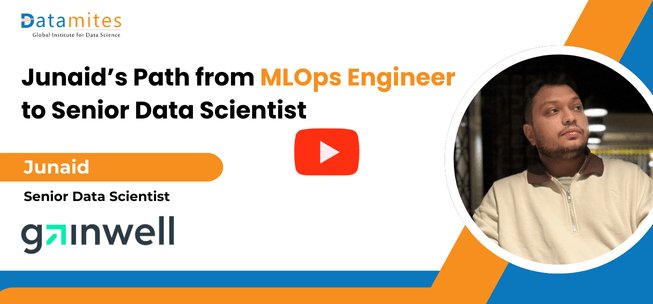
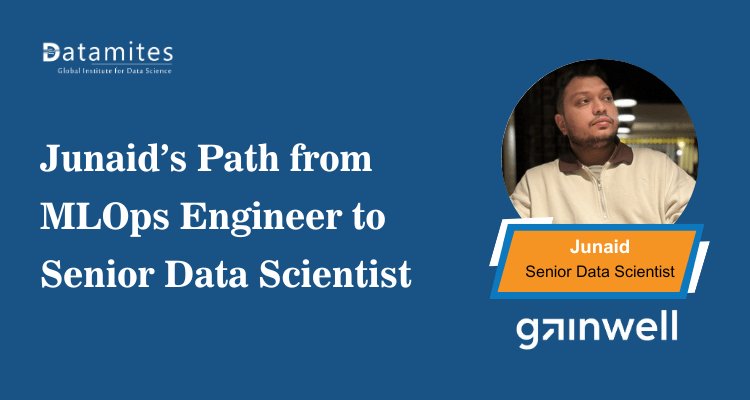
Junaid’s Path from MLOps Engineer to Senior Data Scientist
Junaid’s journey from MLOps to Senior Data Scientist shows how consistent learning, strong fundamentals, and hands-on AI and GenAI work shaped his growth into a full-stack data professional.
 Prerana B A
Breaking into AI and data roles feels exciting and overwhelming at the same time. You hear GenAI, LLMs, pipelines, MLOps, ETL, full-stack data science. But what do these actually mean when you're trying to build a career? And what do companies genuinely expect from you?
Junaid, an AI and data practitioner working in India’s fast-growing tech scene shares how he moved from avoiding programming to building real AI systems in healthcare. Along the way, he explains hiring patterns, practical skills, real-world tech stacks, and why coding still matters.
Junaid’s Journey in Data Science with DataMites Training
See how Junaid transitioned into the world of Data Science, built strong technical skills, and advanced his career through focused learning, hands-on practice, and guidance from DataMites.
Q1. Junaid, how did your journey into Data Science really begin?
Honestly, I never planned to get into programming or Data Science. My interest was initially in chip manufacturing, which is why I took Electronics and Communication Engineering. But during my course, I got exposure to things like OpenCV and computer vision, and that’s where my curiosity for AI and ML really started.
Q2. What motivated you to explore Machine Learning and Deep Learning seriously?
When I saw how powerful AI applications were becoming, I realized this is the future. I started learning independently, took courses from Edureka and later DataMites, and slowly built a strong base in ML and Deep Learning. That’s when I decided to take it seriously.
Q3. Where did you pursue your master’s degree?
I completed my master’s from the University of Strathclyde in the UK, specializing in Machine Learning and Deep Learning. That phase helped me understand AI at a deeper research level.
Q4. Why did you return to India after completing your master’s?
A lot of people think the UK automatically means better opportunities, but the truth is most core AI development teams are based in India. Even government organizations abroad outsource major AI work here. So if you want to work in hardcore development roles, India is actually a better place to start.
Q5. What changes did you notice in Data Science job expectations when you started working?
Earlier, companies wanted people who knew basic ML. But now, companies expect full-stack Data Scientists people who can build models, deploy them, work with data pipelines, and even understand MLOps. The expectations have grown significantly.
Q6. What tech stacks do you currently work with?
I work on two major tracks:
- AI & Conversational Systems NLU combined with LLMs to build hybrid conversational architectures.
- Data Engineering PySpark pipelines, ETL workflows, bronze–silver–gold layers, and cloud deployments.
- So my work spans both AI development and end-to-end data workflows.
Q7. What kinds of AI solutions are you developing now?
Right now I’m building an AI-based analytical engine for the healthcare domain. It includes transforming call transcripts into useful features, building cost-efficient chatbots, and combining LLMs with NLU for enterprise conversation systems.
Q8. When you interview freshers, what do you look for?
For freshers, I don’t look for perfection. I look for effort. If they put genuine effort into learning and have clarity in fundamentals like Python, ML basics, and one or two solid projects that’s enough. Depth matters more than knowing everything.
Q9. What about experienced candidates? What do you expect from them?
For experienced people, I expect implementation depth. I want to know how they solve real business problems, how they deploy systems, how they handle pipelines, monitoring, and versioning. Experience should reflect in problem-solving maturity.
Q10. With tools like ChatGPT available, is Python still necessary?
Absolutely. Python is still the base. ChatGPT can write code, but if you don’t understand what a list or loop does, how will you debug or customize anything? AI tools help you but they can’t replace your foundational understanding.
Q11. Do companies still test Python during interviews?
100%. Every company checks Python basics data structures, logic, simple coding. You can’t skip Python just because LLMs exist.
Q12. How important is DSA for Data Science roles?
For product-based companies, DSA is extremely important. It’s not something you can learn in one week you need consistent daily practice. Companies want to see how you think, not just whether you know ML.
13. What kind of projects really impress recruiters today?
It depends on the company:
- Service companies prefer candidates with varied projects GenAI, analytics, automation, NLU, etc.
- Product companies expect depth like manually building trees, designing architectures, and showing strong understanding of how the model works internally.
Q14. Apart from ML and Python, what additional skills should beginners focus on?
Beginners should definitely learn:
- SQL & databases
- Cloud basics
- PySpark
- API integration
- Git
- Fundamentals of deployment
These skills give you an advantage in real-world environments.
Q15. Are GenAI skills now essential?
Yes, GenAI is no longer optional. Companies look for knowledge in LLM fine-tuning, RAG, building GenAI agents, and optimizing inference costs. Even at junior levels, GenAI exposure adds strong value.
Q16. What is your final message to aspiring Data Science professionals?
Stay consistent and keep learning. Don’t rush, don’t copy projects do things the right way. Focus on understanding concepts deeply and keep building practical end-to-end solutions. The field is evolving fast, and those who learn continuously will always stay ahead.
Junaid’s journey reflects the reality of modern AI careers multidisciplinary, evolving, and highly opportunity-driven. His experiences and advice offer clarity for beginners and working professionals aiming to build a long-term future in Data Science, Machine Learning, and GenAI.
Refer these articles:
- The Ultimate Guide to Data Science Models
- Top 10 Data Mining Tools Every Data Scientist Should Know in 2025
- Guide to Data Science Career
Key Lessons from Junaid’s Data Science Journey
Here are the core insights from Junaid’s path that can help anyone looking to begin or advance a career in Data Science.
- Junaid entered Data Science unexpectedly after discovering computer vision and AI during his engineering studies.
- He built his foundation through self-learning and structured courses from Edureka and DataMites.
- His master’s degree in the UK strengthened his understanding of Machine Learning and Deep Learning at a research level.
- He chose India for career growth because most core AI development teams and opportunities are based here.
- Data Science roles have evolved to demand full-stack skills: modeling, deployment, pipelines, and MLOps.
- His work covers both AI development with LLM-NLU systems and data engineering using PySpark and ETL pipelines.
- He builds AI solutions for healthcare, including analytical engines and hybrid conversational systems.
- When interviewing freshers, he values clarity in fundamentals and sincere effort over having many projects.
- For experienced candidates, he expects strong implementation depth and real problem-solving maturity.
- Python remains essential even with tools like ChatGPT, and companies still test basic coding skills in interviews.
- DSA is key for product-based companies and needs consistent practice to build strong logical thinking.
- Recruiter expectations differ: service companies want project variety, while product companies expect deeper technical understanding.
- GenAI skills like fine-tuning, RAG, and LLM-based systems are increasingly necessary, and continuous learning is crucial for staying competitive.
Refer these articles:
- Vinay Gaikwad’s Journey in Freelance Data Science
- How Parag Thakur Built His Career in Data Science
- Freelancing in Data Science: Samapika Singh’s Insights
If you’re starting out in data science or considering a career switch, Junaid’s journey shows how building strong fundamentals, practicing consistently, and gaining hands-on experience can make all the difference. According to Grand View Research, the global data science platform market, valued at USD 96.25 billion in 2023, is projected to grow at a 26% CAGR from 2024 to 2030. With industries generating massive amounts of data every day, the demand for skilled professionals is rising, making data science one of the IT courses in demand today.
Junaid’s career growth was fueled by structured training at DataMites institute. With beginner-friendly courses for learners from non-technical backgrounds, he mastered Python, statistics, and machine learning while gaining practical experience through internships and real-world projects. Datamites, being one of the top data science institute in Coimbatore, Pune, Mumbai, Bangalore, Chennai, Ahmedabad, and Hyderabad, provides learners with flexible, industry-relevant, and practical training that prepares them for today’s competitive job market.
By enrolling in programs from one of the Best data science institute in Chennai, Hyderabad, Bangalore, Kolkata, Pune, Mumbai, or Delhi, learners gain expert mentorship, project exposure, and placement support. Whether you’re a fresher, a professional from a non-technical field like Junaid, or exploring a career transition, DataMites makes high-quality data science education accessible. With structured guidance, hands-on learning, and consistent effort, stepping into a successful data science career is entirely achievable and future-ready.