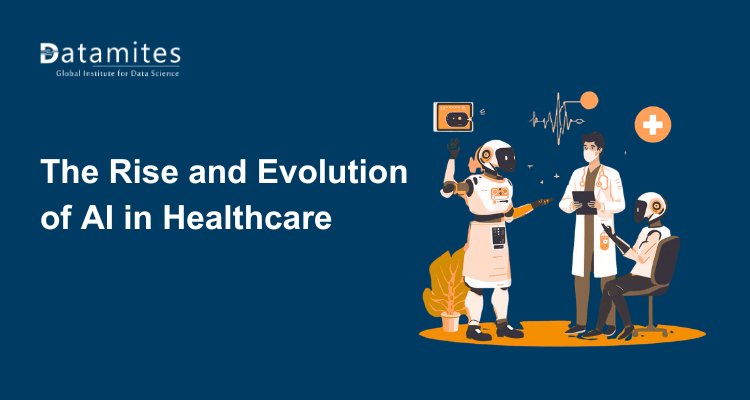
The Rise and Evolution of AI in Healthcare
AI has rapidly evolved in healthcare, moving from basic data processing to advanced diagnostics, predictive analytics, and personalized treatments. It enhances accuracy, speeds up decision-making, and is reshaping patient care and medical research globally.
 Prerana B A
Artificial Intelligence in Healthcare is rapidly transforming how medical professionals diagnose diseases, treat patients, and manage healthcare systems. What once seemed like science fiction is now a critical component of modern medicine. From predictive analytics in medicine to AI-powered healthcare systems, the integration of AI is enhancing accuracy, efficiency, and accessibility across the healthcare ecosystem.
As healthcare data continues to grow exponentially, AI in healthcare is enabling faster decision-making and improved patient outcomes. This article explores the evolution, applications, benefits, and future of AI medical technology, offering a complete understanding of its growing impact.
How AI is Used in Healthcare?
AI in healthcare leverages machine learning algorithms, natural language processing, and data analytics to simulate human intelligence in medical processes. These systems analyze vast datasets to uncover patterns that would be difficult for humans to detect.
Common uses include:
- Clinical decision support systems to assist doctors in diagnosis
- Healthcare data analytics for predicting disease outbreaks
- Healthcare automation to streamline administrative workflows
- AI-powered healthcare systems for personalized treatment plans
According to a 2024 report by Accenture, AI applications could save the U.S. healthcare industry up to $150 billion annually by 2026 through efficiency improvements and automation.
The Evolution of AI in Healthcare
The journey of Artificial Intelligence in Healthcare spans several decades and reflects the broader progress of computing, data science, and digital healthcare innovation. What began as simple rule-based systems has now evolved into sophisticated AI-powered healthcare systems capable of analyzing complex medical data, supporting clinical decisions, and transforming patient care.
Understanding this evolution helps explain why AI in healthcare is becoming such a powerful force in modern medicine.
Early AI and Medical Expert Systems (1960s–1980s)
The first stage in the evolution of AI medical technology focused on rule-based expert systems. These early programs were designed to mimic the decision-making abilities of medical specialists.
One of the most notable examples was MYCIN, developed in the 1970s at Stanford University. This system helped physicians diagnose bacterial infections and recommend appropriate antibiotics based on predefined rules.
Key characteristics of this phase included:
- Rule-based algorithms
- Limited computing power
- Small medical datasets
- Basic clinical decision support systems
Although these early systems were groundbreaking, they were limited because they could only operate using manually programmed knowledge rather than learning from real-world data.
The Emergence of Machine Learning in Healthcare (1990s–2000s)
As computing power increased and healthcare systems began digitizing medical records, a new phase emerged: machine learning in healthcare.
During this period, hospitals and research institutions started adopting electronic health records (EHRs), creating massive amounts of healthcare data. This data made it possible to train algorithms capable of identifying patterns and predicting health outcomes.
Major developments during this stage included:
- Early healthcare data analytics
- Predictive modeling for disease risk
- Decision-support tools for physicians
- Early forms of predictive analytics in medicine
Machine learning systems could now analyze thousands of patient records to detect correlations between symptoms, treatments, and outcomes.
The Big Data and Deep Learning Revolution (2010s)
The 2010s marked a major turning point in AI healthcare applications due to breakthroughs in deep learning and big data technologies.
Deep learning algorithms enabled computers to process large datasets such as medical images, genomic sequences, and clinical records with unprecedented accuracy.
This era saw the rapid growth of:
- AI medical imaging
- Advanced AI in medical diagnosis
- AI-assisted radiology and pathology
- Intelligent diagnostic tools
- Large-scale healthcare automation
For example, deep learning models began outperforming traditional algorithms in detecting diseases such as cancer, diabetic retinopathy, and lung conditions from medical images.
Major technology companies and healthcare startups also began investing heavily in digital healthcare innovation, accelerating the development of AI-driven medical tools.
AI-Powered Healthcare Systems (2020s)
Today, AI-powered healthcare systems are integrated into nearly every aspect of the healthcare ecosystem.
Artificial intelligence now supports:
- Hospital workflow optimization
- Remote patient monitoring
- Virtual health assistants
- Clinical decision support systems
- AI in patient care
- AI drug discovery
AI technologies are also being used to process real-time patient data from wearable devices and connected health platforms, allowing doctors to monitor patients outside hospital settings.
This stage represents the transition from experimental AI tools to fully integrated AI healthcare applications that support clinicians in daily medical practice.
The Future Evolution of AI in Healthcare
Looking ahead, the future of AI in healthcare is expected to bring even more transformative innovations.
Emerging trends include:
- AI-driven personalized medicine
- Autonomous diagnostic systems
- AI-assisted robotic surgery
- Advanced predictive healthcare models
- AI-powered drug discovery platforms
- Global healthcare automation
According to industry research, the global AI healthcare market is projected to grow rapidly over the next decade as hospitals and healthcare organizations increasingly adopt intelligent technologies.
As these innovations continue to evolve, Artificial Intelligence in Healthcare will play a critical role in making medical systems more efficient, accessible, and patient-centered.
Refer to these articles:
- AI Product Development Life Cycle Explained
- The 2026 Guide to Implementing AI in HR Analytics
- A Complete Guide to AI in Marketing
Key Applications of AI in Healthcare
Artificial Intelligence is transforming healthcare by helping doctors diagnose diseases, improve treatments, and manage patient care more efficiently. With technologies like machine learning and data analytics, AI can quickly analyze large amounts of medical data.
AI in Medical Diagnosis
AI systems analyze patient data, symptoms, and medical history to help doctors detect diseases earlier and make faster clinical decisions. These tools can also reduce diagnostic errors and improve accuracy in identifying conditions like cancer and heart disease.
AI in Medical Imaging
AI technologies assist radiologists in analyzing medical scans such as X-rays, MRIs, and CT scans. They help detect abnormalities like tumors, fractures, and infections quickly while improving image analysis and reducing workload for medical professionals.
AI in Drug Discovery
AI accelerates the development of new medicines by analyzing biological data and predicting molecular interactions. This helps researchers identify potential drug candidates faster and reduces the time and cost required for drug development.
AI in Patient Care
AI improves patient care through virtual health assistants, wearable health monitoring devices, and personalized treatment recommendations. These systems allow continuous monitoring of patients, especially those with chronic diseases.
AI in Hospital Management
AI helps hospitals automate administrative tasks such as scheduling, patient flow management, and billing processes. This improves operational efficiency and allows healthcare professionals to focus more on patient care.
AI applications in healthcare improve diagnosis, medical imaging, drug discovery, patient care, and hospital management, making healthcare faster, more accurate, and more efficient.
Benefits of AI in Healthcare
The benefits of AI in healthcare extend across clinical, operational, and economic areas.
- Improved Diagnostic Accuracy: AI algorithms analyze vast datasets and detect patterns that human doctors might miss.
- Faster Medical Decisions: Clinical decision support systems provide real-time insights that help physicians make faster treatment decisions.
- Reduced Healthcare Costs: Automation and predictive analytics reduce unnecessary procedures and hospital stays.
- Personalized Medicine: AI enables treatments tailored to an individual patient's genetic profile and health history.
- Enhanced Patient Monitoring: AI-powered devices allow continuous monitoring of patient health outside hospitals.
According to PwC research, AI healthcare technologies could generate $150 billion in annual savings for the U.S. healthcare system by 2026.
Challenges and Ethical Concerns of AI in Healthcare
Despite its potential, Artificial Intelligence in Healthcare also raises several challenges.
- Data Privacy and Security: Healthcare data is extremely sensitive. AI systems must ensure strict data protection.
- Algorithm Bias: If training data is biased, AI models may produce inaccurate or unfair predictions.
- Regulatory Compliance: Medical AI tools must meet strict regulatory standards before being deployed in clinical settings.
- Lack of Transparency: Some AI models operate as “black boxes,” making it difficult for clinicians to understand how decisions are made.
Addressing these concerns is essential for responsible digital healthcare innovation.
Refer to these articles:
- How AI is Transforming Customer Analytics in 2026
- Why Black‑Box Models Are Losing Trust
- Will AI Agents Replace Your Next Coworker
Future Trends of AI in Healthcare
The future of AI in healthcare looks incredibly promising.
Emerging AI healthcare trends include:
- Generative AI for medical documentation
- AI-assisted robotic surgery
- Advanced predictive analytics in medicine
- AI-powered personalized medicine
- Digital twins for patient modeling
- Autonomous diagnostic systems
According to Grand View Research, the global AI healthcare market is expected to grow at a compound annual growth rate of over 37% through 2030.
As computing power and medical datasets continue expanding, AI systems will become even more intelligent and precise.
Across the world, AI medical technology is reshaping healthcare delivery systems.
Healthcare organizations are using AI to:
- Improve medical research
- Accelerate clinical trials
- Expand telemedicine services
- Reduce physician burnout
- Improve global healthcare accessibility
Countries with limited medical resources are especially benefiting from AI healthcare applications, which allow remote diagnostics and digital consultations.
In many regions, AI-powered tools are helping doctors reach patients in rural areas where medical specialists are scarce.
This transformation marks the beginning of a new era in medicine driven by healthcare data analytics and intelligent automation.
Artificial Intelligence in Healthcare is no longer a futuristic concept; it is a present-day reality transforming many areas of modern medicine. From AI in medical diagnosis to AI-powered healthcare systems, intelligent technologies are improving efficiency, accuracy, and innovation across the healthcare industry. Hospitals and medical institutions are increasingly using AI to analyze patient data, support clinical decisions, and enhance overall healthcare delivery.
As the demand for AI-driven medical solutions continues to grow, many professionals are enrolling in an AI for Healthcare certification course to gain the skills needed to apply artificial intelligence in healthcare environments. While challenges such as data privacy and ethical concerns remain, the benefits of AI in healthcare far outweigh the risks when implemented responsibly, leading to a more personalized, accessible, and efficient global healthcare system.
DataMites offers an AI for Healthcare Professionals course that helps medical practitioners apply artificial intelligence in clinical and operational settings. The program covers core AI concepts, data-driven insights, and applications in patient care, hospital management, and healthcare research. Learners can choose flexible formats such as online training, classroom sessions, and project-based internships. The certifications are globally recognized and accredited by IABAC and the Certified AI Professional for Healthcare & Clinical Ops, and training is delivered through 30+ centers across major Indian cities along with virtual learning options.