Top AI Trends That Will Shape 2026
Explore the latest AI trends in 2026, including agentic AI, multimodal systems, and AI-driven automation transforming business and technology.
 Swagatam Sinha
Artificial Intelligence (AI) is evolving at an unprecedented pace, transforming industries, economies, and the way people interact with technology. Over the past few years, AI has moved beyond simple automation and predictive analytics into advanced intelligent systems capable of learning, reasoning, and decision-making. As organizations accelerate digital transformation, understanding the latest artificial intelligence trends has become essential for businesses, technology professionals, and policymakers.
According to recent market research, the global AI market is experiencing massive growth. A report by Gartner predicts that worldwide AI spending could reach over $2 trillion by 2026, driven by increasing adoption across industries such as healthcare, finance, retail, and manufacturing.
Similarly, McKinsey Global Institute estimates that generative AI could contribute $2.6 trillion to $4.4 trillion annually to the global economy, highlighting the immense potential of AI-powered innovation.
These developments show why organizations are paying close attention to AI trends shaping 2026 and investing heavily in emerging artificial intelligence technologies that will shape the future of business and society.
In this article, we explore the most important AI trends expected to define 2026 and beyond.
Why Artificial Intelligence Will Dominate the Next Decade
Artificial Intelligence is becoming one of the most influential technologies driving global innovation. Governments, enterprises, and startups are investing heavily in AI to remain competitive in the digital economy.
According to PwC, AI could contribute up to $15.7 trillion to the global economy by 2030, making it one of the largest commercial opportunities in modern history.
AI adoption is increasing due to several key factors:
- Growth in big data and digital information
- Advances in machine learning algorithms
- Increased computing power and cloud infrastructure
- Demand for automation and intelligent decision-making
As businesses adapt to rapid technological change, the latest artificial intelligence trends are becoming central to digital transformation strategies.
Refer to these articles:
- LLM Fine-Tuning vs Prompt Engineering: Which Is Better?
- Why Agentic AI Is the Most In-Demand Skill for Data Scientists in 2026
- How AI is Transforming Customer Analytics in 2026
Key AI Trends That Will Shape 2026
Understanding the latest artificial intelligence trends helps businesses, professionals, and organizations stay competitive in a technology-driven economy.
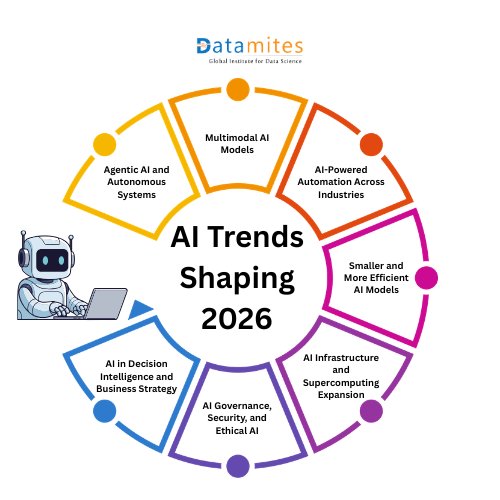
Below are the most important ai trends 2026 that will shape the future of technology and business.
1. Agentic AI and Autonomous Systems
One of the most important future AI trends is the rise of Agentic AI. These AI systems are designed to operate autonomously, make decisions, and complete complex tasks with minimal human intervention.
Unlike traditional AI models that only analyze data, agentic systems can:
- Plan multi-step actions
- Interact with digital tools
- Adapt to changing environments
- Execute tasks independently
For example, AI agents are already being used in:
- Customer support automation
- IT system management
- Autonomous financial analysis
- Intelligent workflow automation
Companies are adopting these solutions to improve efficiency and reduce operational costs, making agentic systems one of the most promising emerging ai technologies.
2. Multimodal AI Models
Another major trend shaping the future of AI is the development of multimodal AI models. These systems can process and analyze multiple types of data simultaneously, such as text, images, audio, and video.
Multimodal AI enables more advanced applications, including:
- AI-powered virtual assistants
- Automated video generation
- Voice-enabled chatbots
- Real-time image and speech analysis
This innovation is transforming industries such as healthcare, marketing, and education. For instance, healthcare providers can use multimodal AI to analyze medical images alongside patient data for more accurate diagnoses.
As businesses explore emerging ai technologies, multimodal AI will play a critical role in delivering smarter and more intuitive digital experiences.
3. AI-Powered Automation Across Industries
Automation has long been a key application of AI, but the latest artificial intelligence trends indicate that automation is becoming far more sophisticated.
AI-powered automation is now capable of handling complex business processes such as:
- Supply chain optimization
- Fraud detection in financial systems
- Intelligent customer support
- Predictive maintenance in manufacturing
Businesses that adopt AI-driven automation will gain significant advantages in efficiency, scalability, and cost reduction.
According to Accenture, AI has the potential to increase business productivity by up to 40% through intelligent automation and advanced analytics.
4. Smaller and More Efficient AI Models
While large AI models have received significant attention, another important trend in future of artificial intelligence is the development of smaller, more efficient AI systems.
Organizations are increasingly focusing on:
- Lightweight AI models
- Edge AI deployment
- Domain-specific AI solutions
These models require less computing power while delivering high performance in specific tasks. This shift enables AI deployment in environments such as:
- Smartphones
- IoT devices
- Autonomous vehicles
- Smart manufacturing systems
This approach makes emerging ai technologies more accessible and cost-effective for businesses of all sizes.
5. AI Infrastructure and Supercomputing Expansion
As AI applications grow more advanced, demand for high-performance computing infrastructure is also increasing. Tech companies are investing heavily in AI data centers, GPUs, and specialized AI hardware.
According to Deloitte, global spending on AI infrastructure is expected to grow significantly as organizations expand their AI capabilities.
Major technology companies are building powerful AI supercomputers capable of training massive machine learning models. These investments are crucial for supporting the latest artificial intelligence trends and enabling breakthroughs in areas such as climate modeling, drug discovery, and scientific research.
According to Morgan Stanley, the construction of AI-focused data centers could generate nearly $2.9 trillion in global investment by 2028, making AI infrastructure one of the largest technology investment cycles in history.
6. AI Governance, Security, and Ethical AI
As AI becomes more powerful, concerns about ethical use, bias, and security are also increasing. Governments and organizations are developing frameworks to ensure responsible AI adoption.
Key areas of focus include:
- AI transparency
- Bias mitigation
- Data privacy protection
- Regulation of AI-generated content
- Prevention of deepfakes and misinformation
For example, the European Union’s AI Act aims to establish guidelines for safe and trustworthy AI development.
Addressing these challenges will be essential for maintaining public trust and ensuring that emerging ai technologies benefit society responsibly.
7. AI in Decision Intelligence and Business Strategy
One of the most impactful latest artificial intelligence trends is the growing use of AI in strategic decision-making.
Organizations are increasingly leveraging AI-powered analytics to:
- Predict market trends
- Optimize pricing strategies
- Identify business risks
- Improve operational efficiency
Decision intelligence combines data analytics, machine learning, and business intelligence to help companies make smarter and faster decisions.
This capability is becoming a key competitive advantage for organizations adopting AI industry trends.
Refer to these articles:
- Explainable AI: Why Black-Box Models Are Losing Trust
- Will AI Agents Replace Your Next Coworker? Exploring the Future of Work
- CrewAI vs. AutoGen vs. LangGraph: Which multi-agent framework should you learn in 2026?
Business Benefits of Emerging AI Technologies
The rapid growth of AI adoption is driven by the significant benefits it offers to businesses.
Some of the most important advantages include:
Increased Productivity
AI automation reduces manual work and enables employees to focus on higher-value tasks.
Better Decision Making
Advanced analytics provide real-time insights that improve strategic planning.
Cost Reduction
AI-powered optimization helps businesses reduce operational expenses.
Improved Customer Experience
AI chatbots and recommendation systems deliver personalized customer interactions.
Competitive Advantage
Companies adopting emerging ai technologies are able to innovate faster and respond more effectively to market changes.
Refer to these articles:
- How Knowledge-Augmented Generation (KAG) Is Solving AI Hallucinations
- AI Sovereignty: The New Mandate for Data Governance in the Cloud Era
- LLMs vs. SLMs: Key Differences and How to Choose the Right Model
Skills Professionals Need for the AI Future
As artificial intelligence continues to transform industries, the demand for AI-related skills is growing rapidly. Organizations across the world are looking for professionals who can understand data, build intelligent systems, and use AI tools to drive business innovation. According to a report by LinkedIn, AI-related roles such as machine learning engineers, data scientists, and AI specialists have been among the fastest-growing jobs globally in recent years. This surge reflects the increasing importance of staying updated with the latest artificial intelligence trends and developing skills that align with ai trends 2026.
To succeed in the AI-driven economy, professionals need a combination of technical expertise, analytical thinking, and business understanding. Below are some of the most important skills required for the future of AI.
1. Data Literacy and Data Analysis
Data is the foundation of artificial intelligence. AI systems rely on large datasets to train algorithms and generate insights. As a result, professionals must develop strong data literacy skills.
Key competencies include:
- Understanding data structures and databases
- Cleaning and preparing datasets
- Performing statistical analysis
- Interpreting data-driven insights
According to research by IBM, the global demand for data science and analytics professionals is expected to grow significantly as organizations increasingly adopt emerging ai technologies.
2. Machine Learning and AI Fundamentals
A strong understanding of machine learning is essential for professionals working in AI-related roles. Machine learning enables computers to learn patterns from data and make predictions without explicit programming.
Important concepts include:
- Supervised and unsupervised learning
- Deep learning and neural networks
- Model training and evaluation
- Natural language processing (NLP)
These skills allow professionals to build intelligent applications that support business decision-making and automation, making them crucial for understanding modern AI industry trends.
3. Programming and AI Tools
Programming skills are a core requirement for working with AI systems. Languages such as Python and R are widely used for data analysis and machine learning development.
Professionals should become familiar with tools and frameworks such as:
- Python for AI and data science
- Machine learning libraries like TensorFlow and PyTorch
- Data visualization tools such as Power BI or Tableau
Learning these technologies enables professionals to implement solutions aligned with the latest artificial intelligence trends and build scalable AI applications.
4. Critical Thinking and Problem-Solving
While technical skills are important, AI professionals must also develop strong analytical thinking abilities. Artificial intelligence projects often involve solving complex business problems using data-driven methods.
Key abilities include:
- Identifying patterns in data
- Designing AI-driven solutions
- Evaluating model performance
- Making data-informed decisions
Organizations value professionals who can combine AI knowledge with practical problem-solving to create business impact.
5. AI Ethics and Responsible AI
As AI adoption increases, ethical considerations have become a major focus. Issues such as data privacy, algorithmic bias, and transparency require careful attention.
Professionals should understand:
- Ethical AI development practices
- Data protection and privacy regulations
- Responsible AI deployment
Companies are prioritizing responsible innovation as they adopt emerging ai technologies, making ethical awareness an essential skill in the AI workforce.
Future Outlook of AI Beyond 2026
Looking ahead, artificial intelligence will become a foundational technology for global economic growth.
Several major developments are expected in the coming years:
- AI-powered digital workplaces
- autonomous business systems
- AI-driven scientific research
- personalized healthcare powered by AI
- intelligent smart cities
With the generative AI market projected to exceed $1.2 trillion by 2035, the long-term impact of AI on the global economy will be immense. Source: (Precedence Research)
As organizations continue exploring future AI innovations, the integration of emerging AI technologies into everyday operations will accelerate innovation across industries.
Artificial Intelligence is entering a new era of innovation and impact. The latest artificial intelligence trends indicate that AI will become even more integrated into business operations, decision-making, and everyday life.
From autonomous AI agents to multimodal systems and advanced automation, the AI trends shaping 2026 highlight a future where intelligent technologies drive productivity and innovation across industries. As organizations continue to adopt emerging ai technologies, businesses and professionals must stay informed and develop the skills needed to thrive in an AI-powered world.
Understanding these trends today will help organizations prepare for the transformative opportunities that artificial intelligence will bring in the years ahead.
At DataMites, we focus on helping professionals build future-ready skills in artificial intelligence, data science, and analytics through industry-relevant training programs. Our learning approach combines practical projects, expert mentorship, and real-world case studies to help learners understand the latest AI technologies and industry trends.
If you are looking to build expertise in AI, the Artificial Intelligence course in Hyderabad offered by DataMites provides hands-on training in machine learning, AI tools, and real-world applications, helping learners develop the skills needed to succeed in the evolving AI-driven job market.