Best Programming Languages for Artificial Intelligence Development
Selecting the best programming language for artificial intelligence development depends on project goals, performance needs, and developer expertise. Understanding the strengths of each language helps developers build efficient and scalable AI systems tailored to their specific needs.
 Farheen Sabha
Artificial Intelligence (AI) is revolutionizing nearly every industry from healthcare and finance to transportation and entertainment. As more companies integrate AI into their operations, the demand for skilled developers who understand the right tools, especially programming languages, is soaring. Choosing the best programming language is critical for building efficient, scalable, and maintainable AI systems.
Whether you're a beginner starting your journey through an artificial intelligence course or an experienced developer aiming to expand your skill set, understanding the strengths and limitations of each programming language will help you make informed decisions.
Why Choosing the Right Programming Language Matters in AI Development
Different AI applications require different tools, and the choice of programming language can significantly impact the effectiveness of a project. While some languages are better suited for statistical modeling, others excel in developing neural networks or building real-time AI systems. Selecting the right programming language can:
- Accelerate development time
- Improve model accuracy and performance
- Ensure compatibility with leading AI libraries and frameworks
- Enhance overall productivity and scalability
According to a report by Grand View Research, the global artificial intelligence market was estimated at USD 390,908.1 million in 2025 and is projected to reach USD 3,497,258.8 million by 2033, growing at a CAGR of 30.6% from 2026 to 2033, underscoring the growing importance of efficient and scalable AI development practices.
Key Factors to Consider When Choosing a Language for Artificial Intelligence
Different AI applications require different tools. While some languages are better suited for statistical modeling, others shine in building neural networks or real-time AI systems. Selecting the right programming language can:
- Library and Framework Support: A rich set of AI libraries speeds up development.
- Performance: Execution speed is vital for large-scale and real-time AI tasks.
- Community and Documentation: Strong community support helps with troubleshooting and continuous learning.
- Ease of Learning: Beginners may prefer languages with simpler syntax and robust learning resources.
- Integration: The language should integrate easily with other systems and data pipelines.
- Deployment and Production Readiness: Consider how easily the language supports deploying, monitoring, and maintaining AI models in real-world applications.
- Hardware and Computing Support: For performance-intensive AI workloads, compatibility with GPUs, accelerators, and optimized computing libraries can influence language selection.
As the AI market continues to experience significant growth, choosing a programming language that meets key development criteria is crucial for creating efficient and scalable AI solutions. According to ABI Research, the Artificial Intelligence (AI) software market was valued at approximately USD 122 billion in 2024, underscoring the rising demand for intelligent technologies across a wide range of industries.
Refer to these articles:
- AI in Everyday Life
- Understanding Machine Learning: Basics for Beginners
- Top 10 Real-World Applications of Artificial Intelligence
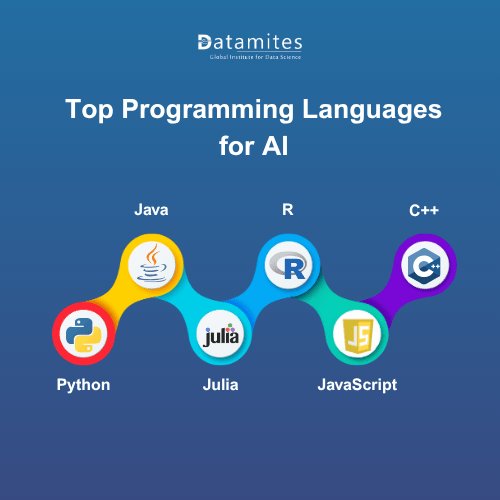
Top Programming Languages for Artificial Intelligence Development
Choosing the right programming language is crucial for effective artificial intelligence development. Here’s a look at the top languages that power today’s intelligent systems.
Python
Python is arguably the most popular programming language for AI development. Known for its simplicity and readability, Python is beginner-friendly and ideal for rapid prototyping.
Why Python Excels in AI:
- Comprehensive Libraries: TensorFlow, PyTorch, Scikit-learn, Keras, and NLTK support key areas of AI development, including machine learning, deep learning, and natural language processing.
- Active Community: With millions of developers, it's easy to find solutions and resources.
- Integration: Easily integrates with web frameworks, APIs, and cloud platforms.
- Production and Deployment: Python supports model deployment through APIs, cloud environments, model-serving tools, and end-to-end machine learning workflows.
R
R is a statistical computing language ideal for data analysis, machine learning, and visualization.
Why R is Relevant in AI:
- Statistical Modeling: Built-in functions for regression, classification, and clustering.
- Data Visualization: ggplot2 and Shiny make it easy to present data insights.
- Research-Oriented: Frequently used in academic and healthcare sectors for AI research.
- Project Suitability: R is particularly useful when statistical analysis, data visualization, and research are central to an AI project.
Java
Java is a powerful, object-oriented programming language that’s widely used in enterprise-level AI applications.
Why Java Stands Out:
- Scalability: Ideal for building large-scale AI solutions.
- Cross-Platform: Write once, run anywhere capability.
- Libraries: Libraries like Deeplearning4j, Weka, and MOA support AI functions.
- Enterprise Integration: Java integrates well with existing enterprise applications, backend systems, and production infrastructure.
C++
C++ is known for its high performance and control over system resources, making it suitable for resource-constrained environments.
C++ in AI:
- Speed: Excellent for time-sensitive applications like robotics and video games.
- Memory Management: Offers detailed control for optimization.
- Compatibility: Used in AI engines and embedded systems.
- Hardware and Performance: C++ is well suited for low-latency inference, embedded systems, robotics, and applications requiring hardware-level optimization.
Julia
Julia is a high-level, high-performance programming language designed specifically for numerical computing.
What Makes Julia Unique:
- High Performance: Julia is designed for fast numerical and scientific computing, making it suitable for computationally intensive AI workloads.
- Mathematical Syntax: Intuitive for users with a background in mathematics or physics.
- Growing Ecosystem: Libraries like Flux.jl and MLJ.jl support machine learning and deep learning.
- Numerical Computing: Julia is suitable for computationally intensive scientific and mathematical AI workloads.
JavaScript
JavaScript may not be the first language that comes to mind for AI, but it has growing importance, especially in browser-based applications.
Why JavaScript Matters:
- Front-End AI: Enables AI models to run directly in the browser.
- Libraries: TensorFlow.js, Brain.js bring machine learning to the web.
- Real-Time Interaction: Ideal for chatbots, visual recognition, and dynamic UI elements.
- Browser and Edge Deployment: JavaScript enables client-side inference and AI features that can run directly within web applications.
Which Language Should You Choose?
The best programming language for AI development depends on your specific goals:
- Beginner-Friendly: Start with Python. It’s well-supported, widely used, and has extensive learning resources and AI libraries.
- Statistical Analysis: Choose R for data-driven research and insights.
- Enterprise Development: Java offers robustness and scalability.
- Performance-Critical Tasks: C++ delivers control and speed.
- Cutting-Edge Research: Julia is well suited to high-performance numerical and scientific computing.
- Web-Based AI: JavaScript allows for seamless integration into web apps.
- Project Requirements: Consider the application type, deployment environment, performance requirements, available libraries, and integration needs before selecting a language.
Refer to these articles:
There’s no one-size-fits-all language when it comes to AI development. As you move forward in your AI course or career, you'll likely find that different problems call for different tools and learning multiple languages can be a big advantage. According to Statista, the global Artificial Intelligence market is expected to reach US$617.62 billion in 2026 and is projected to grow at a CAGR of 14.82% from 2026 to 2032, reaching approximately US$1.42 trillion by 2032. It’s a clear sign of how fast the field is growing and how important it is to stay adaptable.
The Artificial Intelligence course in Hyderabad is expanding and evolving, creating a wealth of opportunities for developers around the world. Choosing the right programming language is a crucial first step in building effective AI solutions. Whether you're just beginning your AI journey or aiming to specialize in a specific area, aligning your goals with the capabilities of the right language can significantly impact your success.
DataMites is a globally recognized training institute offering courses in data science, Artificial Intelligence, machine learning, and Python programming. Accredited by bodies like IABAC and NASSCOM FutureSkills, DataMites stands out for its strong presence in major Indian cities, including Artificial Intelligence Institute in Hyderabad, Bangalore, Chennai, Pune, Ahmedabad, Coimbatore and Mumbai. The Courses combine theory with practical training, featuring capstone projects, internships, and placement assistance, including resume building and interview preparation.
Building on this practical approach, learners can strengthen their Artificial Intelligence skills through hands-on project experience, expert mentorship, and industry-focused learning. With 200,000+ learners trained and 50+ offline centers across India, DataMites AI training provides practical learning through projects, mock interview preparation, resume building, career guidance, and placement support. This approach helps learners connect programming concepts with real-world Artificial Intelligence applications while developing skills relevant to different AI career pathways.