Who is an AI Product Manager? Key Roles and Responsibility
Discover who an AI Product Manager is and explore their key roles and responsibilities. Learn how they bridge data science and business strategy, manage AI-powered product lifecycles, prioritize high-impact features, and deliver measurable value through intelligent, data-driven solutions.
 Kriti Maurya
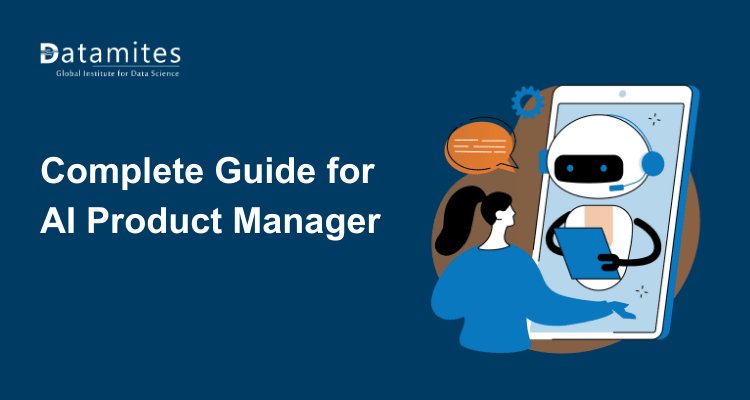
Artificial Intelligence is transforming the way organizations design and deliver products. From intelligent recommendations to automated decision-making systems, AI-powered solutions are becoming essential across industries. This growing adoption has created a new leadership role known as the AI Product Manager. Professionals specializing in AI product manager courses combine business strategy, technical understanding, and customer insights to build successful AI-driven products.
AI Product Managers connect technical teams and business leaders, by leveraging AI solutions to address real needs while aligning with strategy and ethical standards.
Who are AI Product Managers?
AI Product Managers are professionals responsible for planning, developing, and managing artificial intelligence-based products and solutions. They define product strategies and ensure that AI technologies are implemented in a way that meets customer needs and business objectives.
AI Product Managers work closely with data scientists, engineers, designers, and business leaders to deliver AI solutions that create measurable customer and business value. In line with value-based product development, they focus on solving real-world problems, prioritizing high-impact features, managing timelines efficiently, and evaluating performance based on strategic alignment and return on investment rather than technical feasibility alone.
The Value-based product development focuses on delivering measurable customer and business value. For AI Product Managers, this means prioritizing initiatives based on impact, strategic alignment, and return on investment not just technical feasibility. Using structured evaluation methods like value scorecards improves transparency and decision-making. In AI products, where costs and risks are high, this approach ensures purposeful innovation, optimizes resources, strengthens collaboration, and drives meaningful business outcomes.
With the rapid adoption of intelligent systems across healthcare, finance, e-commerce, and manufacturing, AI Product Managers have become essential for scaling AI initiatives effectively with product management. The concept of AI product managers highlights the need for leaders who understand both business strategy and AI capabilities making an AI product manager course crucial for professionals aiming to build expertise in this evolving domain.
Refer to the articles below:
What is the Role and Responsibility of an AI Product Manager?
AI Product Managers play a strategic and operational role throughout the product lifecycle. Their responsibilities extend beyond traditional product management because AI products require data-driven decision-making and continuous model improvements.
As projected by Grand View Research Report, The global product lifecycle management market, valued at USD 28.02 billion in 2022, is projected to grow to USD 54.36 billion by 2030, expanding at a CAGR of 9.2% between 2023 and 2030. This steady growth highlights the rising demand for skilled AI Product Managers to drive innovation and strategic product success.
1. Defining the AI Product Vision and Strategy
One of the primary responsibilities of an AI PM is defining the long-term product vision.
They must answer key strategic questions:
- What problem will AI solve?
- Why should AI be used instead of a rule-based system?
- How will AI improve customer experience?
- What business value will it generate?
AI Product Managers align AI initiatives with company objectives, ensuring the product supports revenue growth, operational efficiency, or market differentiation.
They create roadmaps that balance innovation with feasibility, considering model training cycles and data dependencies.
2. Identifying AI Use Cases
Not every problem requires AI. One of the most important responsibilities of an AI Product Manager is determining when AI is appropriate.
They evaluate:
- Whether sufficient data exists
- If the problem is predictable using historical patterns
- Whether AI offers measurable value over traditional approaches
- The complexity and risk of implementation
This ability prevents organizations from misusing AI for marketing hype rather than real value creation.
3. Collaborating with Cross-Functional Teams
AI Product Managers work closely with:
- Data scientists
- Machine learning engineers
- Software developers
- UX designers
- Marketing teams
- Legal and compliance teams
- Business stakeholders
They serve as the communication bridge between highly technical AI teams and non-technical decision-makers.
For example, they translate business requirements into model performance metrics and explain technical limitations (such as model confidence or bias) in business-friendly language.
4. Overseeing the AI Product Development Lifecycle
AI product development differs from traditional development. Instead of deterministic outputs, AI systems rely on probabilistic results. The AI PM manages the entire lifecycle:
AI Product Development Lifecycle
- Problem identification
- Data collection and preparation
- Model experimentation and training
- Validation and testing
- Model Deployment
- Monitoring and Maintenance
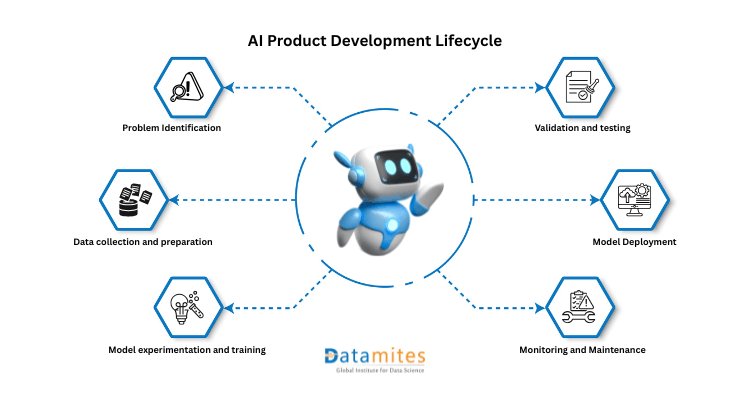
They must understand model iteration cycles and allow time for experimentation, which is essential in machine learning workflows.
5. Defining KPIs and Measuring Success
Unlike standard products where success may be measured by user adoption or revenue, AI products require both business and technical metrics.
AI Product Managers define:
- Model accuracy
- Precision and recall
- False positive/false negative rates
- Model latency
- Customer satisfaction metrics
- ROI and business impact
They continuously monitor performance and decide when retraining or optimization is necessary.
6. Managing Data Strategy while leveraging AI
Data is the foundation of AI products. AI PMs must ensure:
- Data availability
- Data quality
- Ethical sourcing of data
- Compliance with privacy laws
They collaborate with data engineering teams to establish pipelines and maintain clean datasets.
Without reliable data governance, AI products can become unreliable or legally vulnerable.
7. Ensuring Ethical and Legal Compliance
AI systems can introduce risks such as:
- Bias and discrimination
- Data privacy violations
- Lack of transparency
- Regulatory non-compliance
AI Product Managers must stay updated with evolving regulations and ensure products follow ethical AI principles.
They often work closely with legal teams to ensure compliance with data protection laws and AI governance frameworks.
8. Prioritizing Features and Enhancements
AI products often offer multiple capabilities, but not all can be built at once.
AI PMs prioritize features based on:
- Business value
- Technical feasibility
- Data availability
- Risk assessment
- User impact
They maintain a backlog and roadmap that reflects realistic AI development timelines.
Overall, the role emphasizes the practical application of AI for product managers, ensuring that AI technologies deliver meaningful and sustainable business outcomes.
What are the Top Skills an AI Product Manager Needs?
To succeed in this role, professionals need a combination of technical knowledge, business skills, and leadership capabilities.
1. Understanding of AI and Machine Learning for product model
AI Product Managers do not need to be data scientists, but they must understand key concepts such as machine learning models, training datasets, and evaluation metrics. This knowledge helps them communicate effectively with technical teams.
2. Data Literacy of product analysis
Strong analytical skills are essential for interpreting data and making informed decisions. AI Product Managers should understand data structures, data cleaning processes, and visualization techniques.
3. Product Management Skills for development
Core product management skills such as roadmap planning, feature prioritization, and user research remain fundamental. Experience in managing product lifecycles is highly valuable.
4. Business Strategy to scale
AI Product Managers must understand market trends and business objectives. They should be able to identify opportunities where AI can generate competitive advantages.
5. Communication Skills to cope up the challenges
Clear communication is crucial because AI Product Managers work with both technical and non-technical stakeholders. They must explain complex AI concepts in simple terms.
6. Problem-Solving Ability to optimize solutions
AI product development often involves uncertainty and experimentation. Strong problem-solving skills help AI Product Managers adapt to challenges and optimize solutions.
These competencies form the foundation of AI for product managers, enabling professionals to build scalable and impactful AI solutions.
Refer to the articles below:
- Will AI Agents Replace Your Next Coworker? Exploring the Future of Work
- CrewAI vs AutoGen vs LangGraph: Top Multi-Agent Frameworks for 2026
- How Knowledge-Augmented Generation (KAG) Is Solving AI Hallucinations
How to Become an AI Product Manager?
Becoming an AI Product Manager requires a combination of education, skills development, and practical experience.
1. Build a Strong Educational Foundation
A background in computer science, business, engineering, or analytics is helpful. Courses in artificial intelligence, machine learning, and data analytics provide valuable knowledge for AI for Product Managers.
2. Learn Fundamentals of AI
Understanding AI concepts such as supervised learning, neural networks, and natural language processing is essential. Online certifications and AI Product Manager course can help professionals gain these skills.
3. Develop Product Management Skills
Aspiring professionals should learn product strategy, user experience design, and agile methodologies. Working as a product analyst or associate product manager can provide valuable experience.
4. Gain Hands-On Experience
Practical experience is important in mastering AI product manager courses. Working on AI-related projects or collaborating with data science teams helps build industry-ready skills.
5. Build Cross-Functional Knowledge and upskill
AI Product Managers must understand both technical and business perspectives. Learning about software development processes and business operations improves career readiness.
6. Stay Updated with AI Trends
AI technologies are advancing at a rapid pace, making continuous learning essential for AI Product Managers. Staying updated with emerging tools, frameworks,difference between LLMs and SLMs and industry trends ensures they remain competitive and strategically relevant.
AI Product Managers transform artificial intelligence capabilities into practical business solutions, managing the full lifecycle of AI-powered products. With AI Product Manager course learners gain strong technical knowledge, business insight, and product strategy skills, aspiring professionals can build successful careers.
DataMites Institute offers a comprehensive AI Product Manager course designed to help professionals integrate artificial intelligence into modern product strategy and decision-making. The structured program covers AI fundamentals and practical implementation, along with specialized tracks such as AI Product Managers, AI for HR & People Analytics, AI for Finance, AI for Marketing, AI for Healthcare, and Gen AI for Business Leaders. Learners can choose online, classroom, or real-time project-based internship formats for hands-on experience. Accredited by IABAC, the Certified AI Professional in Product Management credential is globally recognized. With training hubs in Ahmedabad, Chennai, Bangalore, Pune, Mumbai, and Coimbatore, DataMites delivers career-focused learning.