How Artificial Intelligence is Transforming Digital Marketing
Artificial Intelligence is transforming digital marketing by enabling smarter customer targeting, personalized content, automated campaigns, and data-driven decision-making. It helps marketers improve engagement, optimize strategies, and deliver more relevant experiences across digital channels.
 Farheen Sabha
Imagine logging into your favorite shopping app and finding the exact product you were just thinking about, or scrolling through social media and seeing an ad that feels like it was designed only for you. This isn't a coincidence, it's the power of Artificial Intelligence at work. In today’s digital-first world, AI is no longer a futuristic concept; it’s the driving force behind how brands capture attention, personalize experiences, and influence buying decisions. From smart chatbots to predictive analytics, AI is rewriting the rules of marketing and businesses that fail to adapt risk being left behind.
Artificial Intelligence in Digital Marketing
In the ever-evolving digital landscape, businesses are constantly searching for innovative ways to engage customers, optimize campaigns, and drive results. Among all technological advancements, Artificial Intelligence stands out as one of the most powerful forces transforming digital marketing today. From personalized recommendations to predictive analytics, AI is revolutionizing how brands connect with their audiences.
AI in digital marketing goes beyond automation, it brings intelligence, personalization, and efficiency at a scale never seen before. In fact, according to a report by PwC, AI could contribute up to $15.7 trillion to the global economy by 2030, and a significant portion of this impact will be driven by marketing and customer experience improvements.
The Growing Role of AI in Digital Marketing
The role of AI in digital marketing has grown from being a supportive tool to becoming an increasingly important part of many marketing strategies. Initially, AI was used to automate repetitive tasks like scheduling posts or sending emails. Today, it powers highly intelligent systems that analyze consumer behavior, predict future trends, and deliver personalized content in real time.
According to MarketsandMarkets, the global AI for sales and marketing market is expected to grow from USD 58.00 billion in 2025 to USD 240.59 billion by 2030, reflecting the growing use of AI across customer engagement, campaign optimization, content generation, and marketing automation.
Some major drivers behind the growing adoption of AI in digital marketing include:
- Data Explosion: With millions of online interactions happening every second, marketers now rely on AI to process massive datasets and extract actionable insights.
- Consumer Expectations: Modern customers demand personalized, seamless experiences. AI enables hyper-personalization at scale.
- Competitive Advantage: Companies are increasingly using AI tools such as predictive analytics, chatbots, and recommendation engines to improve personalization, customer engagement, and campaign efficiency.
- Efficiency & Cost Savings: AI reduces human effort in tasks like customer service, content creation, and ad optimization, making marketing more cost-effective.
Clearly, AI is not just an optional add-on it has become central to how brands attract, engage, and retain customers in a highly competitive digital ecosystem.
Refer these below articles:
- What is a Convolutional Neural Network?
- What is Artificial General Intelligence
- What is Semantic Networks in Artificial Intelligence
Key Applications of AI in Digital Marketing
AI has found applications across nearly every aspect of digital marketing. Here are some of the most impactful use cases:
1. Customer Insights & Data Analytics
AI algorithms can process enormous volumes of data far beyond human capability. This allows marketers to:
- Segment audiences more accurately.
- Predict future buying behavior.
- Identify high-value customers.
Predictive analytics ensures that marketing efforts are directed toward the right audience at the right time, maximizing efficiency.
2. Personalization & Recommendation Engines
Platforms like Amazon and Netflix thrive on AI-driven recommendations, showcasing how powerful personalization can be. Marketers use similar strategies to:
- Recommend products tailored to a user’s browsing history.
- Personalize website landing pages dynamically.
- Deliver customized email campaigns.
Personalization improves customer satisfaction, increases conversions, and fosters loyalty.
3. AI-Powered Chatbots & Virtual Assistants
Chatbots are among the most popular AI tools in digital marketing. They:
- Provide 24/7 customer service.
- Answer FAQs instantly.
- Guide users through the sales funnel.
Virtual assistants powered by natural language processing (NLP) are becoming increasingly human-like, making customer interactions smoother and more engaging.
4. AI Agents & Conversational Marketing
AI is increasingly moving beyond rule-based chatbot interactions toward systems that can handle multi-step tasks, respond to customer conversations, and support personalized engagement. In a 2026 Salesforce study, 81% of marketers in India reported adopting AI, while many also identified data quality and disconnected systems as barriers to scaling personalized customer engagement.
5. Programmatic Advertising
AI is transforming advertising through programmatic ad buying, which uses algorithms to purchase digital ads in real time. Benefits include:
- More precise audience targeting.
- Reduced ad spend wastage.
- Higher ROI due to data-driven placements.
This level of automation ensures that ads are shown to the right people at the right moment.
IMARC group estimates the global smart advertising market at USD 2.11 billion in 2025, projected to reach USD 8.36 billion by 2034, with a 16% CAGR from 2026–2034. The report specifically discusses AI/ML-driven audience segmentation, personalized advertising and real-time ad optimization.
6. Content Creation & Optimization
AI tools like Jasper and Copy.ai are capable of generating ad copies, product descriptions, and even blog content. In addition, AI assists with:
- SEO optimization by identifying trending keywords.
- A/B testing different versions of content.
- Enhancing engagement with predictive performance analysis.
While human creativity is still crucial, AI significantly reduces the time and effort required for content creation.
7. Voice Search & Visual Search
With the rise of voice assistants like Alexa, Siri, and Google Assistant, AI has changed how consumers search online. Similarly, visual search technologies allow users to find products through images rather than text. Marketers must adapt SEO strategies to account for conversational queries and image-based searches, aligning with evolving digital marketing trends.
According to Grand View Research the global artificial intelligence market was valued at USD 390,908.1 million in 2025 and is projected to reach USD 3,497,258.8 million by 2033, expanding at a CAGR of 30.6% from 2026 to 2033.
Real-World Examples of AI in Digital Marketing
Artificial Intelligence is no longer just a buzzword, it's already transforming how leading brands engage with customers. From personalized recommendations to predictive analytics, here are some powerful real-world examples of AI in digital marketing.
- Coca-Cola: Personalized Content & Campaigns: Coca-Cola's “Share a Coke” campaign used personalized packaging and digital engagement to encourage customers to connect with the brand. The campaign was associated with a 2% increase in U.S. sales and an 870% increase in Facebook traffic, demonstrating the potential of personalized marketing to drive engagement.
- Netflix: Recommendation Engine: Netflix’s AI recommendation engine drives over 80% of the content viewed on the platform, playing a critical role in reducing churn This system is estimated to save Netflix approximately $1 billion annually
- Sephora: AI-Powered Shopping Experience: Sephora uses AI to provide personalized beauty recommendations and guided shopping experiences. In 2026, the company also introduced its Sephora app in ChatGPT, allowing users to discover products through conversational recommendations and, when they choose to connect their Beauty Insider account, receive suggestions based on their preferences.
- Amazon: Personalized Shopping Experience: Personalized recommendations in e-commerce can lead to a 15% increase in sales and a 12% higher average transaction value
- Google Ads: Smart Bidding & Targeting: Google Ads uses machine learning to help advertisers optimize bids and reach relevant audiences based on signals such as device, location, time, and user behavior.
AI marketing tools can help teams automate repetitive tasks, analyze customer data, and accelerate content workflows, although the time and performance gains vary by use case and implementation.
Reports show that 72% of AI marketing tool users enhance customer experiences and save an average of 2.5 hours per day or 3 hours per piece of content.
Read these below articles:
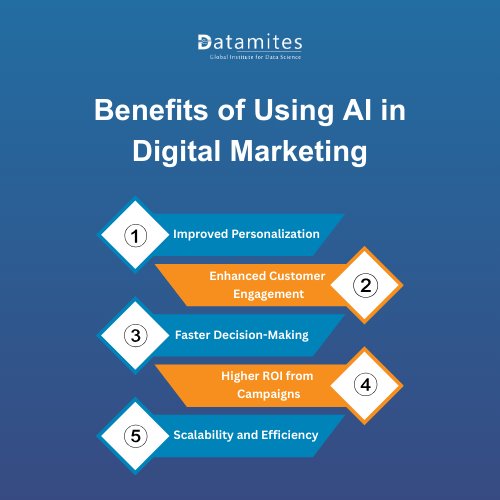
Benefits of Using AI in Digital Marketing
The integration of AI into marketing strategies provides businesses with numerous advantages.
- Improved Personalization: AI tailors experiences to individual customers, increasing satisfaction and boosting conversions. Personalized recommendations, emails, and ads resonate better with audiences.
- Enhanced Customer Engagement: Through chatbots, voice assistants, and interactive content, AI keeps customers engaged round-the-clock. This ensures faster responses and better customer support experiences.
- Higher ROI from Campaigns: By optimizing ad targeting, predicting outcomes, and automating repetitive tasks, AI can help marketers use budgets more efficiently and improve campaign performance. A 2026 Salesforce study found that organizations using AI reported 20% higher marketing ROI.
- Faster Decision-Making: AI provides real-time insights from massive datasets. Marketers can make quick, data-driven decisions instead of relying on guesswork.
- Scalability and Efficiency: AI allows businesses to scale marketing operations effortlessly. Whether managing millions of customer interactions or creating thousands of personalized emails, AI makes scaling seamless.
Future of AI in Digital Marketing
The role of AI in marketing continues to expand as businesses adopt it across personalization, customer engagement, analytics, content, and campaign optimization. As technology advances, we can expect to see:
- Hyper-Personalization: Going beyond basic recommendations, AI will soon predict not only what customers want but also when and how they want it.
- Integration with AR & VR: AI-powered augmented reality (AR) and virtual reality (VR) experiences will revolutionize product marketing, allowing customers to “try before they buy” in immersive environments.
- Predictive Customer Journeys: AI will map out entire customer journeys, from awareness to post-purchase, enabling brands to engage proactively.
- Voice & Conversational Marketing: AI-powered conversational marketing is becoming an increasingly important part of customer engagement, enabling brands to interact with customers through natural, context-aware conversations across digital channels.
The future will belong to businesses that combine human creativity with AI-driven intelligence, ensuring they deliver experiences that are relevant, efficient, and meaningful.
Artificial Intelligence has become a transformative force in digital marketing, redefining how businesses interact with their audiences. From personalized recommendations and AI-powered chatbots to predictive analytics and programmatic advertising, the applications are vast and powerful.
Bangalore, widely recognized as India’s tech hub, is at the forefront of adopting Artificial Intelligence across multiple industries. AI is transforming business processes and reshaping how people interact with technology. Artificial Intelligence institute in Bangalore equips you with cutting-edge skills that are highly sought after, positioning you right in the middle of India’s AI revolution where opportunities are abundant and career growth is limitless.
DataMites is a prominent training institute that provides comprehensive courses in Data Science, Artificial Intelligence, Machine Learning, and Python. With accreditations from IABAC and NASSCOM FutureSkills, the institute has established its presence across major Indian cities such as Artificial Intelligence Institute in Pune, Bangalore, Chennai, Hyderabad, Ahmedabad, Coimbatore, and Mumbai. The programs are designed to blend conceptual learning with practical exposure, offering real-time projects, internship opportunities, and career-oriented support including resume guidance and placement assistance.