AI Agents for Data Analysis: Tools and Use Cases
Discover how AI agents for data analysis transform workflows with automation, real-time insights, and smarter decision-making.
 Swagatam Sinha
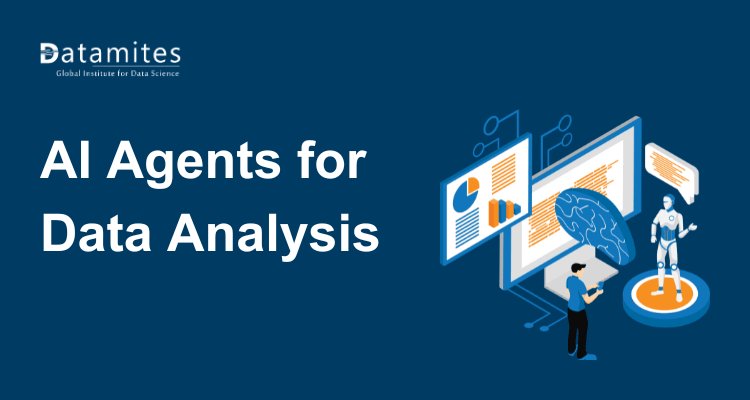
Data is growing faster than ever before. From customer interactions to business operations, organizations are generating massive volumes of data every second. However, traditional analytics tools often struggle to keep up with this speed and complexity.
This is where AI agents for data analysis are transforming the landscape.
Unlike conventional tools that rely heavily on manual inputs, AI agents can autonomously collect, process, and analyze data, delivering actionable insights in real time. The emergence of agentic AI for data analysis represents a shift toward intelligent systems that not only assist but also make decisions and execute tasks independently.
According to MarketsandMarkets, the AI agents market is expected to grow from $7.8 billion in 2025 to $52 billion by 2030, highlighting rapid adoption across industries.
What Are AI Agents in Data Analysis?
AI agents for data analysis are autonomous systems that collect, process, and analyze data to generate insights and take actions without continuous human intervention.
These systems go beyond dashboards by combining automation, machine learning, and decision-making capabilities.
Key Capabilities:
- Interpret natural language queries
- Automate data workflows
- Continuously learn from new data
- Deliver real-time insights
This evolution is driving the rise of AI-powered data analysis, where insights are generated instantly and actions are recommended proactively.
Refer to these articles:
- SQL vs Python for Data Analytics in 2026: Which Skill Should You Learn First?
- How Looker, Tableau, and Power BI Are Revolutionizing Data Analytics
- Is the Data Analyst Market Overcrowded? Realistic Job Outlook for 2026
Why AI Agents Are Transforming Data Analysis
The growing adoption of AI agents is backed by strong industry data and real-world outcomes.
The term "agentic AI for data analysis" refers to AI systems that can independently plan, execute, and optimize tasks.
And the growth is explosive.
- According to Grand View Research, the global AI agents market is projected to grow significantly, reaching over $180 billion by 2033.
- MarketsandMarkets estimates the agentic AI market will grow at over 40% CAGR
- McKinsey highlights that AI-driven automation can boost productivity by up to 30% in data-related roles
These numbers clearly show that AI agents for data analysis are not just a trend; they are becoming a business necessity.
Key Transformation Areas:
- Speed: Insights generated in seconds instead of hours
- Accuracy: Reduced human error in data processing
- Scalability: Ability to handle massive datasets effortlessly
- Real-time insights: Continuous monitoring and decision-making
How AI-Powered Data Analysis Actually Works
AI-powered data analysis works by combining AI models, automation, and data pipelines to convert raw data into actionable insights.
Core Components:
1. Large Language Models (LLMs)
They interpret queries like
"Analyze last quarter's sales trends and predict next quarter's performance.”
2. Data Connectors & APIs
Agents pull data from:
- Databases
- Cloud platforms
- CRMs and analytics tools
3. Task Planning Engines
They break down a problem into steps:
- Fetch data
- Clean data
- Run models
- Generate insights
4. Memory & Learning Systems
Agents remember past queries and improve over time.
This layered system is what makes AI-powered data analysis not just fast but intelligent.
Refer to these articles:
- How GenAI Is Influencing Data Analyst Productivity and Accuracy
- Why Data Analysts Are Choosing DuckDB for Modern Analytics
- Augmented Analytics Explained: How AI is Reshaping the Data Analyst Role
Top Tools Powering AI Agents for Data Analysis
Let’s look at some of the most impactful tools driving this space:
1. LangChain
- Enables building AI workflows using LLMs
- Supports memory, chaining, and tool integration
- Ideal for creating custom data analysis agents
2. AutoGPT
- Fully autonomous agent framework
- Can execute multi-step analysis tasks independently
- Great for experimentation and automation
3. CrewAI
- Focuses on multi-agent collaboration
- Different agents handle different roles (analyst, planner, executor)
- Perfect for complex workflows
4. Hugging Face Transformers
- Provides pretrained models for NLP and analytics
- Supports custom model deployment
5. Microsoft Copilot (Data Integration)
- Embedded AI assistant in analytics tools
- Helps automate queries and insights
These tools are making AI agents for data analysis more accessible even for small teams.
Real-World Use Cases of AI Agents
AI agents are already delivering measurable value across industries.
1. Finance: Fraud Detection
AI agents continuously monitor transactions and detect anomalies in real time, reducing fraud risks significantly.
2. Healthcare: Predictive Analytics
Hospitals use AI agents to predict patient outcomes and optimize treatment plans based on historical data.
3. Retail: Customer Behavior Analysis
Retailers leverage AI agents for data analysis to understand buying patterns and personalize recommendations.
4. Logistics: Workflow Optimization
Companies like FedEx are exploring AI agent-based systems to manage logistics operations more efficiently.
These examples show how agentic AI for data analysis is moving from theory to real-world implementation.
Benefits of AI-Powered Data Analysis
Organizations adopting AI-powered data analysis are experiencing significant advantages.
1. Faster Decision-Making
AI agents reduce the time between data collection and insight generation.
2. Improved Accuracy
Automation minimizes manual errors and ensures consistency.
3. Continuous Monitoring
AI agents operate 24/7, providing real-time updates and alerts.
4. Revenue Growth
According to Salesforce, 83% of AI-driven organizations report increased revenue.
These benefits make AI agents for data analysis a strategic asset for modern businesses.
Refer to these articles:
- Edge Analytics Explained: Processing Data Where It Matters Most
- Data Engineer vs Analytics Engineer vs Data Analyst
- How to Learn SQL for Data Analysis
Key Challenges and Limitations of AI Agents for Data Analysis
While the advantages are clear, adopting AI agents comes with certain challenges.
1. Data Privacy and Security
Handling sensitive data requires strict compliance and governance.
2. AI Hallucinations
AI models may sometimes generate incorrect insights if not properly monitored.
3. High Implementation Costs
Building and integrating AI agents can require significant investment.
4. Uncertain ROI
According to Gartner (reported via Reuters), over 40% of agentic AI projects may be scrapped by 2027 due to unclear value.
Addressing these challenges is essential for long-term success.
Future Trends of AI Agents in Data Analysis
The future of analytics is deeply connected to intelligent automation.
Emerging Trends:
- Autonomous decision-making systems replacing manual workflows
- AI agents managing end-to-end business processes
- Hyper-personalized analytics dashboards
- Integration with IoT and real-time data streams
According to TechRadar, AI agents could generate up to $450 billion in business value by 2028.
This indicates that AI-powered data analysis will become a core business function rather than an optional tool.
The rise of AI agents for data analysis marks a fundamental shift in how organizations interact with data. Instead of relying on static dashboards and manual processes, businesses are now embracing intelligent systems that can think, adapt, and act.
By leveraging agentic AI for data analysis, companies can unlock faster insights, improve decision-making, and stay ahead in an increasingly data-driven world. At the same time, the growing importance of AI-powered data analysis highlights the need for organizations to invest in the right tools, skills, and strategies.
As the technology continues to evolve, one thing is clear:
Businesses that adopt AI agents early will not just keep up; they will lead.
If you're looking to build a strong career in data analytics, DataMites offers industry-relevant training designed to bridge the gap between theory and real-world application. With a focus on practical learning, live projects, and expert mentorship, learners gain hands-on experience in tools and techniques used by professionals.
For those exploring a Data analyst course in Bangalore, DataMites provides flexible learning options along with placement support to help you transition smoothly into the data-driven industry. The program is structured to equip you with the skills needed to work confidently on real business problems.