AI in Healthcare: Key Applications and Real-World Use Cases
AI is transforming healthcare through faster diagnosis, personalized treatments, predictive analytics, and automation, improving patient outcomes, reducing costs, and enhancing clinical decision-making.
 Prerana B A
AI in healthcare is transforming how modern medical systems operate, bringing greater speed, accuracy, and efficiency into clinical practice. From early disease detection to personalized treatment plans, artificial intelligence in healthcare is helping providers make smarter, data-driven decisions. The growing adoption of AI healthcare applications is improving outcomes while reshaping how patients experience care.
AI in healthcare thrives on data, and the industry generates massive volumes of it every day. Traditional systems often struggle to keep up, but machine learning in healthcare and healthcare automation can analyze this data in real time and uncover patterns humans might miss. As a result, the use cases of AI in healthcare continue to expand across diagnosis, patient care, and hospital operations driving a major shift toward more proactive and intelligent healthcare systems.
How AI is Changing Healthcare
AI in healthcare is transforming how medical decisions are made, backed by strong data and growing adoption. Today, artificial intelligence in healthcare and modern AI Tools in Healthcare are helping doctors detect diseases earlier through AI in medical diagnosis. Studies suggest AI can reduce medical errors by up to 86%, improving accuracy and patient outcomes. Adoption is also rising quickly, with over 70% of hospitals using predictive AI tools to analyze patient data and support clinical decisions.
Beyond diagnosis, AI healthcare applications and AI Tools in Healthcare are improving patient care and efficiency. In AI in patient care, wearable devices enable real-time health monitoring, while predictive analytics helps identify risks early. Healthcare automation is also streamlining tasks like billing and scheduling, saving time for medical staff. The AI healthcare market is projected to reach $187 billion by 2030, showing how rapidly this space is growing. What this really means is a shift toward faster, smarter, and more proactive healthcare systems.
Refer to these articles:
- What Skills Are Required for AI in HR Professionals?
- Essential AI Skills for Healthcare Professionals
- Applications of AI in Marketing and Real Use Cases
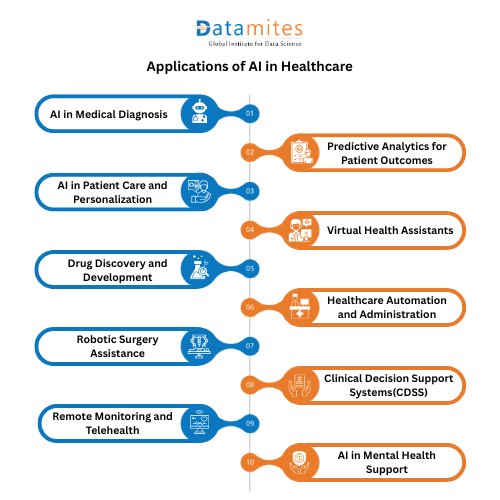
Key Applications of AI in Healthcare
AI in healthcare isn’t a single tool it’s a broad set of technologies solving very different problems across the system. Some applications are patient-facing, others sit behind the scenes improving efficiency, accuracy, and decision-making. Here are the most important ones to understand.
1. AI in Medical Diagnosis
This is one of the most visible and impactful areas.
AI systems analyze medical data such as imaging scans, lab results, and patient history to assist in diagnosis. In fields like radiology and pathology, artificial intelligence in healthcare is helping detect diseases earlier and more accurately.
Common uses include:
- Identifying tumors in X-rays, CT scans, and MRIs
- Detecting early signs of diseases like cancer or stroke
- Assisting doctors in interpreting complex diagnostic data
What makes this powerful is consistency AI doesn’t get tired or overlook subtle patterns.
2. Predictive Analytics for Patient Outcomes
Predictive models use machine learning in healthcare to forecast what might happen next with a patient.
Hospitals use this to:
- Predict disease progression
- Identify high-risk patients
- Prevent hospital readmissions
- Detect conditions like sepsis early
Instead of reacting to emergencies, healthcare providers can intervene sooner and improve outcomes.
3. AI in Patient Care and Personalization
AI in patient care focuses on tailoring treatment to individual needs.
By analyzing genetics, lifestyle data, and medical history, AI can:
- Recommend personalized treatment plans
- Adjust medication dosages
- Monitor chronic conditions remotely
This shift toward personalized medicine is one of the biggest benefits of AI in healthcare.
4. Virtual Health Assistants
Virtual assistants are a growing part of healthcare automation.
These AI-powered tools interact directly with patients and can:
- Answer basic medical questions
- Schedule appointments
- Send medication reminders
- Provide post-treatment guidance
They improve accessibility while reducing workload for healthcare staff.
5. Drug Discovery and Development
Developing new drugs is expensive and time-consuming. AI is changing that.
AI systems can:
- Analyze massive datasets of chemical compounds
- Predict how drugs will interact with the body
- Identify promising candidates faster
This dramatically shortens development cycles and reduces costs.
6. Healthcare Automation and Administration
A large part of healthcare is administrative and often inefficient.
AI helps automate tasks like:
- Medical coding and billing
- Insurance claim processing
- Electronic health record (EHR) management
- Appointment scheduling
Healthcare automation frees up time for doctors and nurses to focus on patient care.
7. Robotic Surgery Assistance
AI-powered surgical systems assist doctors during complex procedures.
These systems can:
- Enhance precision
- Reduce human error
- Enable minimally invasive surgery
While surgeons remain in control, AI provides real-time insights and guidance.
8. Clinical Decision Support Systems (CDSS)
Clinical decision support tools use artificial intelligence in healthcare to help doctors make better decisions.
They provide:
- Evidence-based treatment recommendations
- Alerts for potential drug interactions
- Insights from similar patient cases
This ensures more informed and consistent care.
9. Remote Monitoring and Telehealth
With the rise of wearable devices, AI plays a major role in continuous patient monitoring.
Applications include:
- Tracking heart rate, glucose levels, and vital signs
- Alerting providers to abnormalities
- Supporting telemedicine consultations
This is especially useful for managing chronic diseases and elderly care.
10. AI in Mental Health Support
AI is also expanding into mental health.
Tools like chatbots and digital therapy assistants can:
- Provide cognitive behavioral therapy techniques
- Monitor emotional patterns
- Offer immediate support
While not a replacement for professionals, they improve access to care.
These AI healthcare applications show just how deeply AI is embedded across the system. From diagnosis to administration, and from hospitals to patients’ homes, the use cases of AI in healthcare continue to grow.
The bigger picture is clear: AI isn’t just improving healthcare it’s reshaping how it works.
Real-World Use Cases of AI in Healthcare
Talking about AI in healthcare is one thing seeing it work in real clinical and operational settings is where it becomes real. Across hospitals, research labs, and digital health platforms, artificial intelligence in healthcare is already solving problems that used to take hours, days, or even years.
Here are some of the most impactful real-world use cases of AI in healthcare.
1. AI in Radiology and Medical Imaging
AI in medical diagnosis is especially powerful in radiology, where speed and accuracy are critical.
AI systems are trained on thousands of medical images to detect patterns that might be missed by the human eye.
What’s happening in practice:
- AI scans X-rays, CT scans, and MRIs to detect tumors, fractures, or internal bleeding
- Highlights suspicious areas for radiologists to review
- Reduces diagnostic time significantly
Real impact:
- Early detection of diseases like lung cancer and breast cancer
- Reduced workload for radiologists
- Faster turnaround for patients
This is one of the clearest examples of how AI healthcare applications enhance, rather than replace, medical professionals.
2. Predictive Analytics for Patient Outcomes
Predictive analytics is one of the most valuable use cases of AI in healthcare, especially in hospital settings.
By analyzing historical and real-time data, machine learning in healthcare can forecast patient risks before they escalate.
Common use cases:
- Predicting sepsis before symptoms become severe
- Identifying patients likely to be readmitted
- Forecasting ICU requirements
Why it matters:
Doctors can intervene earlier, which often leads to better outcomes and lower treatment costs.
This shift from reactive care to proactive care is a major step forward in AI in patient care.
3. Virtual Health Assistants and Chatbots
Virtual assistants are quietly transforming patient interaction and healthcare automation.
These AI-powered tools are available 24/7 and handle a wide range of tasks.
What they do:
- Answer basic medical questions
- Provide symptom checks
- Schedule appointments
- Send medication reminders
Real-world value:
- Reduces pressure on hospital staff
- Improves patient engagement
- Makes healthcare more accessible, especially in remote areas
This is one of the most scalable AI healthcare applications today.
4. AI in Drug Discovery and Development
Drug discovery used to be slow, expensive, and uncertain. AI is changing that.
Pharmaceutical companies now use AI to analyze vast datasets and identify potential drug candidates much faster.
How AI is used:
- Predicting how different compounds will behave
- Identifying promising molecules
- Simulating clinical trial outcomes
Real-world outcomes:
- Faster development timelines
- Lower research costs
- Accelerated response during global health emergencies
This is a powerful example of artificial intelligence in healthcare impacting not just treatment but the entire pipeline behind it.
5. Personalized Treatment Plans
AI enables a more tailored approach to treatment by analyzing individual patient data.
Instead of a one-size-fits-all approach, machine learning in healthcare helps doctors design treatments specific to each patient.
What AI considers:
- Genetic information
- Medical history
- Lifestyle factors
- Response to previous treatments
Impact:
- More effective treatments
- Fewer side effects
- Better long-term outcomes
This is a major leap forward in AI in patient care and precision medicine.
6. Remote Patient Monitoring
With the rise of wearable devices, AI in healthcare is extending beyond hospitals.
AI systems continuously monitor patient data and alert providers when something seems off.
Examples:
- Monitoring heart rate and detecting irregularities
- Tracking glucose levels in diabetic patients
- Identifying early warning signs of complications
Why it matters:
- Enables continuous care outside clinical settings
- Reduces hospital visits
- Improves chronic disease management
This is where healthcare automation meets real-time care.
7. AI in Administrative Workflow Automation
Not all AI healthcare applications are clinical some of the biggest gains come from operational efficiency.
Hospitals deal with massive administrative workloads, and AI helps streamline them.
Tasks automated by AI:
- Medical coding and billing
- Insurance claims processing
- Appointment scheduling
- Patient record management
Benefits:
- Reduced human error
- Faster processing times
- Lower operational costs
This frees up healthcare professionals to focus more on patient care.
8. Early Disease Detection and Screening
AI is increasingly used for early screening programs, especially for high-risk populations.
Use cases include:
- Detecting diabetic retinopathy through eye scans
- Identifying skin cancer from images
- Screening for cardiovascular risks
Real-world impact:
Early detection often means simpler treatments, lower costs, and significantly better survival rates.
This is one of the most life-saving use cases of AI in healthcare.
AI in healthcare is transforming the industry from the ground up. From AI in medical diagnosis to healthcare automation and predictive analytics, the impact is already visible and growing.
The real value lies in how artificial intelligence in healthcare complements human expertise. It doesn’t replace doctors; it empowers them.
As technology continues to evolve, the use cases of AI in healthcare will expand, making care more accurate, efficient, and accessible.
What this really means is simple: better outcomes for patients, smarter systems for providers, and a more sustainable future for healthcare as a whole.
Refer to these articles:
- What Are Graph Neural Networks?
- Traditional AI vs Generative AI: Key Differences, Examples, and Use Cases
- What is Artificial Narrow Intelligence?
DataMites offers a comprehensive AI for healthcare course designed to help healthcare professionals apply artificial intelligence in real clinical and operational environments. The program covers AI fundamentals, data-driven medical insights, and practical applications across patient care, hospital workflows, and healthcare research. It also forms part of a broader portfolio of AI programs tailored for roles in Product Management, HR & People Analytics, Finance & Risk, Marketing, and business leadership.
Participants can choose flexible learning formats, including online courses, classroom sessions, and live project-based internships for hands-on experience. Datamites AI for healthcare course comes with globally recognized certifications accredited by IABAC and Certified AI Professional for Healthcare & Clinical Ops. With 30+ training centers across major Indian cities like Bangalore, Chennai, Hyderabad, Pune, Mumbai, Ahmedabad, Coimbatore, and Delhi, DataMites provides both in-person and virtual learning options focused on career growth.