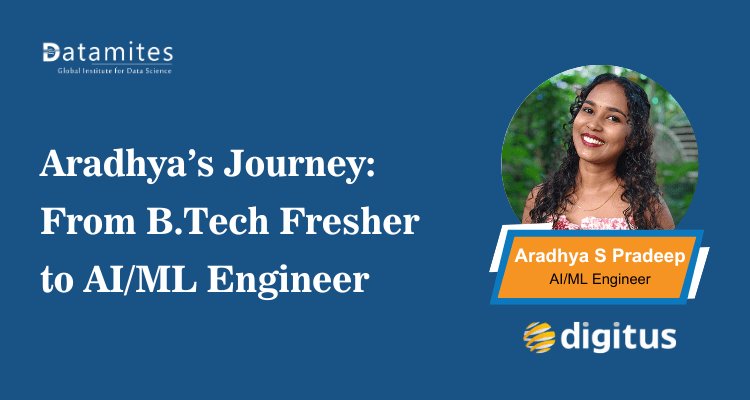
Aradhya’s Journey from B.Tech Computer Science Fresher to AI/ML Engineer
Aradhya’s journey shows how a fresh B.Tech Computer Science graduate can break into the AI/ML field with the right skills, projects, and guidance. Her transformation highlights the power of practical learning, consistent upskilling, and strategic career planning.
 Priyanka BR
Ever wondered if having good coding knowledge alone guarantees a job as an AI/ML Engineer? Aradhya, a B.Tech Computer Science graduate, knew her way around programming and had a solid technical foundation, but she realized that technical knowledge alone was not enough to land her dream AI/ML role. The competitive nature of the industry required hands-on skills, practical project experience, and strategic preparation.
Despite her background, Aradhya faced challenges in translating her theoretical knowledge into real-world applications. She enrolled in DataMites’ Data Science and AI course, attended offline classes, worked on capstone and client projects, and gained experience in Python, machine learning workflows, and AI libraries. Mock interviews and guidance from mentors helped her bridge the gap between knowing concepts and applying them confidently in interviews.
Her journey proves that even if you have only basic technical skills or are from a non-technical background, success in AI/ML is achievable with the right learning path, practical experience, and persistence. Aradhya’s story is an inspiring example for anyone aiming to transition from foundational knowledge to a professional AI/ML career.
Aradhya’s Journey from B.Tech Graduate to AI/ML Engineer: Complete Q&A
This Q&A session highlights Aradhya’s complete journey from graduation to securing a role in AI/ML, covering learning, preparation, and interviews.
Q1. Can you introduce yourself and your background?
I’m Aradhya, a 2024 B.Tech Computer Science graduate. After graduation, I joined DataMites for a Data Science and Artificial Intelligence course. I attended offline training, completed internship projects, including a capstone and client project, and attended mock interviews, which eventually helped me secure a job as an AI/ML Engineer.
Q2. Why did you choose AI and Data Science after Computer Science?
I’ve always liked programming and math. Later, I became interested in AI and Data Science because they allow me to use my Python coding and problem-solving skills on real projects. I decided to follow a step-by-step learning of AI and Data Science, which felt like the perfect next step from what I had already learned.
Q3. How comfortable were you with programming languages before the course?
I had a basic understanding of Python, Java, and C++. Python was easier because of my background, but the DataMites classes helped me explore Python libraries and their applications in AI and Data Science projects.
Q4. Did you have a prior understanding of statistics and mathematics?
Yes, I was interested in mathematics, which made concepts like deep learning equations and derivations interesting. Mathematics forms the foundation for applying AI and Data Science effectively.
Q5. Which company did you get placed in, and what is your role?
I was placed at Digitus Business Solutions as an AI/ML Engineer.
Q6. How was the recruitment process structured?
The process had four rounds:
- Aptitude and SQL, ML and Python basics test
- Technical coding and machine learning workflow assessment
- Virtual technical interview on resume projects
- Final interview focusing on the real-world application of models
Q7. What kind of Python and ML questions were asked?
Python questions included coding exercises like loops and data manipulation. ML questions covered feature engineering, scaling, model building, hyperparameter tuning, evaluation, and deployment workflows.
Q8. How did you prepare for the interview?
I prepared by reviewing LMS recordings, creating handwritten notes for Python, statistics, ML, deep learning, NLP, and computer vision concepts. I also referred to IBM’s technology YouTube channel for recent generative AI updates.
Q9. Were deployment concepts tested during interviews?
Yes, deployment knowledge was a plus, especially for Machine Learning engineers. While not mandatory, familiarity with tools like PySpark helped demonstrate readiness for production-level tasks.
Q10. Which is more important for a Data Scientist, Python or SQL?
Both are important, but Python takes priority due to its use in AI libraries like NumPy and pandas. SQL is essential for handling structured data. Knowledge of NoSQL, like MongoDB, wasn’t required in my interview.
Q11. Do companies still require coding skills?
Coding is important for logic demonstration, but exact syntax is less critical. Companies focus on understanding the logic behind solutions rather than writing perfect code, although basic coding proficiency is essential.
Q12. Did you have to write code for One-Hot Encoding in your interview?
Yes, in the second round, there was a coding test. However, companies often accept pseudocode or a clear explanation of how it works. Knowing the logic is more important than the exact syntax.
Q13. Were generative AI and large language model (LLM) concepts asked?
Yes, questions on generative AI, transformers, and LLMs were asked, including RAG concepts and how generation happens. Having basic knowledge of these models is a plus.
Q14. Were deployment questions related to AWS asked?
No, AWS-specific deployment questions were not asked. Deployment knowledge was optional but beneficial for demonstrating readiness for production-level ML workflows.
Q15. How did you approach resume building?
The DataMites placement team guided me in structuring my resume effectively. I included all relevant projects, such as capstone and client projects, along with an external NLP project, ensuring I could discuss every detail confidently during interviews.
Q16. What external resources did you use for learning?
I referred to IBM’s technology YouTube channel, YouTube tutorials, and repeated reviews of Datamites LMS recordings. Creating personal notes for each concept helped reinforce understanding before interviews.
Q17. What was the offered package for your role?
I was offered a package of 4 to 4.5 LPA as a fresher, which is a strong starting point in AI/ML.
Q18. Where do you see yourself in five years?
I aim to specialize in generative AI and eventually lead a team of Data Scientists and AI Engineers, managing projects and guiding new talent in the industry.
Refer to these articles:
- Reinforcement Learning: Basics and Applications
- What is the Difference Between AI Engineer and AI Expert Course?
- What is an AI Agent? Guide to Intelligent Agents in AI
Key Takeaways from Aradhya’s Journey to Becoming an AI/ML Engineer: Complete Insights
Discover how Aradhya, a 2024 B.Tech graduate, successfully transitioned into an AI/ML Engineer role. This summary highlights her learning, preparation, and career insights for aspiring AI professionals.
- Aradhya, a 2024 B.Tech Computer Science graduate, secured her first job as an AI/ML Engineer at Digitus Business Solutions.
- She completed a Data Science and AI course at DataMites, including offline classes, internships, a capstone, and client projects.
- Python proficiency was crucial for coding exercises and working with AI/ML libraries; SQL was also important for structured data handling.
- A strong foundation in mathematics and statistics helped in understanding AI concepts and deep learning equations.
- The recruitment process included four rounds: aptitude & basics test, technical coding and ML workflow assessment, resume-based virtual technical interview, and final interview on real-world applications.
- Interview questions covered end-to-end machine learning workflow, including feature engineering, model building, hyperparameter tuning, evaluation, and deployment concepts.
- Deployment knowledge (e.g., PySpark) was a plus, demonstrating readiness for production-level ML tasks.
- Aradhya prepared through LMS recordings, handwritten notes, and YouTube resources (like IBM Technologies) to reinforce learning.
- Resume building was emphasized, including all projects she could confidently discuss, such as capstone, client projects, and additional external projects.
- Companies focus on logic and problem-solving over exact coding syntax, but basic coding skills are essential.
- Generative AI and Large Language Models (LLMs) are increasingly relevant in current AI/ML roles.
- The offered package for freshers in this role ranged between 4–4.5 LPA, a strong starting point.
- Aradhya’s career goal is to specialize in generative AI and lead a team of Data Scientists and AI Engineers within the next five years.
- Practical, hands-on experience, continuous learning, and understanding the real-world application of AI/ML models are key to success.
Refer to these articles:
- From B.Tech Graduate to AI/ML Engineer: Shyama’s Inspiring Success Journey
- How Prathmesh Cracked His First AI Engineer Job as a Fresher from Nagpur
- From Mechanical Engineer to AI Professional: Nagasai’s Inspiring Success Story
Aradhya’s success story is an inspiring example of how a B.Tech Computer Science graduate can successfully transition into a rewarding career in Artificial Intelligence. Even with a solid foundation in coding and technical concepts, she realized that theoretical knowledge alone was not enough to secure a job in this competitive field. Her journey, from mastering Python, machine learning algorithms, and deep learning to completing real-world AI projects, demonstrates that consistent effort, practical exposure, and strategic guidance are essential to becoming industry-ready. What truly set her apart was her dedication to learning and applying concepts in real-world scenarios.
A turning point in Aradhya’s journey was enrolling at DataMites, a Data Science and AI institute. Through hands-on projects, mentorship, and placement support, she gained the skills and confidence to excel in interviews, complete capstone and client projects, and secure her role as an AI/ML Engineer at Digitus Business Solutions.
DataMites Training Institute delivers comprehensive Artificial Intelligence courses across Hyderabad, Pune, Bangalore, Chennai, Ahmedabad, Coimbatore, Mumbai, and Delhi. The programs emphasize hands-on learning in Python, machine learning, neural networks, and popular AI frameworks such as TensorFlow and Keras. Students also gain exposure to big data tools, cloud platforms, and AI ethics. Recognized by IABAC and NASSCOM FutureSkills, DataMites offers specialized courses in data science, data analytics, and machine learning, along with career support through placements, internships, and flexible online and offline training options. These programs equip learners with practical expertise and real-world AI experience, helping them achieve success like Aradhya, who transitioned from a B.Tech graduate to an AI/ML Engineer.
Students and professionals in Maharashtra can enroll at DataMites for artificial intelligence training in Mumbai. Offline courses are available at prime locations across the city, offering hands-on learning, industry-relevant projects, and placement support to help learners achieve their career goals.
Similarly, students in Tamil Nadu can pursue AI Training in Coimbatore with practical, project-based sessions, expert mentorship, and placement assistance, just like Aradhya leveraged her training to successfully launch her AI/ML career.