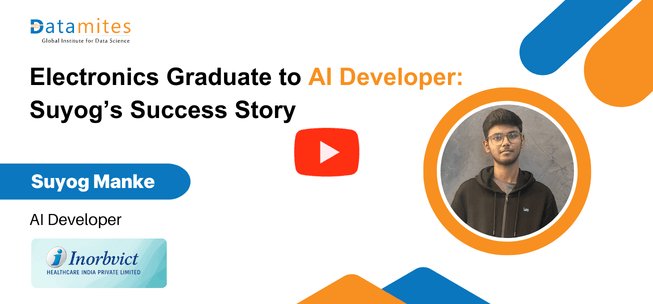
Can an Electronics Graduate Become an AI Developer as a Fresher? Suyog’s Success Story
Suyog, an Electronics graduate, successfully transitioned into an AI developer role as a fresher by leveraging structured learning, hands-on projects, and consistent practice. His journey shows that non-CS graduates can build a strong AI career with the right guidance and dedication.
 Priyanka BR
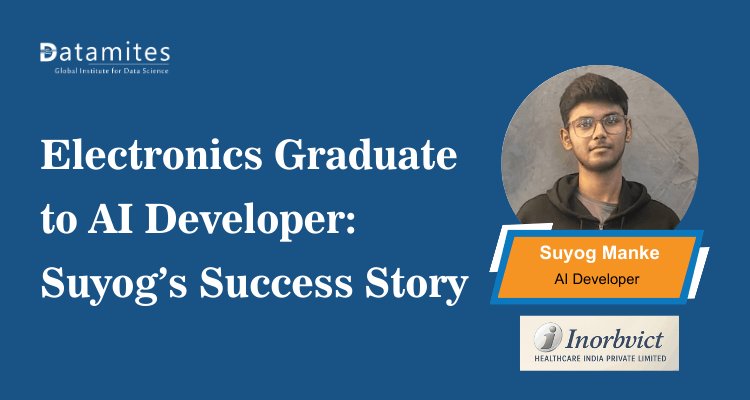
Starting a career in Artificial Intelligence as a fresher from an Electronics Engineering background can feel challenging in today’s competitive job market. Suyog transformed his interest in AI into a successful career move by taking the right steps, committing to consistent practice, and choosing structured mentorship to guide his transition.
His journey was not easy. From initially struggling with Python programming and machine learning concepts to confidently building and explaining real-world AI projects, he demonstrated that discipline and daily effort can overcome uncertainty. The turning point came through structured, hands-on training at DataMites, where he learned how to apply concepts practically and prepare effectively for technical interviews.
For anyone aiming to move into AI as a fresher or from a non-CS background, Suyog’s journey offers a practical roadmap. His experience proves that focused preparation, strong fundamentals, and project-based learning can transform ambition into a successful AI career.
How Suyog Built His Career as an AI Developer with DataMites
Suyog’s journey from an Electronics graduate to an AI Developer highlights how structured training, consistent Python practice, and hands-on projects can accelerate a career in Artificial Intelligence. With mentorship, mock interview preparation, and strong fundamentals, he successfully transitioned into the AI field and secured his first professional role.
1. Can you introduce yourself and your educational background?
My name is Suyog. I recently completed my graduation from Vishwakarma Institute of Information Technology, Pune, in the Electronics and Telecommunication domain. Although my academic background was not directly related to data science, I decided to transition into the AI field after graduation.
2. When did you start your data science journey?
I joined the Certified Data Scientist program at DataMites in February 2025. The data field was completely new to me, so I began from scratch and gradually built my understanding through structured learning, expert guidance, and consistent practice.
3: Where were you placed and what role did you secure?
I secured a position as an AI Developer at Inorbvict Healthcare after successfully clearing the interview process. This opportunity marked the beginning of my professional career in Artificial Intelligence.
4. Were you strong in programming before starting the course?
Not really. I had worked with Java and C during engineering but was not very confident in programming or logic building. I would rate myself around 30 to 40% in terms of programming proficiency before starting Python.
5. How did you improve your Python skills?
I started learning Python from the basics and practiced daily. Consistency played a major role. Instead of solving hundreds of problems in one day and then stopping, I solved 5 to 10 questions daily. That steady approach significantly improved my coding confidence.
6. How important is consistency in learning data science?
Consistency is everything. Motivation may fluctuate, but disciplined daily practice builds long-term capability. Regular coding, revision of concepts, and revisiting recorded lectures helped me strengthen my foundation.
7. Did you attend the course online or offline?
I attended offline sessions at DataMites in Pune. Along with classroom training, I also had access to recorded lectures and LMS materials provided by DataMites, which allowed me to revise concepts and strengthen areas where I needed more clarity.
8. Was Machine Learning difficult initially?
Yes, Machine Learning felt extremely tough at the beginning. There were moments when I doubted whether it was the right field for me. However, with guidance from trainers, repeated practice, and revisiting lectures, I gradually gained confidence.
9. What projects did you work on during your learning phase?
I completed three major projects:
- Rice disease detection using Deep Learning
- Cat vs Dog image classification
- NBA shot prediction using Machine Learning
These projects helped me understand data cleaning, feature engineering, model selection, and evaluation metrics.
10. Were projects discussed during your job interview?
Yes, most interview questions were based on my projects. The interviewer asked about datasets, preprocessing steps, model selection, and evaluation metrics such as precision, recall, F1-score, R2-score, and ROC curve. They also asked why I chose ROC instead of accuracy for a classification problem.
11. How many interview rounds did you face?
I had a single technical round. The discussion covered projects, Python, SQL, and machine learning concepts in detail.
12. How did mock interviews help you?
Mock interviews were very challenging but extremely helpful. They included:
- Basic Python coding questions
- SQL queries from basic to intermediate level
- Writing machine learning code manually
- Questions on libraries like NumPy and Pandas
These mock sessions prepared me for real-world interviews and improved my confidence.
13. What technical areas should students focus on for AI interviews?
Students should focus on:
- Strong Python fundamentals
- SQL basics and intermediate queries
- Data preprocessing techniques
- Machine learning algorithms
- Evaluation metrics
- Libraries like NumPy, Pandas, and Scikit-learn
Many candidates focus only on machine learning models but struggle with basic Python questions, which can lead to rejection.
14. What was the biggest lesson you learned during interview preparation?
If an interviewer wants to test your fundamentals, they will start with basic Python questions. Even if you are strong in Machine Learning, failing to answer basic programming questions can cost you the job. Therefore, foundational knowledge is critical.
15. What advice would you give to newcomers in Data Science and AI?
Focus on fundamentals first. Build strong Python skills. Be consistent. Work on real-world projects. Take mock interviews seriously. And most importantly, do not give up when concepts feel difficult initially. With patience and regular effort, success is achievable.
Refer to these articles:
- Generative AI and Predictive AI: Key Differences Explained
- Learn about the Types of Machine Learning Algorithms
- Traditional RAG vs Agentic RAG — What’s the Difference?
Suyog’s Key Takeaways on Starting a Career in AI with DataMites
His journey reflects the power of disciplined preparation, strong fundamentals, and practical exposure in building a successful career in Artificial Intelligence.
- Background: Suyog completed his graduation in Electronics and Telecommunication Engineering from Vishwakarma Institute of Information Technology, Pune.
- Career Shift: Despite coming from a non-computer science background, he decided to transition into the fields of Data Science and Artificial Intelligence.
- Training Decision: He enrolled in the Certified Data Scientist program at DataMites in February 2025, recognizing the increasing demand for IT courses that offer structured learning and practical exposure to AI and Data Science.
- Learning Approach: The course focused on Python programming, data preprocessing, machine learning, and foundational deep learning concepts.
- Programming Growth: Although he had prior exposure to Java and C, he began Python from scratch and strengthened his skills through daily, consistent practice.
- Project Experience: He completed multiple projects, including rice disease detection, cat vs dog image classification, and NBA shot prediction.
- Evaluation Skills: He gained a strong understanding of evaluation metrics such as precision, recall, F1 score, R2 score, and ROC curve.
- Mock Interview Support: Structured mock interviews tested his Python basics, SQL queries, and machine learning concepts, preparing him for real interview scenarios.
- Technical Preparation: He practiced writing code independently, including train-test split implementation and importing evaluation metrics, rather than relying on copy-paste methods.
- Interview Experience: His actual interview focused heavily on project explanations, cross-questioning, and conceptual understanding.
- Career Breakthrough: He secured an opportunity as an AI Developer shortly after completing his training.
- Location Advantage: After completing his graduation in Pune, he chose to continue working there to explore better AI career opportunities.
- Key Lesson: His journey emphasizes that consistency in Python fundamentals, strong project knowledge, and mock interview practice are crucial for cracking AI roles.
Refer to these articles:
- How Harsha Transitioned into an AI Product Manager Role? An Inspiring Success Story
- How Nakshatra Secured Her First AI Engineer Job as a Fresher
- How Venuprasath Secured His First AI Engineer Job as a Fresher from Tamil Nadu
Suyog’s journey shows that building a successful career in Artificial Intelligence requires consistent practice, strong fundamentals, and the right mentorship. He completed a structured Artificial Intelligence course in Pune at DataMites, where hands-on projects, mock interviews, and expert guidance prepared him for industry expectations. With practical exposure and placement support, DataMites equips learners with the foundation needed to confidently start a successful career in AI.
DataMites Training Institute offers a 9-month Artificial Intelligence course designed to build strong, job-ready AI skills. The program combines core AI concepts, practical tools, real-time projects, and responsible AI practices to prepare learners for industry roles. It includes specialized tracks such as AI Engineer, AI Expert, AI for Product Managers, AI Foundation, and Certified NLP Expert. Accredited by IABAC and NASSCOM FutureSkills, DataMites provides recognized certifications along with hands-on training to help students confidently start their careers in Artificial Intelligence.
Along with Pune, DataMites Institute has 30+ offline centers across India, making quality AI classes accessible to more learners. You can also explore the Artificial Intelligence classes in Hyderabad, Bangalore, Chennai, Mumbai, Ahmedabad, Coimbatore, and Delhi, where structured learning, real-time projects, and placement support help you confidently step into the AI industry.