Data Mesh vs Data Fabric in 2026: Choosing the Right Data Architecture
Explore Data Mesh vs Data Fabric in 2026, key differences, real-world use cases, market insights, and expert predictions to choose the right data architecture for scalable analytics.
 Swagatam Sinha
Data is no longer just a support function it is the backbone of business strategy. Organizations are dealing with growing data volumes, stricter regulations, distributed teams, and real-time decision-making needs. Traditional centralized data platforms struggle to keep up with this scale and complexity. As a result, two modern approaches have taken center stage: data mesh and data fabric.
While both aim to improve how enterprises manage, access, and use data, they solve the problem in very different ways. Understanding the difference between data mesh vs data fabric is critical for organizations planning their long-term data architecture strategy.
This blog explores how each approach works, where they fit best, and how to choose the right data architecture for 2026 and beyond.
Why Data Architecture Decisions Matter More in 2026
Businesses today operate across multiple clouds, regions, and tools. Data lives in SaaS platforms, on-premise systems, data lakes, warehouses, and edge devices. At the same time, teams expect faster access to trusted data for analytics, machine learning, and reporting.
Poor data architecture leads to:
- Slow decision-making
- Duplicate and inconsistent data
- High operational costs
- Governance and compliance risks
Modern enterprises need architectures that scale with business growth while maintaining reliability and trust. This is where data mesh architecture and data fabric architecture come into play.
A McKinsey study found that organizations that effectively use data are 23 times more likely to acquire customers and 19 times more likely to be profitable than their peers.
However, poor data foundations lead to delays, low trust in reports, and duplicated effort. Gartner estimates that poor data quality costs organizations an average of USD 12.9 million per year. As a result, enterprises are rethinking how data is owned, accessed, and governed.
Read to these articles:
- Databricks vs Snowflake: Which Is Better for Data Science
- Modern Data Stack for Data Scientists: Tools You Must Know
- Why Synthetic Data Is the Future of GDPR Compliance
The Shift From Centralized to Modern Data Platforms
For years, centralized data warehouses and data lakes were the standard. A single data team owned ingestion, transformation, governance, and delivery. While this worked at smaller scales, it became a bottleneck as organizations grew.
In response, two different philosophies emerged:
- Data Mesh focuses on organizational and ownership changes.
- Data Fabric focuses on technical integration and automation.
Both aim to simplify data access, but their methods and priorities differ.
What Is Data Mesh?
Data mesh is a decentralized approach to data architecture that treats data as a product. Instead of a central data team owning everything, individual business domains take responsibility for their own data.
Core Principles of Data Mesh Architecture
1. Domain-oriented ownership
Each business domain (sales, marketing, finance, operations) owns its data end to end.
2. Data as a product
Data is designed, documented, and maintained with consumers in mind, just like a software product.
3. Self-serve data platform
A central platform team provides tools, standards, and infrastructure to support domains.
4. Federated governance
Governance rules are shared across the organization, but enforcement happens at the domain level.
How Data Mesh Works in Practice
In a data mesh architecture, the marketing team manages campaign data, the finance team owns revenue data, and the supply chain team controls logistics data. Each team ensures quality, security, and accessibility for their datasets.
This model reduces dependency on a central bottleneck and improves speed, but it requires strong collaboration, maturity, and accountability across teams.
Data Mesh Adoption and Impact Metrics
Gartner’s data architecture research indicates that organizations adopting domain-based data ownership models experience:
- 30–50% faster data product delivery
- Significant reduction in data engineering backlogs
- Higher accountability for data quality and reliability
In a survey of large digital-native companies, teams using data mesh architecture reported improved collaboration between business and engineering teams, particularly in analytics and experimentation workflows.
Refer to these articles:
- Augmented Analytics Explained: How AI is Reshaping the Data Analyst Role
- LLMs vs. SLMs: Key Differences and How to Choose the Right Model
- Edge Analytics Explained: Processing Data Where It Matters Most
What Is Data Fabric?
Data fabric is a unified data architecture that focuses on connecting, integrating, and managing data across diverse systems using intelligent automation and metadata.
Key Components of Data Fabric Architecture
1. Unified data access layer
Provides a single view of data across sources without physically moving all data.
2. Metadata-driven intelligence
Uses metadata to understand relationships, quality, lineage, and usage.
3. Integrated governance and security
Policies are applied consistently across platforms.
4. Automation and orchestration
Simplifies data integration, transformation, and delivery.
How Data Fabric Connects Enterprise Data
In a data fabric architecture, data remains in existing systems but becomes accessible through standardized interfaces. Analytics teams can query and analyze data without worrying about where it resides or how it is formatted.
This approach is especially useful for organizations with complex, hybrid environments and legacy systems.
Data Fabric Market Growth and ROI Insights
The data fabric market is seeing strong growth due to its ability to modernize data access without disrupting existing systems.
Industry research shows:
- Organizations using data fabric reduce data integration costs by up to 40%
- Analytics query response times improve by 20–35%
- Data governance policy enforcement becomes more consistent across platforms
The global Data Fabric platform market reached approximately USD 2.85 billion in 2024 and is projected to grow to USD 15.02 billion by 2033, with a CAGR of 20.1% as enterprises demand unified data integration and governance tools. [Source: Data intelo]
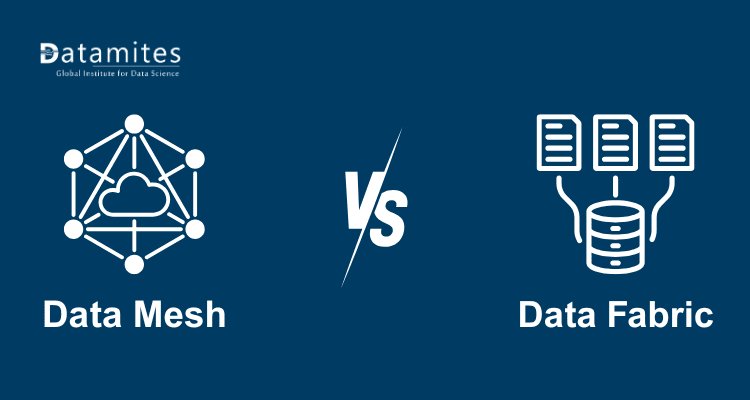
Data Mesh vs Data Fabric: A Side-by-Side Comparison
The following comparison highlights the key differences between Data Mesh and Data Fabric across ownership, scalability, governance, and implementation approach:
Ownership and Responsibility
- Data Mesh: Data ownership is decentralized across domains.
- Data Fabric: Ownership often remains centralized, with shared access.
Scalability
- Data Mesh: Scales well with organizational growth and team autonomy.
- Data Fabric: Scales technically by integrating new data sources quickly.
Governance
- Data Mesh: Federated governance requires strong coordination.
- Data Fabric: Centralized governance ensures consistency and compliance.
Technology Focus
- Data Mesh: Emphasizes culture, processes, and operating models.
- Data Fabric: Emphasizes tools, platforms, and integration layers.
Time to Value
- Data Mesh: Slower initial adoption but long-term agility.
- Data Fabric: Faster implementation, especially for analytics use cases.
A Forrester study also reports that nearly 70% of data and analytics leaders struggle to deliver trusted data at scale, citing siloed ownership and poor integration as key challenges. These findings directly support the rise of data mesh and data fabric approaches.
Refer to these articles:
- Top 7 Data Science Job Roles in 2026 You Should Know
- Data Engineer vs Analytics Engineer vs Data Analyst
- Data Scientist vs ML Engineer vs AI Engineer: Which Career Path Is Right for You?
Real-World Use Cases and Examples
The following real-world use cases:
Data Mesh in Large Enterprises
Global e-commerce and technology companies often adopt data mesh to support autonomous teams. For example, product teams may publish real-time usage data as a consumable dataset, enabling faster experimentation and personalized customer experiences.
This approach works best when teams are already comfortable owning services and APIs.
Data Fabric in Regulated Industries
Banks, healthcare providers, and telecom companies commonly use data fabric architecture to unify data across legacy systems while maintaining strict governance. A single access layer allows analysts to run reports across multiple systems without duplicating sensitive data.
When Data Mesh Is the Better Choice
Data mesh is a strong choice when:
- The organization has multiple autonomous teams.
- Data ownership aligns naturally with business domains.
- There is a strong engineering culture.
- Long-term scalability and flexibility are priorities.
However, without clear standards and leadership support, data mesh can lead to fragmentation.
When Data Fabric Is the Better Choice
Data fabric is ideal when:
- Data is spread across many systems and clouds.
- Governance and compliance are top priorities.
- The organization relies heavily on analytics and reporting.
- Faster time to value is required.
It allows businesses to modernize data access without restructuring teams.
Can Data Mesh and Data Fabric Work Together?
In 2026, many organizations are not choosing one over the other. Instead, they are combining both approaches.
A common pattern is:
- Data mesh defines ownership and accountability.
- Data fabric provides the technical foundation for integration, access, and governance.
This hybrid approach balances autonomy with consistency and is becoming increasingly popular in large enterprises.
Future Trends Shaping Data Architecture in 2026
Several trends are influencing how organizations adopt data mesh and data fabric:
- Increased focus on data governance and sovereignty
- Growth of real-time and event-driven analytics
- Expansion of multi-cloud and hybrid environments
- Higher demand for trusted, business-ready data
As data becomes more distributed, flexible architectures will be essential.
There is no universal answer to the data mesh vs data fabric debate. The right choice depends on organizational structure, technical maturity, regulatory needs, and long-term goals.
- Choose data mesh architecture if you want decentralized ownership and scalable autonomy.
- Choose data fabric architecture if you need unified access, strong governance, and faster insights.
- Consider combining both for a balanced and future-ready data strategy.
In 2026, the most successful organizations will be those that treat data architecture not as a one-time decision, but as an evolving capability aligned with business growth.
For professionals looking to build strong data and analytics capabilities, DataMites Institute offers industry-aligned training programs focused on practical learning. The Data Science course in Ahmedabad is structured to provide hands-on experience, real-world projects, and skills that match current enterprise data requirements.
To support classroom-based learning, DataMites has offline training centers in more than 20+ cities across India, including Bangalore, Pune, Hyderabad, Chennai, Coimbatore, Nagpur, Delhi, and other major locations, ensuring learners can access expert-led training with ease.