
Essential AI Tools for finance Smarter Analysis
Discover essential AI tools for finance that enable smarter analysis, improve forecasting, automate workflows, and enhance decision-making. Learn how AI-driven solutions help financial professionals boost efficiency, reduce risks, and gain deeper insights.
 Kriti Maurya
Artificial intelligence is transforming the financial landscape by enabling predictive, real-time decision-making beyond traditional analysis. AI finance tools help professionals improve efficiency, reduce risks, and extract deeper insights from complex data. As markets become more dynamic, AI tools for financial management are essential for automation, forecasting, and strategic planning. Today, AI implementation in finance is no longer optional but a critical necessity for organizations aiming to remain competitive in an increasingly data-driven and digital economy.
This article explores the essential tools, benefits, challenges, and future scope of AI in financial analysis while providing a comprehensive understanding of how AI is shaping modern finance.
Essential AI Tools for Financial Analysis
The rise of AI finance tools has introduced a wide range of solutions that cater to various financial functions. According to a report by KPMG, while only about 30% to 41% of organizations currently use AI extensively in financial reporting, this adoption is expected to surge to 83% within the next three years. And these tools are designed to streamline operations, improve accuracy, and deliver actionable insights.
1. Predictive Analytics Tools
Data analytics tools use machine learning algorithms to analyze historical data and forecast future trends. These tools are widely used in investment planning, risk assessment, and revenue forecasting. By leveraging AI tools for financial management, organizations can anticipate market movements and make informed decisions.
2. Robotic Process Automation (RPA)
RPA tools automate repetitive tasks such as data entry, invoice processing, and reconciliation. This is a crucial aspect of implementation of data analytics in finance, as it reduces manual effort and improves operational efficiency. Financial teams can focus on strategic initiatives rather than routine activities.
3. Fraud Detection Systems
AI-powered fraud detection tools monitor transactions in real time and identify suspicious patterns. These systems use advanced algorithms to prevent financial crimes and enhance security. As cyber threats increase, AI finance tools play a critical role in safeguarding financial assets.
4. Financial Planning and Analysis (FP&A) Tools
FP&A tools powered by AI provide insights into budgeting, forecasting, and financial performance. They enable organizations to create dynamic financial models and improve decision-making processes. These tools are essential for effective AI tools for financial management.
5. Chatbots and Virtual Assistants
AI-driven chatbots assist customers with financial queries, account management, and transactions. They enhance customer experience and reduce the workload on human staff. This is a key component of AI implementation in finance, especially in customer-facing operations.
6. Algorithmic Trading Platforms
Algorithmic trading tools use AI to execute trades based on predefined criteria and real-time data analysis. These platforms can process large volumes of market data and make split-second decisions, making them indispensable AI finance tools for investment firms.
7. Credit Scoring Tools
AI-based credit scoring tools evaluate an individual’s creditworthiness using both traditional and alternative data sources. This improves accuracy and inclusivity in lending decisions, highlighting the importance of AI tools for financial management in modern banking.
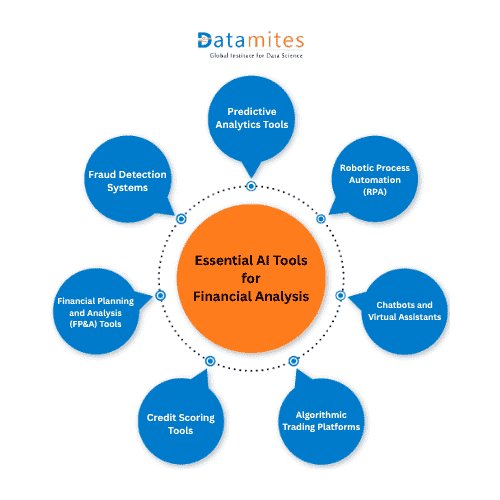
By leveraging these essential AI tools for finance, finance professionals can drive smarter analysis, improve decision-making, and stay ahead in an increasingly data-driven financial landscape.
Refer to the articles below:
- A Complete Guide to AI in Marketing
- 9 Ways AI is Transforming Healthcare
- AI Product Development Life Cycle Explained
Key Benefits of AI Tools for Financial Analysis
The adoption of AI finance tools offers numerous advantages that significantly enhance financial analysis and decision-making.
- Improved Accuracy and Efficiency: AI tools eliminate human errors and ensure high levels of accuracy in financial calculations. By automating complex processes, AI implementation in finance increases efficiency and reduces operational costs.
- Real-Time Data Insights for analysis: One of the key benefits of AI tools for financial management is the ability to analyze data in real time. This enables organizations to respond quickly to market changes and make timely decisions.
- Enhanced risk management by analyzing data: AI tools can identify potential risks by analyzing patterns and anomalies in financial data. This proactive approach helps organizations mitigate risks and maintain financial stability.
- Cost reduction using AI tools: Automation through AI finance tools reduces the need for manual labor, leading to significant cost savings. Organizations can allocate resources more effectively and improve profitability.
- Better Decision-Making with AI: AI-driven insights provide a deeper understanding of financial data, enabling more informed decision-making. This is a critical advantage of AI for finance Course, especially in strategic planning.
- Personalized Financial Services: AI tools enable financial institutions to offer personalized services based on customer preferences and behavior. This enhances customer satisfaction and loyalty.
AI tools empower financial analysis by enhancing accuracy, efficiency, and data-driven decision-making, enabling organizations to achieve smarter and more strategic financial outcomes.
Key Challenges in Adopting AI Tools in Finance
Despite the numerous benefits, the adoption of AI finance tools comes with certain challenges that organizations must address.
- Data Privacy and Security Concerns: Financial data is highly sensitive, and the use of AI increases the risk of data breaches. Ensuring data security is a major challenge in AI implementation in finance.
- High Implementation Costs: Implementing AI technologies requires significant investment in infrastructure, software, and talent. This can be a barrier for small and medium-sized enterprises.
- Lack of Skilled Professionals: The successful use of AI tools for financial management depends on skilled professionals who can develop, manage, and interpret AI systems. The shortage of such talent is a major challenge.
- Integration with Legacy Systems: Many financial institutions rely on outdated systems that are not compatible with modern AI technologies. Integrating AI finance tools with these systems can be complex and time-consuming.
- Ethical and Regulatory Issues: The use of AI in finance raises ethical concerns related to transparency and bias. Organizations must ensure that their AI systems comply with regulations and operate fairly.
Addressing these challenges is essential for financial institutions to fully leverage AI while ensuring accuracy, compliance, and long-term sustainability.
How AI is Shaping the Future of Financial Analysis
The future of AI in financial analysis is promising, with continuous advancements in technology driving innovation in the sector. As AI becomes more sophisticated, its applications in finance will expand further.
The global Generative AI market in financial services was valued at USD 2.21 billion in 2024 and is expected to reach USD 25.71 billion by 2033, growing at a CAGR of 31.0%. (Grand View Research report)
AI in finance is evolving through big data integration, explainable AI, and automation, enhancing analysis, transparency, and decision-making while creating new career opportunities and improving efficiency by using AI tools for financial management.
Another important trend is the rise of explainable AI, which focuses on making AI decisions more transparent and understandable. This is crucial for building trust and ensuring compliance in AI implementation in finance.
The integration of AI into finance is transforming the way organizations analyze data, manage risks, and make decisions. AI finance tools are enabling smarter analysis by providing real-time insights, automating processes, and enhancing accuracy.
While there are challenges associated with AI implementation in finance, the benefits far outweigh the risks. Organizations that embrace AI tools for financial management can achieve greater efficiency, improved decision-making, and a competitive advantage in the market.
As the financial industry continues to evolve, the role of AI will become even more significant. By leveraging the ai tools for finance, businesses can unlock new opportunities and drive sustainable growth in an increasingly complex and dynamic environment.
Refer to the articles below:
- Top AI Trends That Will Shape 2026
- LLM Fine-Tuning vs Prompt Engineering: Which Is Better
- Why Agentic AI Is the Most In-Demand Skill for Data Scientists in 2026
DataMites Institute provides a well-structured AI for Finance course aimed at helping finance professionals harness artificial intelligence for more informed, data-driven decision-making. The curriculum includes AI fundamentals, financial analytics, and real-world applications such as risk management, fraud detection, investment analysis, and financial forecasting. It is part of a wider range of programs, including AI for HR, AI Marketing, AI for Healthcare, and AI for Business Leaders.
Participants can opt for flexible learning modes, including online and classroom sessions, along with real-time, project-based internships for practical exposure. With globally recognized IABAC certifications, DataMites operates over 30+ centers across key Indian cities such as Hyderabad, Pune, Chennai, Ahmedabad, Bangalore, Mumbai, Coimbatore, Delhi, Nagpur, and Kochi, offering career-oriented training.