How to Switch from Graphic Designer to AI Developer - Sriram’s AI Career Success Story
Sriram’s career shift from graphic designer to AI developer showcases how focused learning and hands-on practice can open doors to artificial intelligence roles. His journey offers clear takeaways for creative professionals planning a structured transition into AI.
 Priyanka BR
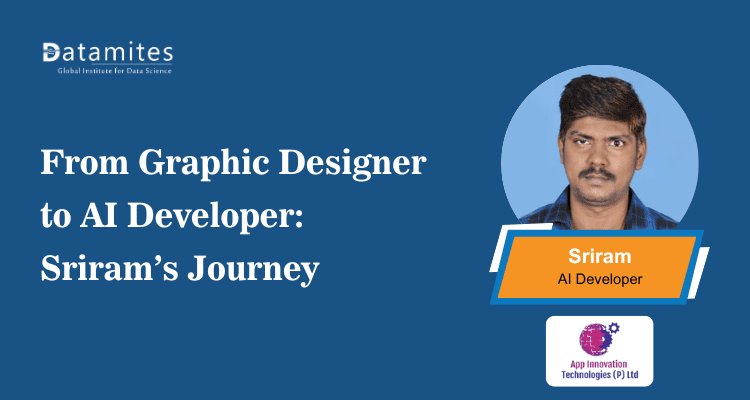
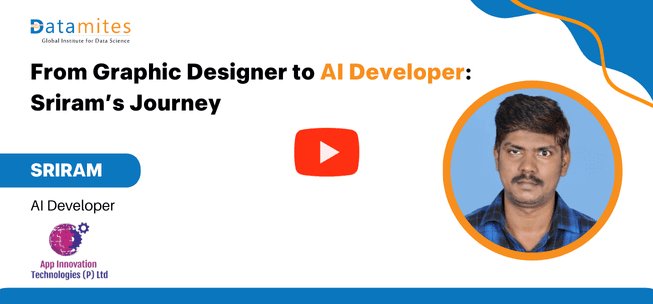
Sriram’s journey from Graphic Designer to AI Developer is a powerful example of how curiosity and determination can reshape a career. His growing interest in Artificial Intelligence pushed him to explore new possibilities beyond design, marking the beginning of an inspiring AI Career Success Story.
As he navigated this Career Transition to Artificial Intelligence, Sriram realized that structured learning and hands-on practice were essential to move forward with confidence. He focused on understanding real-world AI concepts, building practical skills, and preparing himself for industry expectations.
For those exploring how to become an AI Developer, Sriram’s journey provides clear direction. His growth was shaped at DataMites, where learning evolved into practical, industry-ready expertise.
How Sriram Transitioned from Graphic Designer to AI Developer with DataMites
Sriram’s journey from a graphic designer to an AI developer shows how curiosity and determination can reshape a career. With structured training and hands-on guidance at DataMites, he turned his interest in Artificial Intelligence into real-world, job-ready skills.
1. Can you introduce yourself and your background?
I’m Sriram, originally from Coimbatore. I completed my post-graduation in MSE Software Systems in 2017. After that, I worked as a graphic designer for over five years before deciding to transition into AI.
2. What motivated you to move from graphic designing to AI?
During the pandemic, I became curious about how data sampling works in healthcare and population statistics. I realized that AI allows for versatile roles, combining analytics with development, which appealed to me more than traditional programming roles.
3. How did you start your learning journey in AI?
Initially, I tried self-learning using online resources and YouTube. However, I realized that the lack of a structured roadmap made it challenging. That led me to research and enroll in DataMites in December last year.
4. How long was your course at DataMites, and what did it cover?
The course lasted 3 to 4 months and included hands-on training, mentorship, and exposure to multiple projects. The course also provided 4-month internship opportunities, which helped me gain real-world experience.
5. Did you work on projects during your training?
Yes, I completed four capstone projects and one client project during my internship. These projects allowed me to apply concepts like data preprocessing, visualization, and machine learning algorithms in real scenarios.
6. How did you balance working and learning at the same time?
DataMites offered flexible schedules, allowing me to study during weekdays or weekends. The mentors were highly supportive, which made managing both work and learning much easier.
7. How did you secure your AI engineering role?
After completing the course, internship, and mock interviews, I received an interview call from App Innovation Technologies in Coimbatore. I cleared the technical rounds and secured the position as an AI engineer.
8. How important were the projects for your interview preparation?
Projects were essential. They helped me understand end-to-end AI processes. Concepts learned in class were applied practically, which made it easier to tackle technical interview questions.
9. Did your interviews focus on your project work?
Absolutely. In my interview, I was given a complex price prediction dataset with 47 features and 10,000 rows. I had to apply statistical methods like ANOVA and t-tests to identify key features without manual elimination.
10. How challenging was the technical round of your interview?
It was challenging but manageable. The task took about 1.5 to 2 hours, including manual analysis, function applications, and applying statistical methods to eliminate unnecessary columns.
11. How did your previous programming knowledge help you in learning Python?
Though my college didn’t teach Python, my background in C and Java helped me quickly adapt. Python is beginner-friendly and easy to learn, making it ideal for transitioning from a non-technical field.
12. Were mock interviews helpful for your preparation?
Yes, they were very useful. Attending mock interviews boosted my confidence and helped me practice technical questions related to Python, statistics, and machine learning before the real interviews.
13. Any advice for people transitioning into AI?
Focus on the fundamentals of Python, statistics, machine learning, SQL, and business intelligence tools like Power BI. A strong foundation in these areas significantly increases your chances of landing a role in AI.
14. How do you see your career progressing in the coming years?
I aim to continue building expertise in AI and data analytics, work on diverse projects, and contribute to emerging fields like healthcare analytics, which is growing rapidly and offers impactful opportunities.
Refer to these articles:
- Will AI Agents Replace Your Next Coworker? Exploring the Future of Work
- How Knowledge-Augmented Generation (KAG) Is Solving AI Hallucinations
- LLMs vs. SLMs: Key Differences and How to Choose the Right Model
Sriram’s Key Takeaways on Transitioning to an AI Developer Role
Sriram shares the essential lessons he learned while moving from a graphic designer to an AI developer. From building practical skills to embracing hands-on learning, his insights guide anyone looking to make a similar career transition.
- Career Transition Success: Sriram successfully transitioned from a graphic design background to an AI engineering role, proving that non-linear career shifts into AI are achievable with the right approach.
- Importance of Structured Learning: Self-learning through online platforms lacked a clear roadmap, which led him to choose a structured training program that provided direction, mentorship, and continuity.
- Role of Mentorship and Training: Trainer guidance, mentor support, and a well-defined curriculum played a critical role in strengthening his technical foundation and career confidence.
- Hands-On Experience Matters: Completing multiple capstone projects and a real client project during the internship phase significantly improved practical understanding and job readiness.
- Persistence Through Rejections: Multiple interview rejections were part of the journey, reinforcing the importance of resilience and continuous improvement.
- Strong Fundamentals Are Essential: A solid grasp of Python, statistics, data preprocessing, visualization, machine learning concepts, and SQL was crucial in clearing technical interviews.
- Projects Bridge Learning and Interviews: End-to-end project implementation helped translate theoretical learning into practical problem-solving, which was directly tested during interviews.
- Statistical Thinking in Real Interviews: The interview required statistical validation for feature selection, emphasizing real-world expectations beyond basic data cleaning or assumptions.
- Value of Mock Interviews: Mock interviews boosted confidence, improved interview performance, and prepared him for real technical discussions.
- Time Management While Working: Balancing a full-time job with learning was manageable through flexible schedules, weekend study, and consistent practice.
- Healthcare as a Motivation Area: Curiosity sparked during the pandemic around data sampling, and healthcare analytics played a role in motivating his shift to AI.
- Versatility of AI Roles: AI appealed due to its versatility, allowing work across analytics, development, and domain-specific applications.
- Python as a Beginner-Friendly Language: Python was highlighted as an accessible language for learners from non-technical backgrounds.
- Practical Interview Format: The final technical evaluation involved a real-world dataset and a time-bound task, reflecting industry-level expectations.
- Advice for Aspiring AI Professionals: Focus on Python basics, statistics, machine learning, SQL, and BI tools like Power BI to build a strong entry point into AI roles.
Refer to these articles:
- How Prathmesh Cracked His First AI Engineer Job as a Fresher from Nagpur
- From B.Tech Graduate to AI/ML Engineer: Shyama’s Inspiring Success Journey
- Aradhya’s Journey from B.Tech Computer Science Fresher to AI/ML Engineer
Sriram’s journey shows how a creative professional can transition into AI by combining curiosity, consistent effort, and hands-on learning. His persistence and practical approach turned his interest in AI into a job-ready skill set.
If you’re motivated by Sriram’s journey and looking to make your own transition into AI, DataMites offers a comprehensive Artificial Intelligence Course in Coimbatore designed for learners from diverse backgrounds. This course provides structured training, hands-on projects, real-world internships, and expert mentorship to help you gain industry-ready skills in Python, machine learning, statistics, data analytics, and AI development.
Whether you’re a working professional, a recent graduate, or someone from a non-technical field, DataMites’ Top IT Course in Coimbatore ensures you gain the confidence and practical knowledge to clear technical interviews and excel in your AI career. Just like Sriram, you can turn your curiosity into a successful career in Artificial Intelligence with the right guidance and training.
DataMites Training Institute offers a 9-month Artificial Intelligence training with specialized programs such as AI Engineer, AI Expert, AI for Product Managers, AI Foundation, and NLP Expert. With flexible online and offline learning, hands-on projects, internships, and dedicated placement support, learners gain real-world experience and develop industry-ready skills. DataMites also has Artificial Intelligence Classes in Chennai, Hyderabad, Bangalore, Pune, Ahmedabad, Coimbatore, Delhi, and Mumbai, making practical, career-focused AI training accessible to students across India. Participants earn globally recognized certificates from organizations like IABAC and NASSCOM FutureSkills, enhancing their professional credibility and opening doors to advanced career opportunities in the rapidly growing AI and ML sector.