How is Artificial Intelligence Changing the World?
Artificial Intelligence is transforming industries by automating tasks, improving decisions, and enabling smarter solutions. From healthcare to education, AI is changing how people live and work.
 Shiva PS
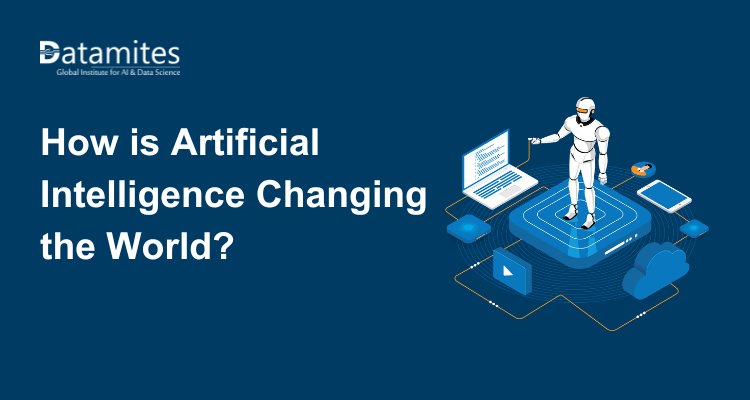
Artificial Intelligence is transforming the world by changing how people work, communicate, learn, shop, travel, and access services. From virtual assistants and personalized recommendations to healthcare diagnostics, smart agriculture, cybersecurity, robotics, and automated business processes, AI is becoming part of everyday life and modern industries. Its ability to analyze large amounts of data, recognize patterns, generate content, and support decision-making is helping organizations improve efficiency while creating new possibilities across different sectors.
The impact of AI is expected to grow as machine learning, deep learning, generative AI, and multimodal systems advance. According to McKinsey’s Global Survey on AI, 78% of respondents said their organizations were using AI in at least one business function, up from 55% a year earlier, highlighting its rapid adoption across business operations. AI also brings important considerations around privacy, cybersecurity, employment, ethics, and responsible use.
What is Artificial Intelligence?
It is some technology or technological equipment or analytical tools or algorithms that manage to give us the facility to alter the real environment based on its calculated decision or data it collects from various sources.
In simple words, Al is a technology to do the tasks or simplify any work that human beings are doing on their own previously, or in earlier times, they did it in a complicated manner. So, any device which simplifies your day-to-day work is an AI device.
Artificial intelligence has two parts, one is Machine learning, and another is Deep learning.
- Machine Learning is independent of human interference in AI processes. It collects all the data on its own from the environment, and according to the data, it collects. Utilizing an algorithm system builds some predictions and works based on what it figured out from the database.
- On the other hand, deep learning is working on a “deep neural network, “which summarizes a complex mathematical formula. A very good example of deep learning is a computer; you can see how it simplifies the work of a human being by using the analytical formulas stored in the base of data.
Refer to these articles:
- Learn about the Types of Machine Learning Algorithms
- What is a Confusion Matrix in Machine Learning?
- Supervised vs. Unsupervised Learning: What’s the Difference?
How is Artificial Intelligence Changing the World
AI has brought significant changes to industries, businesses, and everyday technology. For example, modern smartphones now include AI-powered features such as intelligent photo editing, real-time translation, voice assistance, personalized recommendations, and generative AI tools that help users complete everyday tasks.
The influence of AI extends beyond calculations, with applications across healthcare, agriculture, business, security, entertainment, and daily life. Let’s explore where its impact can be seen:
Virtual assistance:
Virtual assistance and automation are made to respect the value of time. It makes every day’s work faster, more efficient, and smarter by using its technology and production.
Virtual assistance acts as your personal assistant, similar to human assistance, which collects your data and does your work when you command it.
Examples of AI-powered virtual assistants include Amazon Alexa and Google Gemini. From the switch, on, off the AC, TV to calculating the daily investment, everything was done by just asking, “Hello Alexa, can you please turn on the AC or calculate the problem?”
In the corporate field:
In the corporate business, the computer is like a blessing. The smart technology of computers simplifies complicated calculations, measurements. It stored valuable data which can be utilized further. By coding, it becomes very easy to generate any website, develop smart machinery.
Another important development involving AI is the advancement of robotics. AI-powered robots can automate specific tasks, improve efficiency, and work alongside humans in various industries.
A prominent example of AI in corporate business is Tesla, which uses artificial intelligence, computer vision, and neural networks in its driver-assistance and autonomous-driving technologies.
In agriculture:
In agriculture also the impact of AI and Robots is priceless. Due to the adverse conditions over the environment by human beings, crop generation is decreased to serious levels if AI is not present to rescue the situation. The overpopulation of the world is a cause of the food crisis. But AI and robotic technology can improve the efficiency of agricultural processes and help address challenges such as labor shortages and resource management.
There are many problems seen earlier in the agriculture field like lack of food due to industrialization, over-farming, shortage of Labour, deficiency of suitable nutrients in the soil, etc. Still, smart innovations like drones, automated machines, and AI-powered technologies can help address several agricultural challenges.
The Harvest CROO robotics is a great example of the use of AI in agriculture. It uses a robot to reap the strawberries from the field. At the same time, it reduces labour and makes the harvest fast.
In the security field:
Security cameras, security surveillance, sensors, drone cameras, and microchips are crucial instruments in the security field. This is very effective in intelligence agencies, for tracking criminals, in military fields. AI-powered security systems can use GPS and other sensor data to help monitor locations, detect unusual activity, and improve security operations.
Now in this internet era, AI-powered cybersecurity can help detect suspicious activity, identify potential threats, and protect sensitive information, although it cannot completely prevent data breaches or information leaks.
In health care services:
In health care, the gifts of AI are uncountable. With the help of modern AI devices, the diagnosis of different types of disorders is now possible. AI is being used to support diagnosis, disease management, medical research, drug discovery, and other areas of healthcare.
AI can support earlier detection, disease monitoring, treatment planning, and medical research, but its effectiveness varies depending on the disease, clinical application, data quality, and validation.
AI can be integrated into ultrasound, X-ray, and laparoscopic technologies to support image analysis, detection, and clinical decision-making.
AI-powered digital health applications can connect with patients remotely and provide information, symptom guidance, and other healthcare support through apps, while professional medical evaluation may still be required.
In Business Marketing:
In retailing business, AI benefited it in multiple ways. AI obtains data from the target users. Based on the client’s desire, it suggests the product. E-commerce groups trace the search record of the target audience and recommend the commodity about past searching history.
You can see by yourself if you search for some type of dress online, sometime later when you search for any other things from a website from Google, they show you the advertisement of the dress you searched for earlier. Here, your search and browsing activity may be used by advertising or recommendation systems to personalize the products or advertisements shown to you, with AI and machine learning often helping analyze these signals.
In the entertainment industry:
Video gaming to musical video, movie, social media and every entertainment industry reap the services of AI.
Video game creators can develop a more lively and interesting game by collecting the database from the players. Video content creators also modify their content according to audiences’ search or preference. Thus AI helps to fulfil every user’s expectation successfully.
Modern video games use AI for features such as non-player character behavior, player personalization, matchmaking, game testing, and content generation, making gameplay more dynamic and engaging.
Refer to these articles:
- Explainable AI: Why Black-Box Models Are Losing Trust
- How AI is Transforming Customer Analytics in 2026
- LLM Fine-Tuning vs Prompt Engineering: Which Is Better?
The future chances of Artificial Intelligence:
The destiny of artificial intelligence is no question sky-high as the need for it rises every day from every region of users. Its unique ability to recognize the user’s demand is the key point of its accomplishment. AI manufacture is looking for additional progress with the rapid change of the world. It’s useful to see wherever you put your eyes.
AI’s future looks promising as its adoption expands across industries and everyday applications. According to Grand View Research, the global AI market was valued at USD 390.9 billion in 2025 and is projected to reach USD 539.5 billion in 2026 and USD 3,497.3 billion by 2033, growing at a 30.6% CAGR. This growth is being supported by the rapid adoption of generative and agentic AI and their expanding real-world applications.
So you can see the importance of AI in daily life. It automatically works out most of the problems: the economy and society. From government sectors to international companies, all emphasize its power. And it can predict that shortly it creates a better world of the living.
DataMites provides a globally accredited Artificial Intelligence course with industry-recognized certification. Competing with esteemed institutions like IIT and IIM, it offers top-quality AI training. The program includes advanced AI concepts, practical projects, and expert mentorship. With a strong reputation, DataMites empowers professionals with the skills to succeed in AI-driven industries.
DataMites AI Training also offers learners the opportunity to earn IABAC certification and NASSCOM FutureSkills certification, helping validate their Artificial Intelligence skills through industry-aligned credentials. With 40+ offline training centers across India, including Bangalore, Hyderabad, Pune, Chennai, Ahmedabad, Coimbatore, Delhi, and Mumbai, DataMites provides learners with flexible access to classroom-based AI training alongside its online learning options.