How Venuprasath Secured His First AI Engineer Job as a Fresher from Tamil Nadu
Venuprasath transformed his passion for Artificial Intelligence into a career by mastering core skills and real-world projects. His journey highlights how dedication, structured learning, and consistent upskilling can help freshers land their first AI Engineer role in Tamil Nadu.
 Priyanka BR
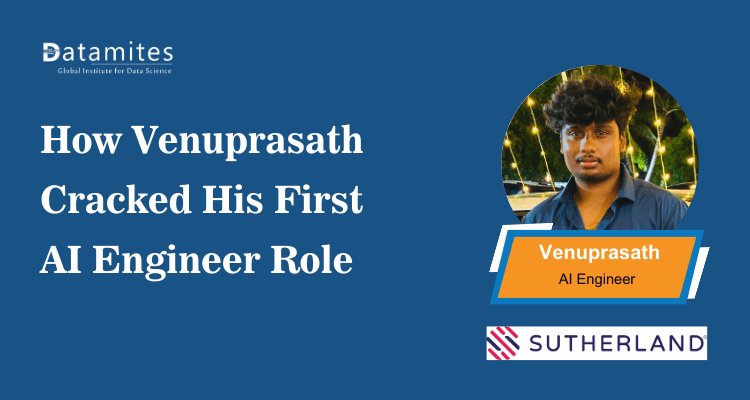
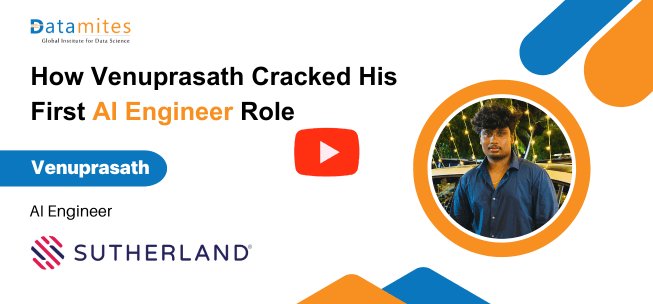
Have you ever wondered how a fresher can land their first AI Engineer role in today’s competitive industry? Meet Venuprasath, who transformed his ambition for Artificial Intelligence into a thriving career by taking the right steps, staying disciplined, and consistently upskilling himself.
His journey wasn’t without challenges. From understanding the fundamentals of Python and machine learning to handling real-world AI tasks, Venuprasath demonstrated that determination and structured learning can overcome any barrier. The turning point came when he enrolled in a hands-on AI program at DataMites, where he focused not just on theory but on applying skills in projects and interview preparation.
If you’re aspiring to become an AI Engineer as a fresher, Venuprasath’s story provides a clear roadmap, from building a solid foundation to cracking interviews and securing a role, proving that dedication, logical thinking, and the right strategy can turn ambition into achievement.
Venuprasath’s Journey to Becoming an AI Engineer: Complete Q&A
This Q&A session highlights Venuprasath’s complete journey from upskilling to securing his first role as an AI Engineer, covering learning, preparation, and interview experiences.
1. Can you introduce yourself and your background?
My name is Venuprasath, and I am from Tamil Nadu. I graduated in 2024. After completing my undergraduate degree, I decided to upskill myself in Artificial Intelligence because I wanted to build a strong career in the IT industry.
2. When did you decide to pursue AI as a career?
After graduation, I started thinking seriously about my future. During college, I was less focused on career planning, but toward the end, I began asking myself, “What next?” That question motivated me to upskill and choose Artificial Intelligence career path.
3. Why did you choose Artificial Intelligence instead of another domain?
The AI market is growing rapidly. After understanding industry trends and discussing with my father, who has an IT background, I realized AI would offer strong long-term opportunities. That pushed me to pursue AI seriously.
4. How long did your AI learning journey take?
The course duration was around 11 months. After completing it, I spent an additional two months practicing and preparing for interviews before getting placed.
5. What role did you get placed in?
I was placed as an AI Engineer at Sutherland, Bangalore. Currently, I am working on projects related to Large Language Models and AI integrations.
6. What technologies are you currently working on?
My work involves:
- Large Language Models (LLMs)
- Log analytics
- AI engine integrations
- Azure OpenAI services
- Agent-based AI systems
These are advanced AI technologies actively used in industry.
7. Did your course training help you in your job?
Yes. Everything I know, data cleaning, machine learning, accuracy improvement, Python, and SQL, is useful in my current job. However, I also believe learning should not stop with just course content. External research and continuous self-learning are important.
8. What kind of questions were asked in your AI Engineer interview?
The interview mainly focused on:
- Python programming
- Machine Learning concepts
- SQL basics
- Logical thinking
They were more focused on practical understanding rather than theoretical memorization.
9. Were you asked coding questions in Python?
Yes, but not very complex ones. I was asked logic-based questions like checking prime numbers. The company was testing logical thinking skills more than advanced coding.
10. How important is logical thinking in AI and Data Science?
Logical thinking is extremely important. In today’s world, tools like ChatGPT, Gemini, and other AI assistants can generate code. But companies expect candidates to think logically and implement solutions correctly. Logic matters more than copying code.
11. How did you prepare for your AI interview?
I prepared in multiple ways:
- Completed ML and Statistics books thoroughly
- Practiced all algorithms like Linear Regression and Logistic Regression
- Referred to external YouTube resources
- Practiced mock interviews
- Improved communication skills by speaking with friends
- Preparation was consistent and focused.
12. How did you build your resume as a fresher?
Initially, I followed normal YouTube templates. Later, I refined my resume structure properly and focused on project descriptions. A good resume is crucial because shortlisting depends heavily on it.
13. What projects did you include in your resume?
I included projects like:
- Sales Effectiveness Analysis
- FIFA 20 Data Analysis
- Bike Rental Prediction
Interviewers asked detailed questions about these projects. They wanted to verify if I had real hands-on experience.
14. What advice would you give to freshers who want to become AI Engineers?
Study consistently. Do not rely on shortcuts. Avoid copying code without understanding it. Practice implementing logic. Companies can easily identify candidates who lack genuine knowledge.
15. What is your opinion on the future of AI and Agentic AI?
AI has been booming since around 2017 and continues to grow. Agentic AI is becoming increasingly powerful, and autonomous AI systems will transform workplaces. Anyone entering AI now has strong long-term career potential.
Refer to these articles:
- How AI is Transforming Customer Analytics in 2026
- Will AI Agents Replace Your Next Coworker? Exploring the Future of Work
- LLMs vs. SLMs: Key Differences and How to Choose the Right Model
Key Takeaways from Venuprasath’s Journey to Becoming an AI Engineer: Complete Insights
Discover how Venuprasath successfully transitioned into his first AI Engineer role. This summary highlights his learning process, preparation strategies, and career insights for aspiring AI professionals.
- Career growth often begins with a serious self-question. The shift from being casual about the future to actively planning for it created the momentum needed to enter the Artificial Intelligence field with clarity and commitment.
- Structured training provides a strong foundation, but real progress happens when learning goes beyond the syllabus. Independent research, external references, and continuous self-study are essential in the Artificial Intelligence industry.
- Logical thinking is more valuable than memorizing code. In today’s AI landscape, tools can generate syntax, but companies prioritize candidates who understand problem-solving approaches and can explain their reasoning clearly.
- Interview performance depends heavily on communication skills. Technical knowledge must be supported by confident articulation, structured answers, and the ability to discuss projects in depth.
- A well-crafted resume can significantly influence shortlisting. What matters is not just listing projects but demonstrating a genuine understanding of implementation, algorithms used, and business impact.
- Consistency is more powerful than temporary motivation. Even after periods of reduced focus, returning to disciplined preparation made the difference in securing the AI Engineer role.
- The AI ecosystem is evolving rapidly toward Large Language Models and agent-based systems. Freshers entering Artificial Intelligence must stay adaptable and open to continuous skill upgrades.
- Authentic preparation builds long-term credibility. In an era where AI tools can assist with answers, genuine hands-on practice and ethical learning remain critical for sustainable career growth in Artificial Intelligence and Machine Learning.
Venuprasath’s success story is an inspiring example of how a determined fresher can successfully launch a career as an AI Engineer. Even with basic technical knowledge, he realized that understanding theory alone was not enough to stand out in the competitive AI industry. His journey, from mastering Python, machine learning algorithms, and data science concepts to completing hands-on AI projects, demonstrates that consistent effort, practical exposure, and strategic guidance are essential to becoming industry-ready. What truly set him apart was his commitment to learning and applying concepts effectively in real-world scenarios.
Refer to these articles:
- How to Switch from Graphic Designer to AI Developer - Sriram’s AI Career Success Story
- How Prathmesh Cracked His First AI Engineer Job as a Fresher from Nagpur
- From B.Tech Graduate to AI/ML Engineer: Shyama’s Inspiring Success Journey
A defining moment in Venuprasath’s journey was joining a structured AI program at DataMites. The combination of practical projects, expert guidance, and focused preparation gave him the confidence to tackle interviews, work effectively on real-world AI tasks, and ultimately secure his first role as an AI Engineer. This experience provided him with the clarity, hands-on skills, and industry exposure needed to transition smoothly into a professional AI career.
DataMites has a strong presence across India with 30+ offline centers, providing learners with easy access to high-quality, in-person AI training. If you are from Tamil Nadu and looking for classroom learning, DataMites offers Artificial Intelligence training in Chennai at three convenient locations: Perungudi, Anna Nagar, and Guindy. These centers provide hands-on projects, expert mentorship, and industry-relevant guidance, equipping students with the practical skills and confidence needed to build a successful career in AI.
Apart from Chennai, DataMites offers its Artificial Intelligence course in Coimbatore as well, providing students with practical, project-based learning and expert guidance. The course is designed to build real-world AI skills, preparing learners to confidently step into professional AI roles.